
The idea that painting began by tracing an outline around a man’s shadow probably originates in Pliny the Elder’s (23–79 A.D.) voluminous work, Historia Naturalis.1 Although what we now know about the pre-historical Lascaux paintings does not seem to endorse Pliny’s idea, the notion that an object’s shadow is the main ingredient in its representation restores a value denied to it since Plato’s indictment of all semblances in his famous Allegory of the Cave. In the twentieth century, avant-garde artists like Marcel Duchamp, Man Ray, and, more recently, Christian Boltanski produced seminal works that brought substance back to shadows. Yet Regina Silveira’s sustained twenty-five-year exploration of the aesthetics of shadows has been more systematic and encompassing than that of any other artist.
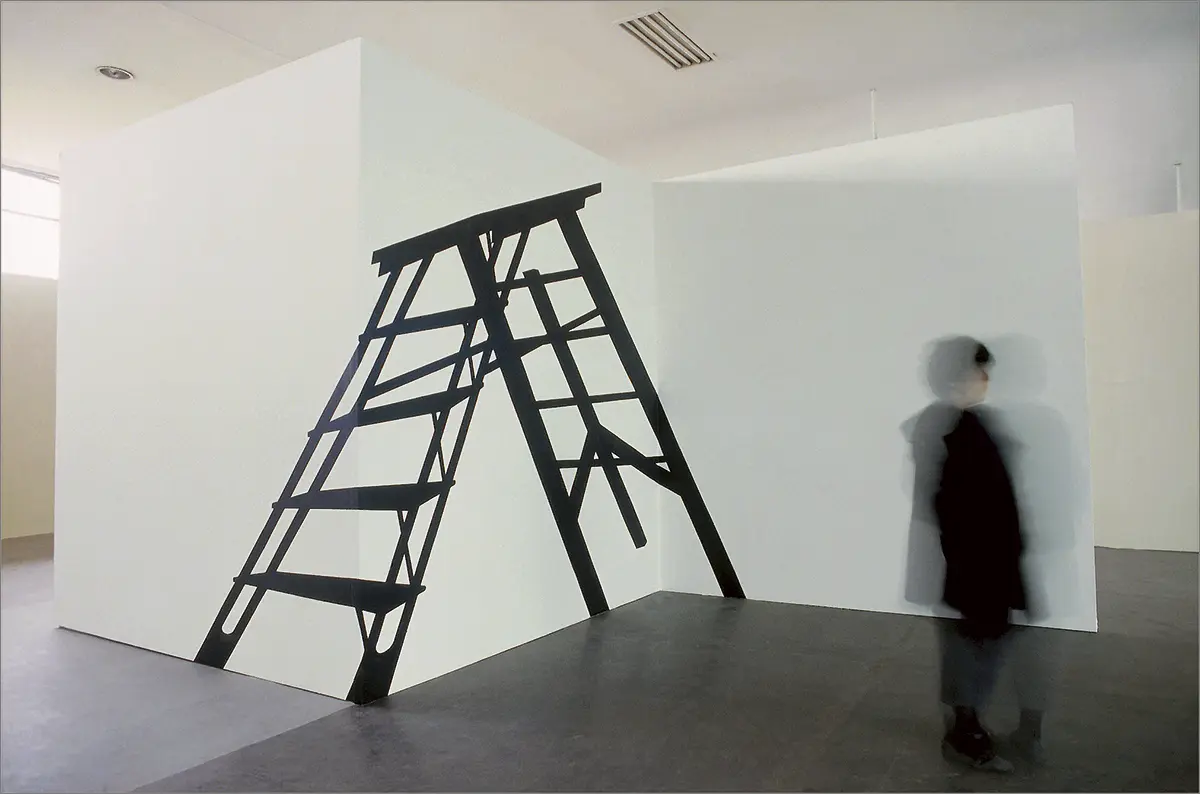
Perhaps the first evidence of skiagraphia in Silveira’s work is a series of photographic works she called Enigmas (1981) in which the shadows of a saw, a hammer, and a fork—without the objects that projected them—descend upon a valise, a typewriter, and a telephone, respectively. What made these works more than playful is the way the shadows settled on the surface of these utilitarian objects; i.e., as if they had the material properties of the fabric. From these works, important features became apparent that were decisive for Silveira’s later works: the angle of projection of light/shadow onto an irregular surface, the geometric logic of shadows, and the point of view of the beholder. A few years later in Projectio II (1984), Silveira painted the shadow of a ladder onto the surface of three walls at right angles with each other so that it looked correct only from the exact point from which it was projected.
The elastic properties of shadows led Silveira’s work toward anamorphic art. Known since the Renaissance, this type of art consists of pictures that appear distorted except when viewed in a certain way, such as through a cylindrical mirror or from a specific angle to the surface of the image. These pictures entail the explicit admission of a viewer and a point of view. Silveira—perhaps the most eloquent commentator of her work—states, “I wanted perspective to act as a sort of philosophical look at the world of appearances, delving into our recognition of the things in our surroundings.”
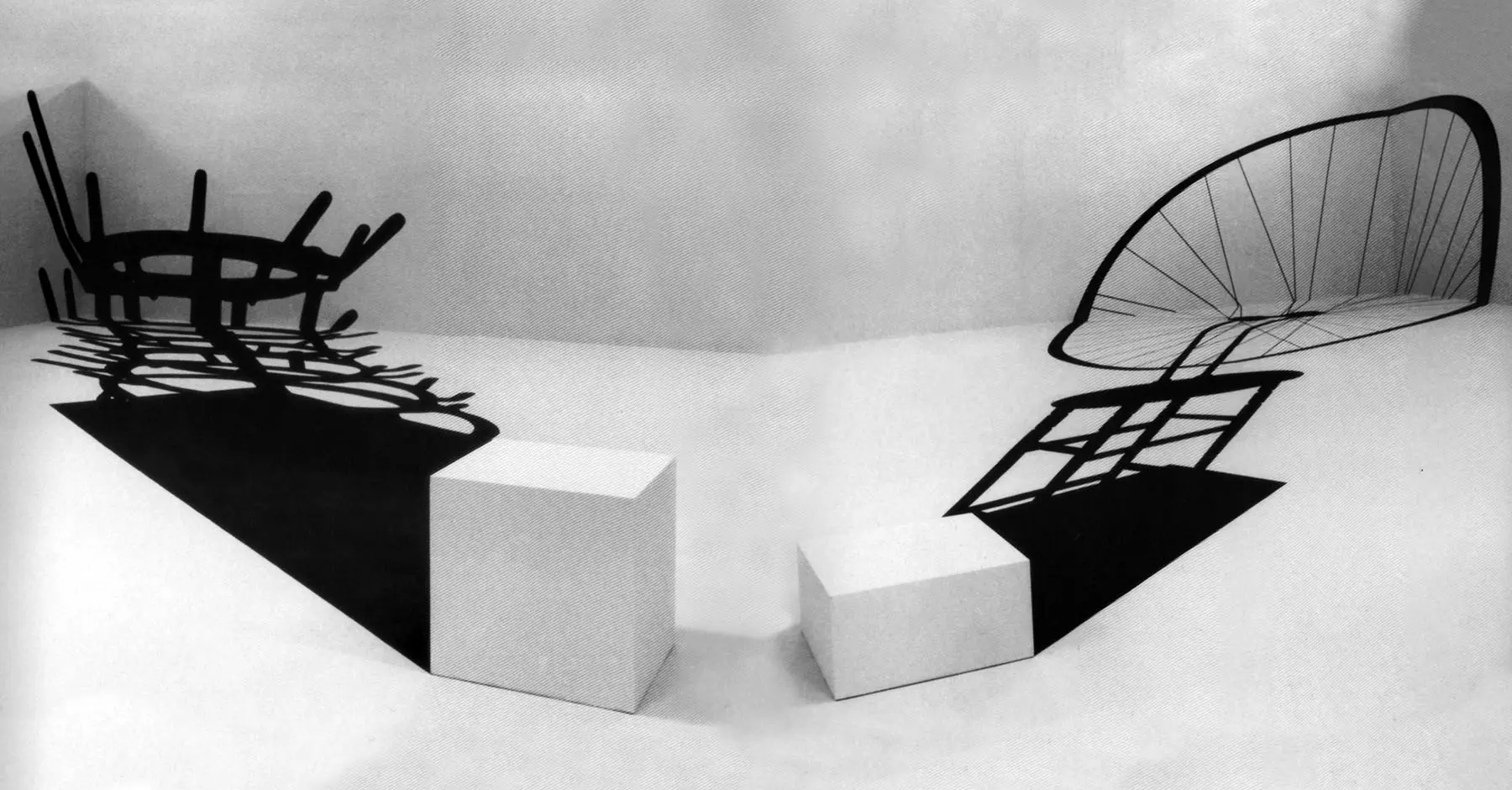
Silveira’s series In Absentia: Masterpieces alludes to the legend of the origin of painting cited by Pliny. A potter’s daughter outlined the shadow of her lover’s profile on the wall so she could remember him during his absence. At least two installations of this series allude to Silveira’s artistic mentors: Duchamp and Man Ray. In Absentia; M. Duchamp (1988) quotes the widowed wheel in Duchamp’s readymade Bicycle Wheel (1913), his photographic work Shadows of Readymades (1918), and the very last painting he made, Tu m’ (1918). Meanwhile, In Absentia; Man Ray (1998) honors the work of the artist whose “rayographs” (Man Ray’s term for photograms) reversed the tonal values of shadows, showing them as light areas whereas lighted areas appear dark. However, the Man Ray work to which In absentia alludes is not a photograph but rather a readymade, Le Cadeau (1921), the prickly iron whose insubordinate domesticity makes an unlikely gift. Silveira’s homage to these two artists is evidence of her penchant for the Dadaist principle of “destructive projection of all formal art” but with a twist.
In Sombras, from the series Dilatáveis (1981/1993), Silveira depicts two men in dark suits and one in a military uniform, casting shadows seven times bigger than themselves. In Silveira’s works, political commentary is not expressed as righteous indignation but rather as subtle and intelligent humor. In a work titled Encuentro (1991), five men and two women project not the shadows of their own bodies but enormous shadows of tools: a screw, a hand saw, a handgun, a circular saw blade, corkscrew, a sling-shot, and scissors. It is a motley assortment that deviates from explicitly political commentary and is closer to Dadaist, anti-establishment, modernist incongruities.
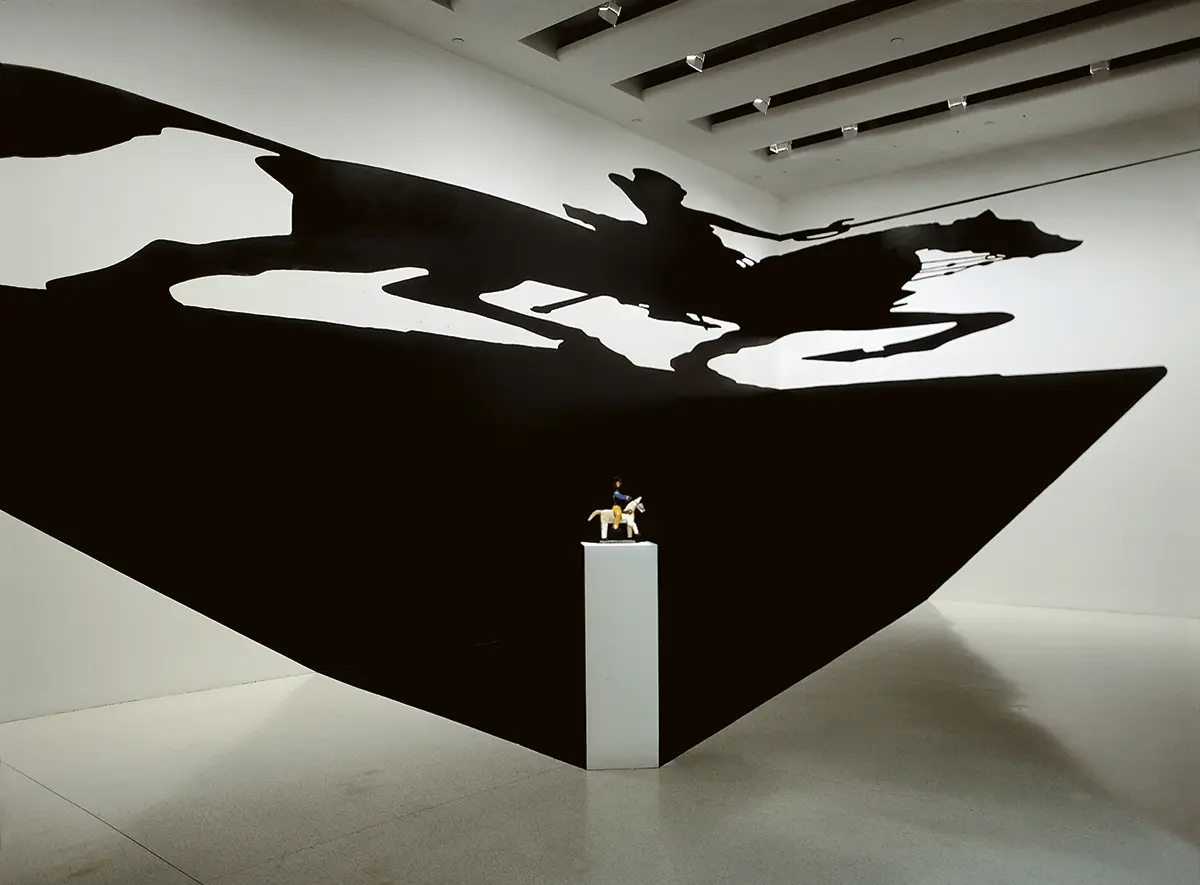
The idea of a small object projecting an enormous shadow appeared once again in Silveira’s 1994 installation The Saint’s Paradox at the Museo del Barrio to make a political comment about the far-reaching implications of the European conquest of the Americas. In this work, a small wooden statuette of Saint James the Apostle on horseback projected a huge shadow of the equestrian monument of General Luis Alves de Lima e Silva, Duque de Caxias, erected in Sao Paulo by the sculptor Víctor Brecheret. Saint James is also known as Santiago Matamoros, literally “killer of Moors” and by extension of all infidels, including all Native Americans who refused to convert to Christianity. The Duque de Caxias was commander-in-chief of the Brazilian army in the War of the Triple Alliance (1864–1870) that joined Brazil, Argentina, and Uruguay against Paraguay. The political subtext makes evident the metaphor of shadows as a sinister legacy. In other words, objects in Silveira’s works do not necessarily project their own shadow; they may also project the shadow that most reveals their character or the shadow they deserve.
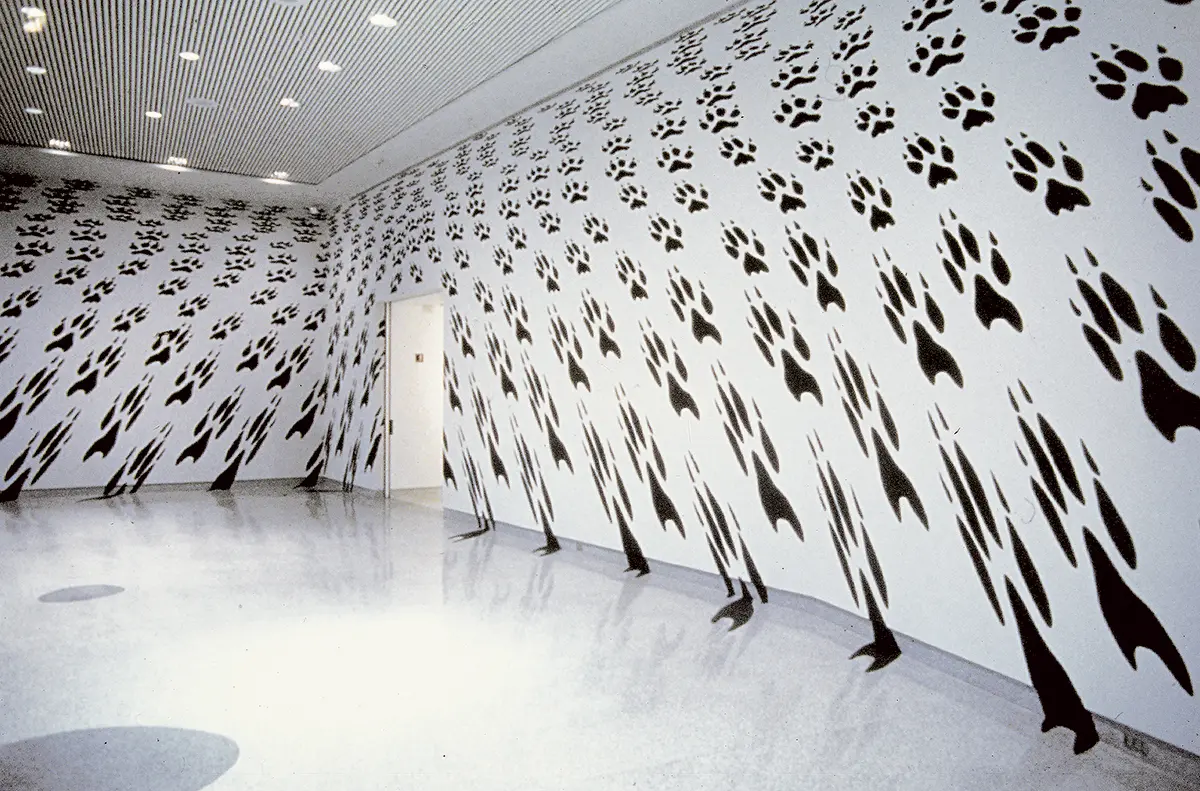
For the twenty-fourth edition of the Sao Paulo Biennial, Silveira produced Tropel (1998), an enormous 600-square-meter vinyl mural on the facade of the event’s headquarters. It was a burst of animal tracks—of birds, lizards, horses, bears, tigers, monkeys, etc.—as if an actual stampede had just been recorded on the wall. The work reflected the biennial organizers’ adoption of the anthropophagous theme derived from Oswald de Andrade’s Anthropophagous Manifesto (1928). Proposition V of the manifesto reads: “I am only interested in what is not mine. Man’s law. Law of the anthropophagous.” The destruction of the rainforest in Brazil is causing an unprecedented extinction of animal species. In Silveira’s Gone Wild (1996), at the La Jolla Museum of Contemporary Art and Intro (Re: Fresh Window R.S.) —a re-interpretation of Duchamp’s darkened window from 1920—animal tracks also replaced shadows as the primary motif. The coyote tracks from Gone Wild had a political dimension as La Jolla is located in a region where so-called “coyotes” traffic in illegal immigrants. The title, however, points towards Joseph Beuys’s legendary performance I Like America and America Likes Me (1974) in which the German artist wrapped himself in felt and shared a room with a coyote for five days. Sharing a small room with a large carnivore is curiously analogous to traveling across the immense desert at the mercy of that other coyote—an anthropophagous being in a more direct sense.
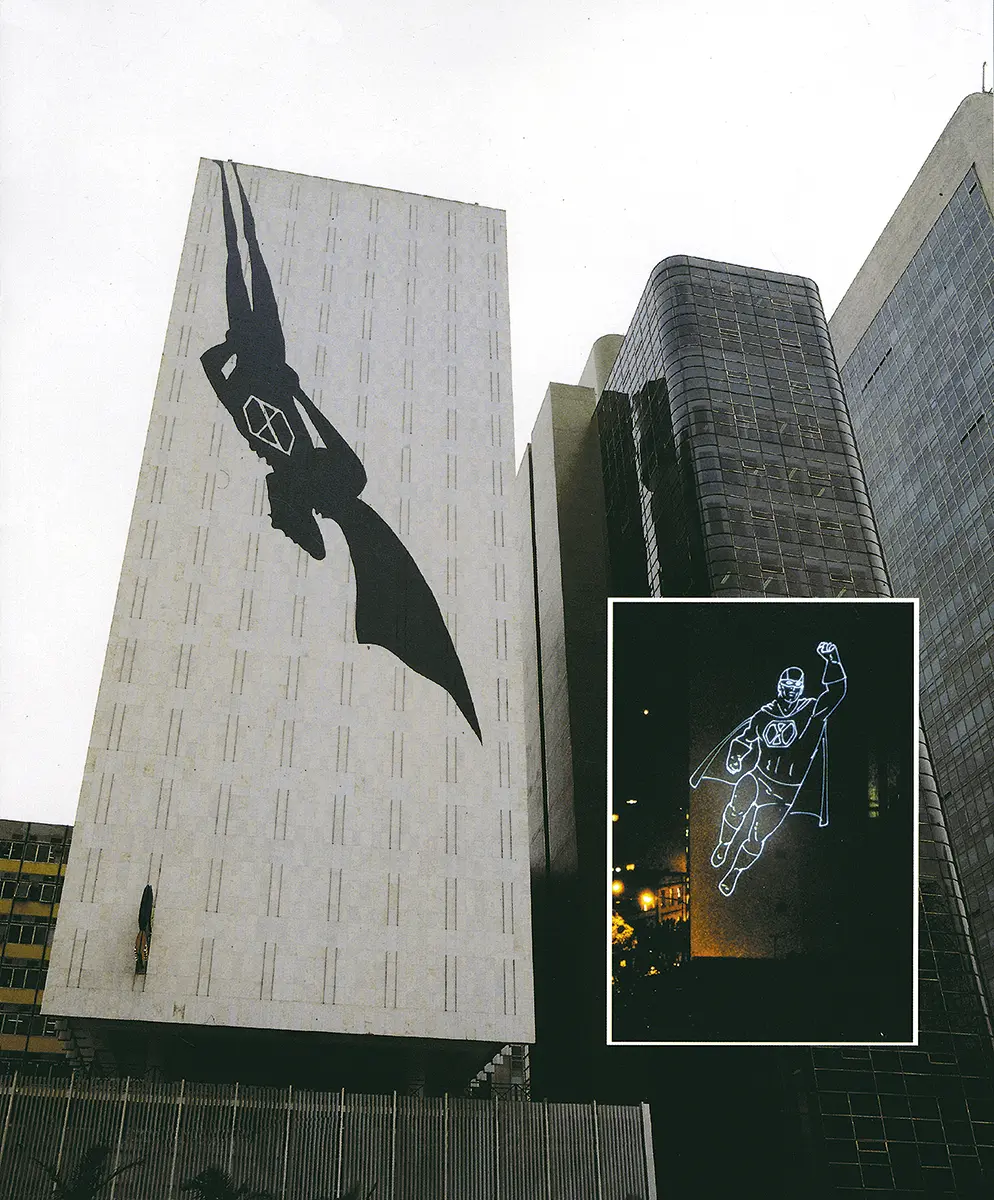
For the work Super Herói (Night and Day) (1997) Silveira created a cartoon-like superhero of ambivalent credentials. Super X’s shadow, a 39-meter-tall vinyl form glued on the façade of a branch of the Itaú Bank in Sao Paulo made the hero superhuman while the actual absent figure was quite small. About this hybrid, generic, and improbable hero, she has stated: “His meaning was intentionally ambiguous. Supposedly, the hero saves us in the urban jungle, but at the same time, flying over the corporate skyscrapers, he watches us and is an accomplice of the corporations that control us.” At night, Silveira projected the outline of Super Herói with his fluttering cape with a laser onto several office buildings of downtown São Paulo, Buenos Aires, and San Juan.
Silveira’s most recent book, Lumen, focuses on the installations she placed at Madrid’s Palacio de Cristal in 2005. She explains, “I have given the title Lumen to the entire project, in order to underscore that light is the axis of my poetic reflection and the clue to all the operations of language implied in my dialogue with the architecture of the Palacio de Cristal.” The word “lumen” stands for a standard unit of luminous flux. Transluz is a work of blue vinyl that spells the word luz adhered to the translucent ceiling of the Palacio, and sunlight projects it onto the interior walls and floor. According to Silveira, Memoria Azul is the visual narrative of the imaginary destruction of the glass and iron frames of the palace’s ceiling. The photographs of these fragments are pasted on the vault and on the floor underneath in order to generate in the viewer, who is positioned in between, the responsibility of “reconstructing” the imaginary creative/destructive event.
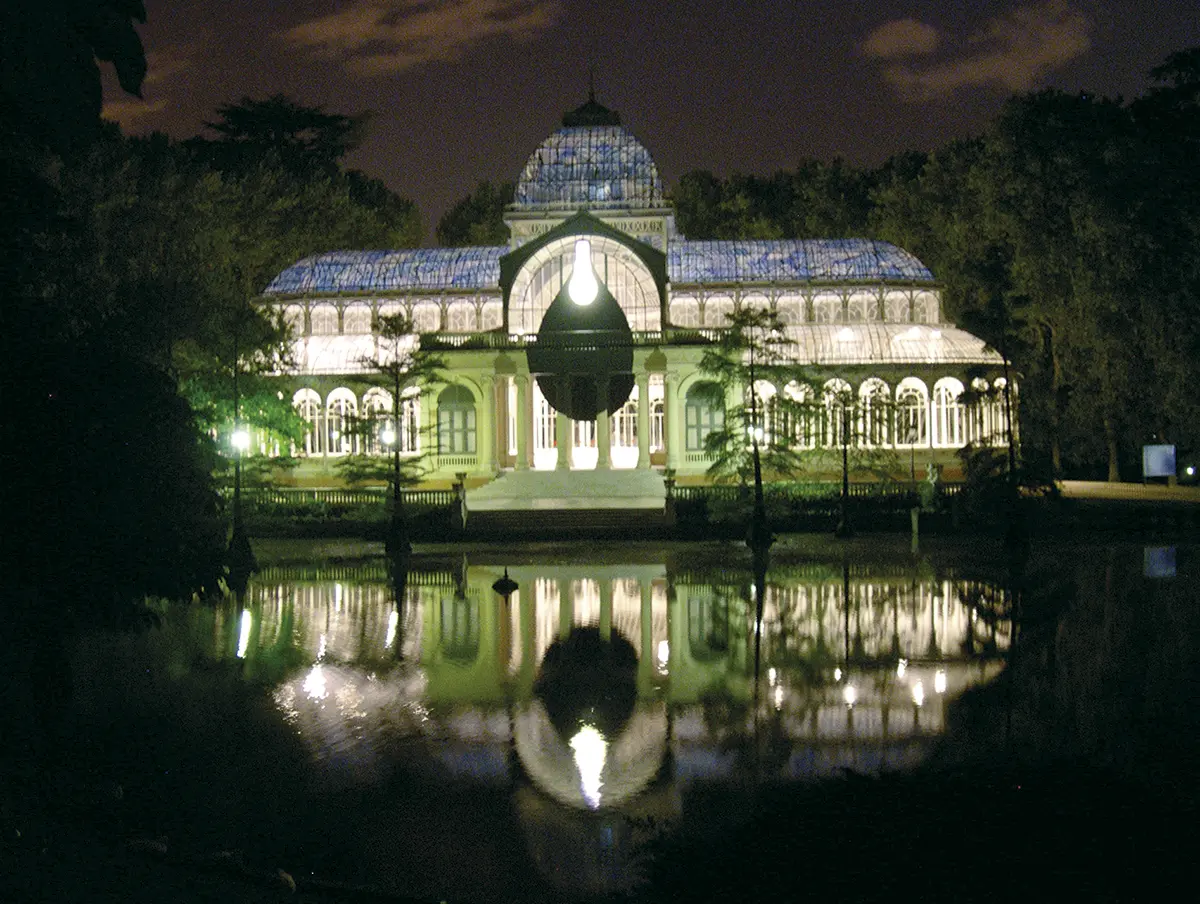
A chimera is a monstrous female creature from Greek mythology, a hybrid with the head of a lion, the body of a goat, and the tail of a serpent. Silveira sought to merge under this name the two main ingredients of her poetics: light, represented as a light bulb, and shadow, represented by a dark cone. The idea goes back to a 1995 lithograph titled A Lampada, in which a light bulb casts its own shadow. In the installation Quimera (2003), the idea evolved into a light source surrounded by a cone of shadow. The paradoxical aspect of the image lies in the fact that shadows are not made by light sources but are cast by objects.
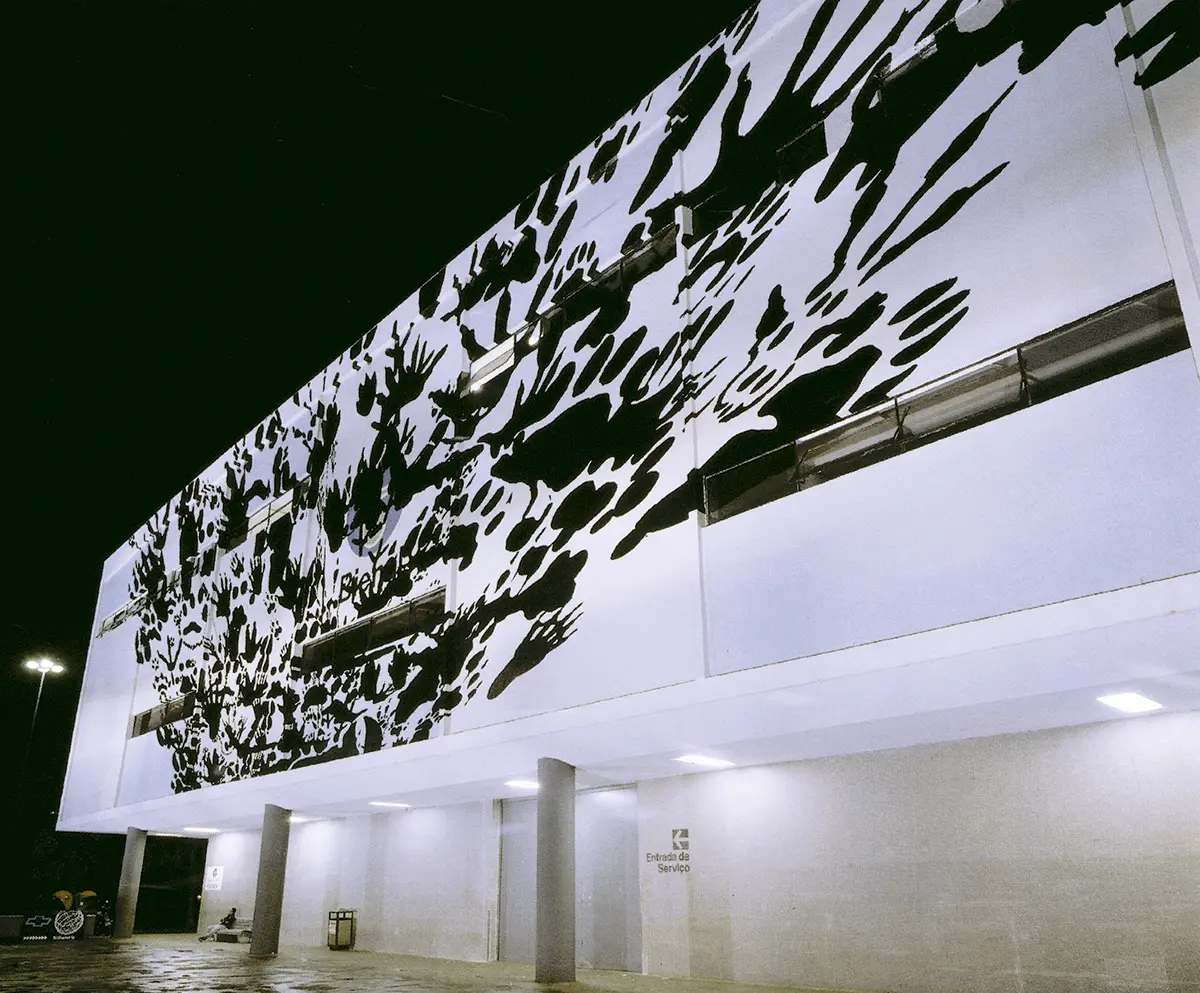
In the 2003 version of Quimera, shadows behaved like light. In the 2005 version for the Palacio de Cristal, where the architecture and materials trap and reflect light, the monumental black vinyl installation returns to the A Lampada design and thus the paradox vanishes. However, the anamorphic design makes the viewer aware that there is an architecturally ideal point for viewing it. The Quimera at the Palacio de Cristal is more like the Super Herói or The Saint’s Paradox because a heroic little bulb casts an enormous shadow. One cannot help but wonder whether the political subtext in the Madrid version quotes the bare bulb in Picasso’s Guernica, perhaps the most memorable image of Spain’s darkest hour. Perhaps, as Silveira’s oeuvre has matured, it too has turned into a hybrid creature of darkness and light.
NOTE
1. Pliny the Elder writes about a hypothetical origin of painting: “…but all agree that it began (picturae initiis) with tracing an outline around a man’s shadow (umbra hominis lineis circumducta)…” (Natural History, XXXV, 15).
*Images illustrating this article are courtesy of Galeria Brito Cimino.
FERNANDO CASTRO R.
Philosopher and artist.