
With more than ten individual shows held in various Latin American countries and in the United States, the Peruvian painter Rosario D. Pinasco is exhibiting for the first time in Lima, at the Museo Pedro de Osma. This exhibition can be seen as an anthology, given that the works on view—large-format acrylics on canvas and on wood and three-dimensional objects—date from 2000, the beginning of the artist’s professional career. Working as the curator, Pinasco selected works that give an account of her oeuvre to a public that has not yet had a chance to encounter it.
The artist asserts herself in the artistic language of abstraction, cultivating gesture as a salient feature of her visual rhetoric. To add vitality to her leitmotif of bells and fruit, Pinasco uses pure colors and marked contrasts of light and shadows. Here is one of the show’s achievements: Pinasco states her goals without overemphasizing technical sophistication. The vital tenor of her work would be diminished by an overly finessed execution, and fortunately, this is not the case.
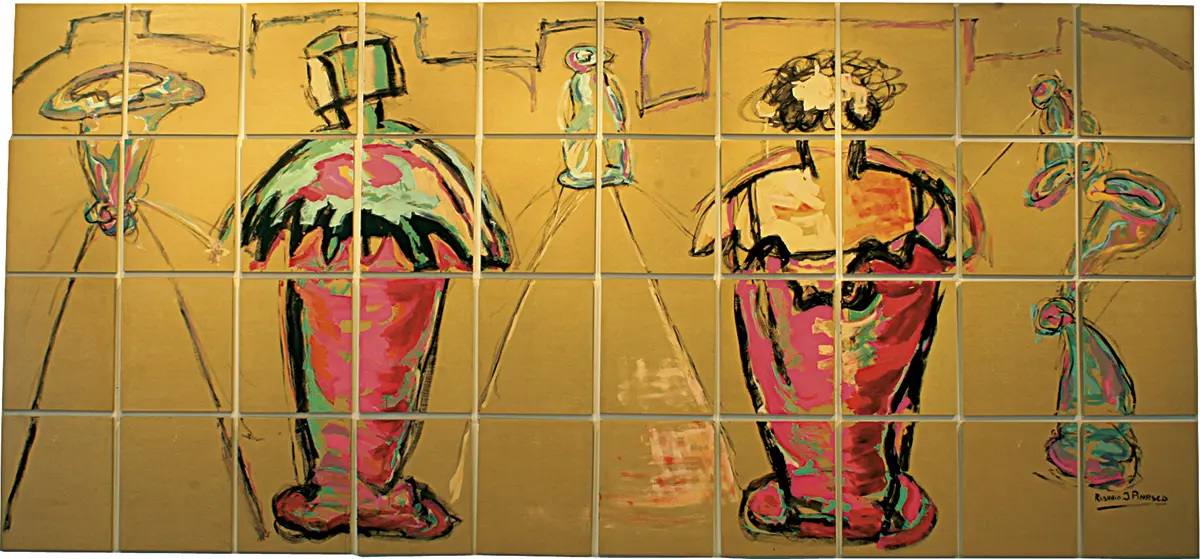
Undoubtedly, the recognizable shapes of bells and fruits suggest human forms. Even when color could submerge the viewer in an atmosphere of sensuality, it is possible to intuit the tension in the exchanges between beings whose interaction is inscribed within closed spaces barely delineated by architectural vectors. It might be that Pinasco’s characters fight to be heard like bells, to conquer a space like a bedroom, or to affirm themselves on their biological essence like fruit. At this level, ambiguity is a deliberate resource and grants the viewer the autonomy of reading the image on his or her own terms. Indeed, the artist stops at this point, making clear her intention of removing any form of intellectualization. The point is to suggest vital impulses and perhaps to shake the lethargy of a city conditioned by its gray skies and its surrounding desert.
While her three-dimensional assemblages have been included in the show due to the anthological intent, Pinasco seeks to assert herself as a painter and persists on that path. Her gestural freedom demands large formats, and one expects her to continue to display her comfort with them; also, her handling of color is solvent. It is in these two areas that the artist’s achievements are most recognizable, justifying following her future work.
In sum, it is the first encounter between the painter and her city. It is a unique encounter, as Pinasco seems to move with greater fluency in international spaces than in the local gallery circuit. In that sense, Pinasco’s option calls attention to Peruvian art’s inescapable need to penetrate the global scene.
LUIS AGUSTI