
If there is one thing Rubén Torres Llorca believes in, it’s the unreliability of language and the sorrows that its betrayals visit on humankind. Not that Torres Llorca is easy to pin down. Visitors to his bifurcated installation at the Frost Museum this winter, Modelo para armar/Easy-to-Build, found themselves in for a dose of bittersweet tough love. No signage. No artist’s statement. No obvious narrative connection between one work and the next, although it was pretty clear that you were expected to navigate the maze-like layout from beginning to end like a lab rat. The exhibition lived and died on what was lining the walls and littering the floor, and it took some patience and deliberation to put two and two together.
This is not necessarily bad. In an age in which museums increasingly want to tell visitors what to see, with labels, wall texts, audio tours, and pamphlets with chewy mouthfuls of explanatory essays, Modelo para armar (A Model to Build) was a clean, refreshing throwback, all the more so if you divined how much Torres Llorca circles like a raptor around notions that art exists as a model of enlightenment, an accouterment of celebrity, a consumable trinket, or something easy to swallow.
To start things off, there were two doorways, and you were forgiven for assuming that one was an entrance and the other an exit. On the wall between the doorways, a Lewis Carroll rabbit in tuxedo tails stood guard by a quotation which summed up what visitors were in for: “The only consistency you can expect from me is that I did and will do everything possible to disappoint you.”
This sort of thing is calculated to heighten a museum-goer’s anxiety, but if you relaxed into the pithy angularity, offbeat wordplay, and elaborate visual jokes inside the walls, you could begin to discern the artist’s intentions and even enjoy them.
Torres Llorca likes to repeat himself, but what is useful about visiting such a substantial gathering of his works is that you see in a graphic way that these repetitions are really variations or embellishments on themes, as in a symphony. His affection for the ambiguities of language is well known, and he made founded the exhibition on linguistics. The entrance/exit problem related to translation and its inexactitude, and its conceit was that a Spanish speaker would enter through one doorway and an English speaker through the other. At the one place in the exhibition where there seemed to be a direct translation, however, the Spanish text below the English “Who’s been eating my porridge?” actually said, “Who’s been lying in my bed?”
Torres Llorca’s cantankerousness about the modalities of art and the art market are equally familiar to anyone who has read his habitually peevish sentiments about the suffering of the artist at the hands of dealers, critics, and landlords, among many others. One fine moment in the exhibition came at the intersection of the installation’s two paths, where there was a floor plan and a list that contained the show’s “ingredients,” including, “Two museum directors (temporary)... One artist (optional/ornamental).” The maquette bore the legend, “The Frost Art Museum, Easy to Build,” a rather antagonistic reference, under the circumstances, to the complicated, unhappy chore the Frost is facing in trying to complete its new building.
The frequent appearance of out-of-scale child figures, fuzzy animals in strange and threatening circumstances, and cruel aphorisms based on beloved fairy tales—“Hansel and Gretel were abandoned by their parents. End of story.”—wove through the exhibition the heaviest of Torres Llorca’s myriad sadnesses: the illusionary nature of innocence and the endless varieties of its disappointment.
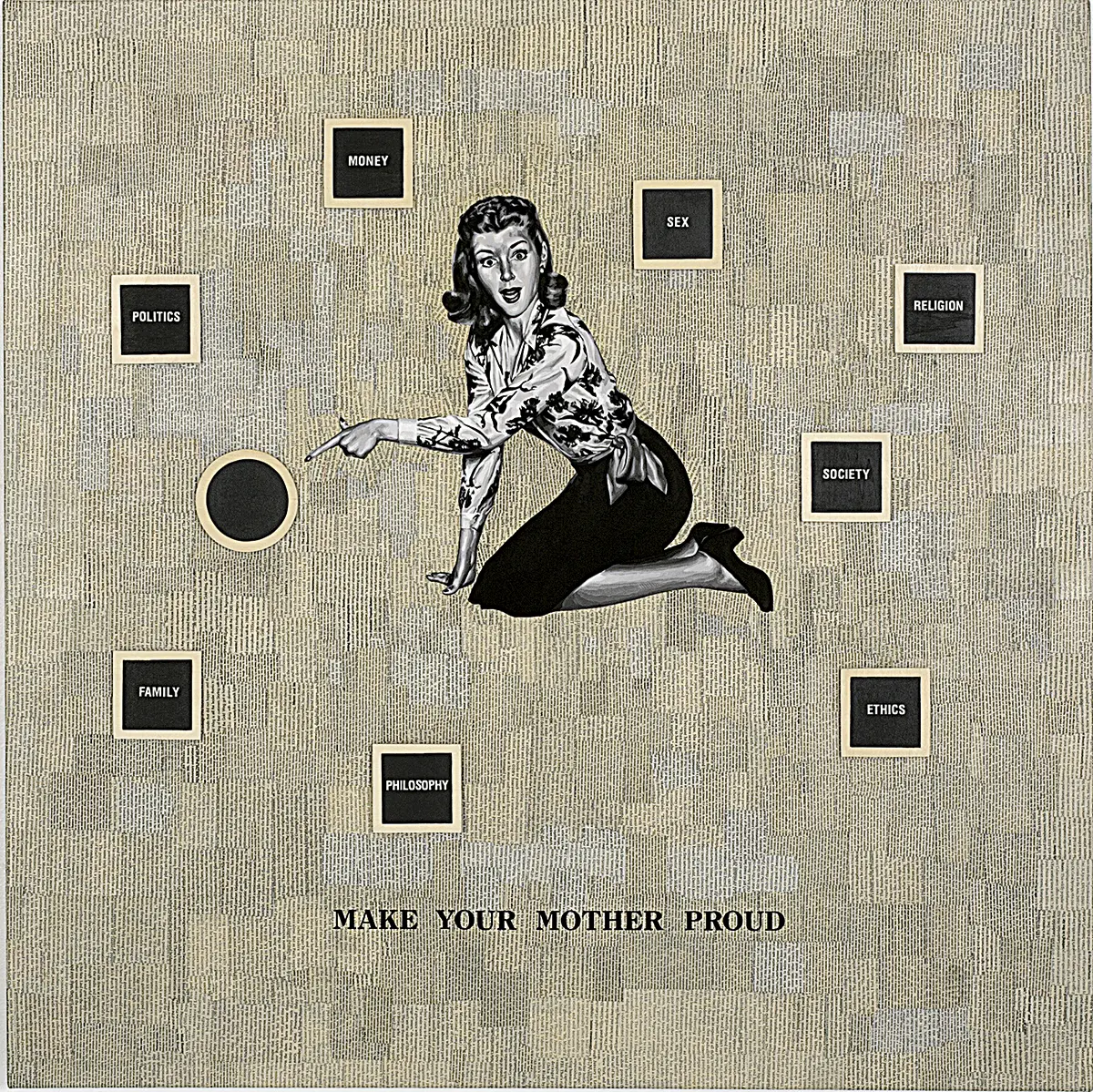
But Modelo para amar (A Model to Build) was not all word games, artist-samurai jibes, and conceptual puzzle-rigging. As an installation, it was limpid and elegant, just like its parts, and there were lovely juxtapositions that may have been the product of fortunate accidents, which one often hopes to see in art but rarely does. At the end—or perhaps at the beginning—of one route through the exhibition, a wall work that read “Make Your Mother Proud” featured the kneeling figure of a shapely 1950s-era gal pointing to an empty blackboard in the shape of a hole, a hilarious confabulation of sex, incest, and the parental and societal pressure that was at once a parody of that era’s endlessly fatuous, Freudian beard-tugging and a piercing look at human foibles in any time. Nearby, an antique table called More & More had a small church atop it and an underwater diver that seemed to rise from below the surface of the table. Between these elements, a figure of a waitress gestured toward the other work and the wall text between the two, which warned the viewer in what could only be the artist’s voice: “...you will see me one more time if you do good, you’ll see me two more times if you do bad.”
JOEL WEINSTEIN