
“I am a painter, that is my craft,” insisted the artist Santiago Cárdenas when he was faced with insistent questions from the public during his exhibition at Museo de Arte Moderno de Bogotá (MAMBO) between February 23 and April 1, 2006.
Santiago Cárdenas (born in 1937, in Bogotá) was educated in the United States of America at a time when Abstract Expressionism was at its peak. Some of these artists were his teachers; “they looked at you weird if you did something figurative,” the artist says. Around the late 1950s, Pop Art was gathering strength, and Cárdenas felt increasingly drawn to it. This explains the two influences in his work. After clearly seeing what he received as an education and what truly interested him, he established himself in Bogotá in 1965, and there he painted and taught at the Universidad de Los Andes and the Universidad Nacional. The exhibition Santiago Cárdenas: Exposición retrospectiva (Santiago Cárdenas: A Retrospective Exhibition) brings together 120 works made from 1965 to 2006.
In works from the 1960s, like Supermercado de la séptima (Supermarket on 7th Avenue), the influence of Pop is evident in the flat planes and the primary colors. Later, Cárdenas abandoned his interest in human figures, his strongest link to Pop, and found beauty in everyday objects. He began painting coffee cups, and later images of umbrellas, coat hangers, and clothes racks became the artist’s signature. The way he arrived at these images was casual. He wasn’t seeking them; after using these objects on a daily basis, he discovered them anew. In Rincón y paraguas (A Corner and an Umbrella), a large-format canvas, the viewer can guess the arrival of the artist to his study, as he has left the umbrella at the entrance to dry. This object is part of something autobiographical and archaeological and is repeated throughout the exhibition. Amidst power plugs and scissors painted in oil, it constitutes the nucleus that binds together the works exhibited on the lower floor of the gallery.
In Santiago Cárdenas’s recent series Sombras (Shadows), one recognizes an interest in three-dimensionality. In the midst of the silence that dominates these works, the presence of nature is insinuated by what could be a garden, by subtle branches that are stunted from being blocked by the windows’ geometry. With these almost-monochromatic canvases, which are dominated by white as if in tribute to Malevich’s White on White, Santiago Cárdenas’s interest in and taste for light is confirmed. For him, light is the main theme of his paintings. Along with space, it is a protagonist.
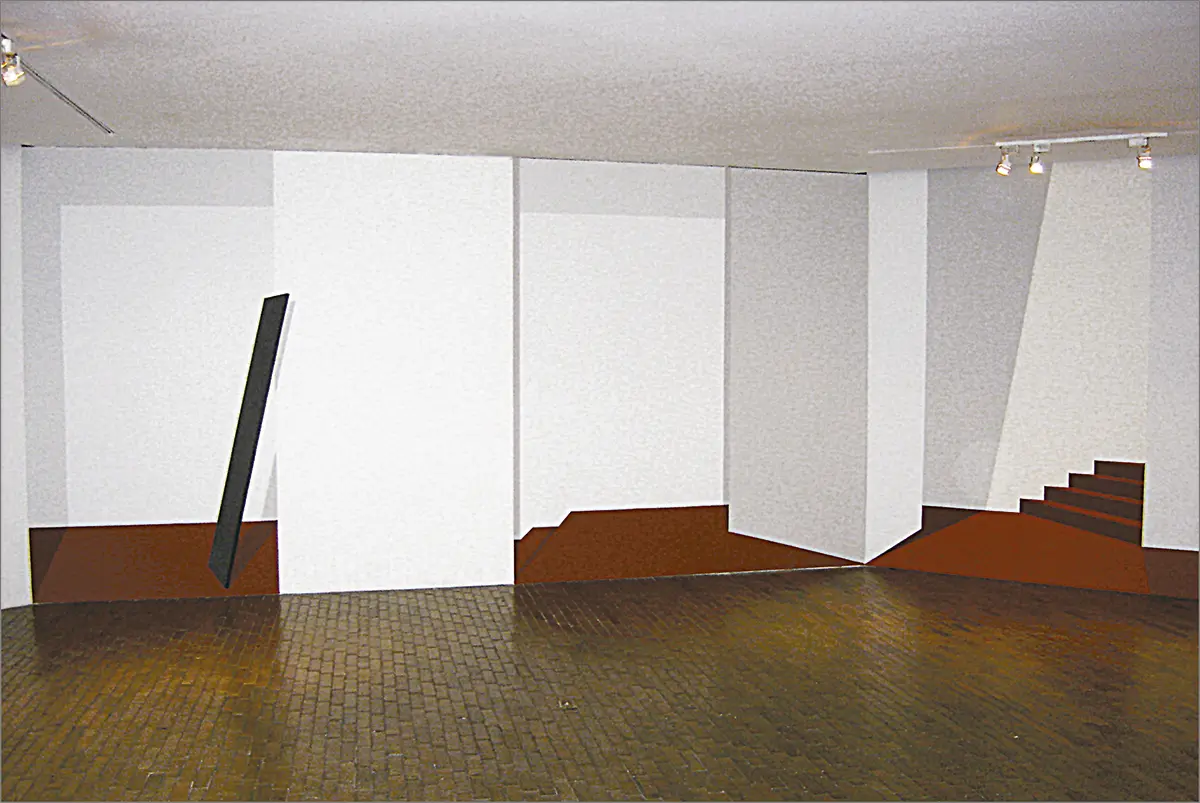
One of the most polemical works presented is a large installation titled Espacios ambientales II, homenaje a Marta Traba. (Environmental Spaces II, Homage to Marta Traba). In 1968, the Museo de Arte Moderno at the Universidad Nacional presented Espacios ambientales (Environmental Spaces), organized by Álvaro Barrios and Marta Traba. Alongside other artists, Santiago Cárdenas took part with Espacios negativos (Negative Spaces). His work consisted of painting images of walls on the walls, like a large mural that created the feeling of wider spaces. In his work for the MAMBO, Cárdenas once again appropriated the space and rendered an illusion, this time using a bold red that had a presence both formally continuous and haughty on the gallery’s white walls.
Highlights of the exhibition were two early works, Florero (Flower-Vase,1958) and Paisaje de Barrington, R. I. (Barrington’s Landscape, R. I., 1959). These were selected as anecdotes, as explained by the curator María Elvira Ardila. There were also large oil paintings with windows, mirrors, cardboard boxes, and blackboards. Santiago Cárdenas sees the world differently than the way it is normally presented. For example, after painting aboard, he appropriated it as an object and reworked it many times with chalk, as if in the midst of a class lecture. Three of these large 140 by 500-centimeter canvases were exhibited, reminding one of the childhood years. With them was the oldest work, the small aeiou from 1976.
The show closed with a chromatic flavor that is unusual in Santiago Cárdenas’s oeuvre and implies a break in his work from the 1980s. Perhaps, in order to free himself of his faithfulness to the precision of drawing, he worked on expressionistic works where color breaks through gestural brushstrokes and becomes a protagonist.
Amidst the interesting developments of Colombian conceptual art, Bogotá and also Medellín are once again experiencing painting from the hand of one of the genre’s best practitioners.
MILADYS ÁLVAREZ