
The Armory Show
The elegant and restrained 2006 Armory Show featured 154 galleries from 38 cities around the world, including new appearances from Brussels (Rodolphe Janssen) and Geneva (Guy Bärtschi) as well as notable absences, namely from São Paulo galleries as well as such New York fixtures as Marian Goodman and Jack Shainman. As usual, the fair drew large crowds (47,000 people) and a few Hollywood celebrities, including Dustin Hoffman, Glenn Close, Adrien Brody, and Matt Dillon. It generated $62 million dollars in sales, a 37% increase over last year’s edition, and featured related programming that was more extensive than ever. Pulse and the LA Art Fair made their New York debuts, Scope changed its presentation format from hotel rooms to a large exhibition space, and DIVA, The Digital and Video Art Fair held its third edition.

The featured artist this year was John Wesley, represented by Fredericks and Freiser (New York), whose work exploits comic book imagery for unexpected, often humorous effects. Apart from illustrations for the catalog and all promotional material, the artist also contributed drawings for the Benefit Print, a new fundraiser aimed to support cancer research, and the acquisitions for the Museum of Modern Art. Art installations around the Armory Show included sculptures by Michael Joo and Richard Jackson and a 65 foot mural by the Brazilian duo Os Gemeos. Wrapping around several walls, the colorful mural entitled History for Children’s Sleep depicted an enormous cartoon-like family posed against a stark landscape on the walls facing the building’s entrance. As visitors turned the corner, they followed the hilly landscape, punctuated by a few shanties, and then, around another corner, encountered a gargantuan representation of the Virgin and Child surrounded by a sundry cast of characters including a pregnant bride and groom, a deer, cow, and a red mermaid. Staring blankly into space, these figures filled walls around the entry halls that usually go unused with vibrant colors and unexpected Catholic and socially conscious imagery.
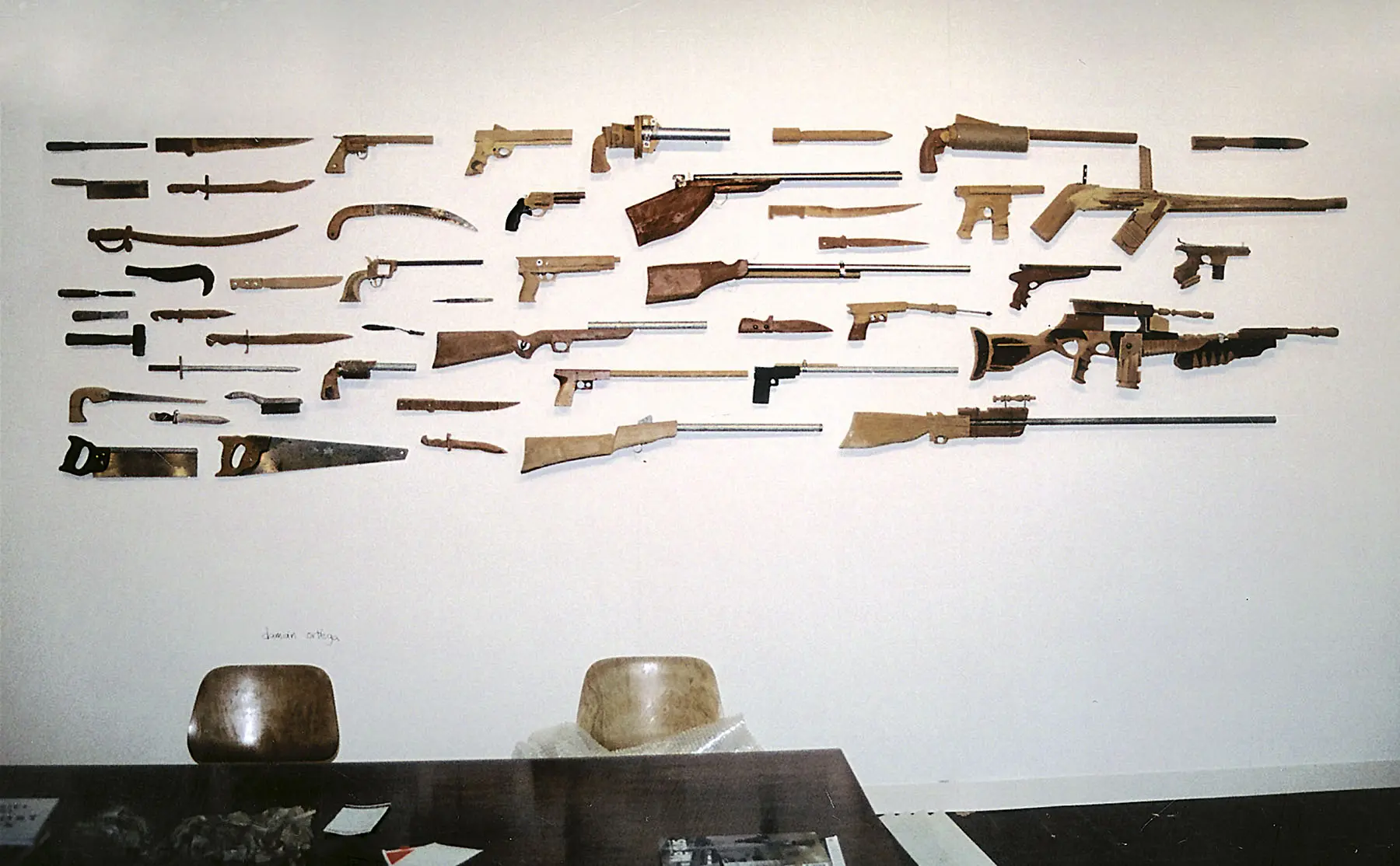
Although works by Latin American artists abounded at The Armory Show this year, only two galleries from Latin America were present at the fair: kurimanzutto and Enrique Guerrero, both from Mexico City. kurimanzutto’s selection was very strong, featuring memorable works by Damián Ortega, Gabriel Kuri, Gabriel Orozco, Daniel Guzmán, and Carlos Amorales. Ortega’s sculptural installation Breve Historia de la Agarradera consisted of a series of representations of knives, rifles, and guns whose handles were elaborately carved in wood. They were juxtaposed to a hammer, saws, and other woodworking instruments actually used to carve them, foregrounding themes of reality versus representation as well as of the fetishization of violence. A series of electric blue monochromatic works by Gabriel Orozco also called attention to the process of their own making. In one set, blue ink seemed to have been spilled along diagonal folds of a piece of construction paper, while in another the paper had been crumpled up and smoothed over, and the paint was smeared more haphazardly.
Enrique Guerrero’s booth included works in a variety of media by a dynamic group of young artists. Manuel Cerda’s decorative mixed-media canvases contained intriguing subliminal political imagery. Yoshua Okón was represented with a photograph from a very interesting recent project called Shoot, in which he continued his exploration of class relations through the reenactment of a real-life shootout inspired by the Hollywood movie Heat. Olga Adelantado contributed a lovely photographic diptych with the words poco cree, a simple expression denoting skepticism and forcing the viewer to ponder questions of a metaphysical order.
Numerous New York and European galleries featured works by artists who are from or have worked in Latin America. They ranged from the expected group of internationally recognized artists who are a fixture at such events to a few pleasant surprises in the form of lesser-known emerging artists. At Sikkema Jenkins, a lovely Vik Muniz photograph of powdered pigments arranged after Gauguin’s The Day of the God had a velvety texture that almost improved on its original source. The gallery also featured a photograph by Janaína Tschäpe and intriguing collage drawings by Arturo Herrera on a grid paper background. Galerie Lelong brought the estates of Ana Mendieta and Hélio Oiticica, and also introduced a large-scale, vibrant painting by Emilio Pérez that looked like a fascinating hybrid between Pop Art and Abstract Expressionism, by Alfredo Jaar were photographs from the series Muxima; this is also the name of his first film, shot in Angola, which was being screened concurrently at the gallery’s physical space. Jaar’s work was also featured by Lia Rumma and Peter Blum. The latter included a very recent series, The Sound of Silence (2006), which continues the artist’s engagement with the African continent through documentation of the Robben Island prison off of the Cape of Good Hope, where Nelson Mandela was held captive for eighteen years.
As in past years, Roebling Hall highlighted works by Iván Navarro and Courtney Smith. Navarro’s piece, entitled Backstage, dominated the space; it consisted of a set of three ladders constructed entirely of neon light bulbs, each in one of the primary colors. The lively Junkhouse by Smith was a sculpture made entirely in blocks of wood decorated with different colors and designs. Nearby, Alexander and Bonin featured a stark sculptural construction by Doris Salcedo consisting of parts of chairs fused together that reference the 1985 siege of the Palace of Justice in Bogotá. Galleria Continua from San Gimignano presented the large-scale sculpture, Porque toda ciudad tiene derecho a llamarse utopía (Because Each City Has the Right to Call Itself Utopia), and a set of delicate mixed-media drawings by Carlos Garaicoa. The former was a long wooden table whose surface was covered with different colored threads wrapped around pins executed on black background, were made up of silver hair-thin lines, some of which so faint as to be barely visible.
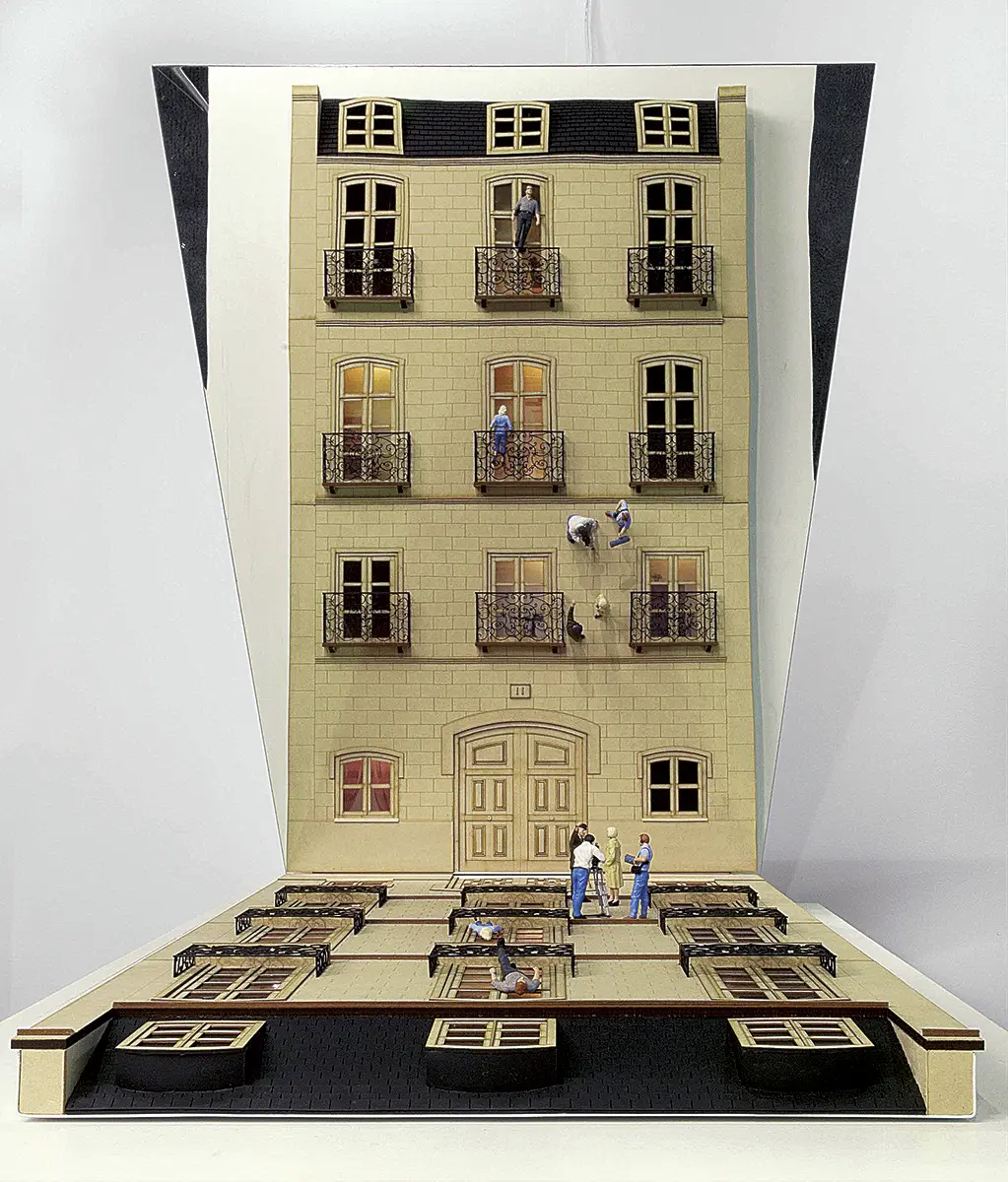
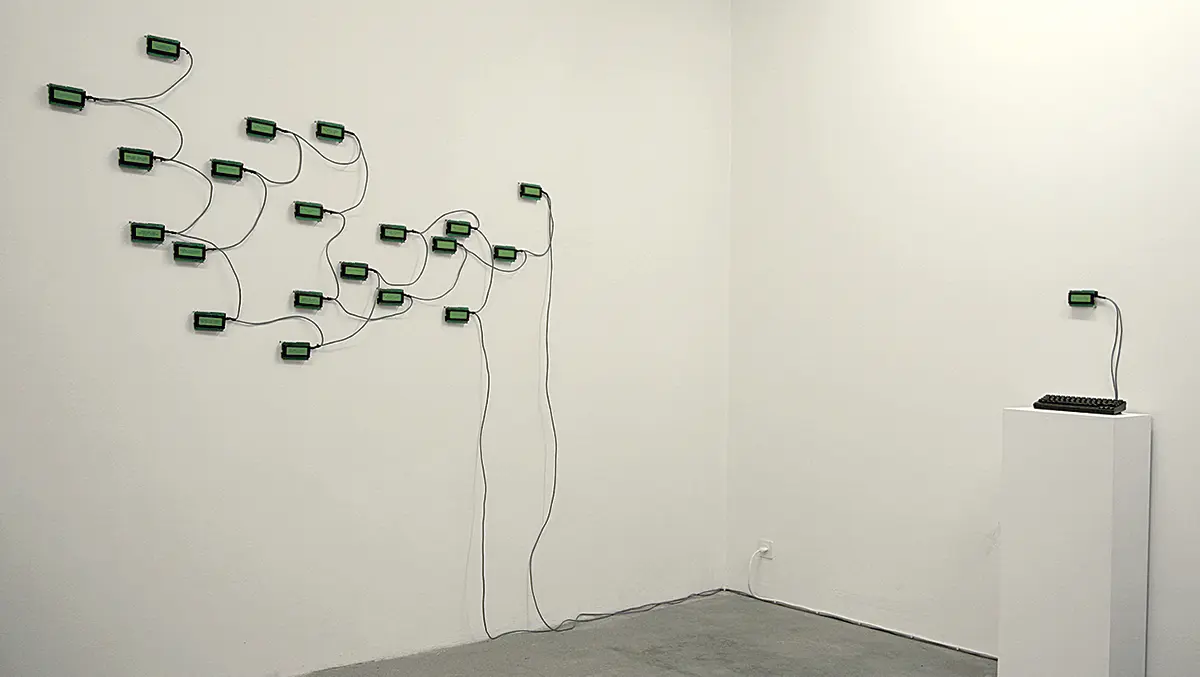
Other well-known names represented at the fair included Carlos Amorales at Yvon Lambert; Allora and Calzadilla at Chantal Crousel; Iran do Espirito Santo at Sean Kelly; Daniel Joseph Martínez at The Project; and Francis Alÿs, Melanie Smith, and Jorge Macchi at Peter Kilchmann. Emmanuel Perrotin featured Leandro Erlich with the work Nuit Blanche, depicting the facade of a building with different characters and whose overall view is complemented with a mirror image, creating a new reality, and a sculpture by up-and-coming Miami artist Cristina Lei Rodríguez. Entitled Nasty Queen and made of synthetic materials, the work was a dystopic still-life of an artichoke blossom surrounded by grotesque drippings of melted plastic. Delia González and Gavin Russom were represented at Peres Projects with a three-tier sky blue sculpture resembling a fountain that featured electronic sound effects. Frederic Snitzer presented paintings by Hernán Bas and nearby at Guy Bärtschi was an interesting new media piece, 33 Questions, by Rafael Lozano Hemmer, was part of a larger trend at the fair this year in favor of new media and technologically inflected work. At first glance, his piece consisted of 21 small screens that flashed enigmatic messages, such as “Have you struggled to decay the insinuation?”. Upon closer observation, however, it became clear that the work was interactive. A computer asked the spectator to type in a question which all the screens would then project simultaneously. Then, the words were combined with all the other phrases in the computer’s memory generating billions of possibilities but no real answers.
Overall, The Armory Show was inspiring, as it has been in the past. This year, galleries seemed to take greater risks, such as Magazzino d’Arte Moderna from Rome which offered in its booth a single work: Double Happiness by the Kosovo artist Sislej Xhafa, a large scale circular sculpture in neon that alternated between a peace sign and the Mercedes logo. Lehmann Maupin devoted most of its space to the work of Ashley Bickerton, who set up bamboo walls and exhibited works commenting on colonialist stereotypes, and Ronald Feldman presented a touching homage to Hannah Wilke in the form of a mini-retrospective of her work. It is regrettable that so few Latin American galleries participated in such a memorable event.
Scope
PULSE / DIVA / LA ART
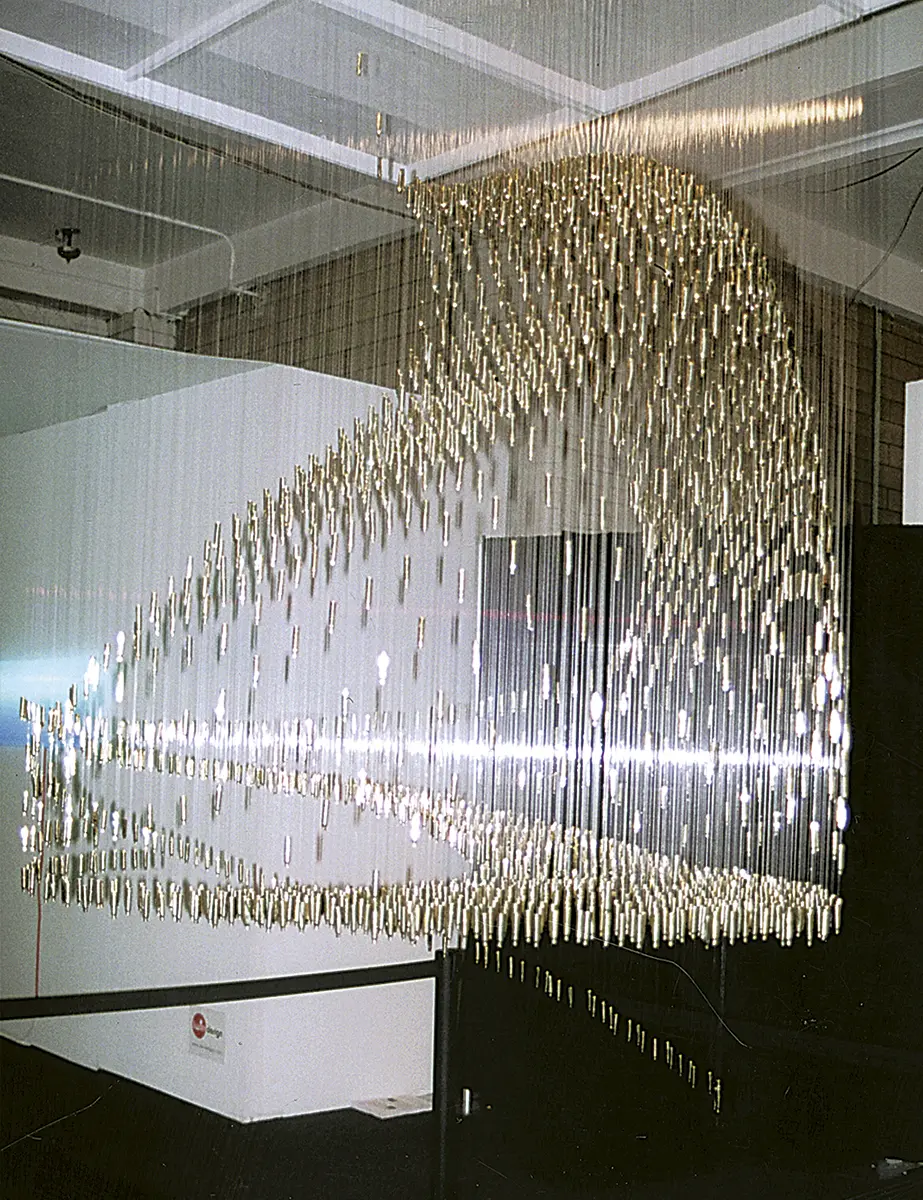
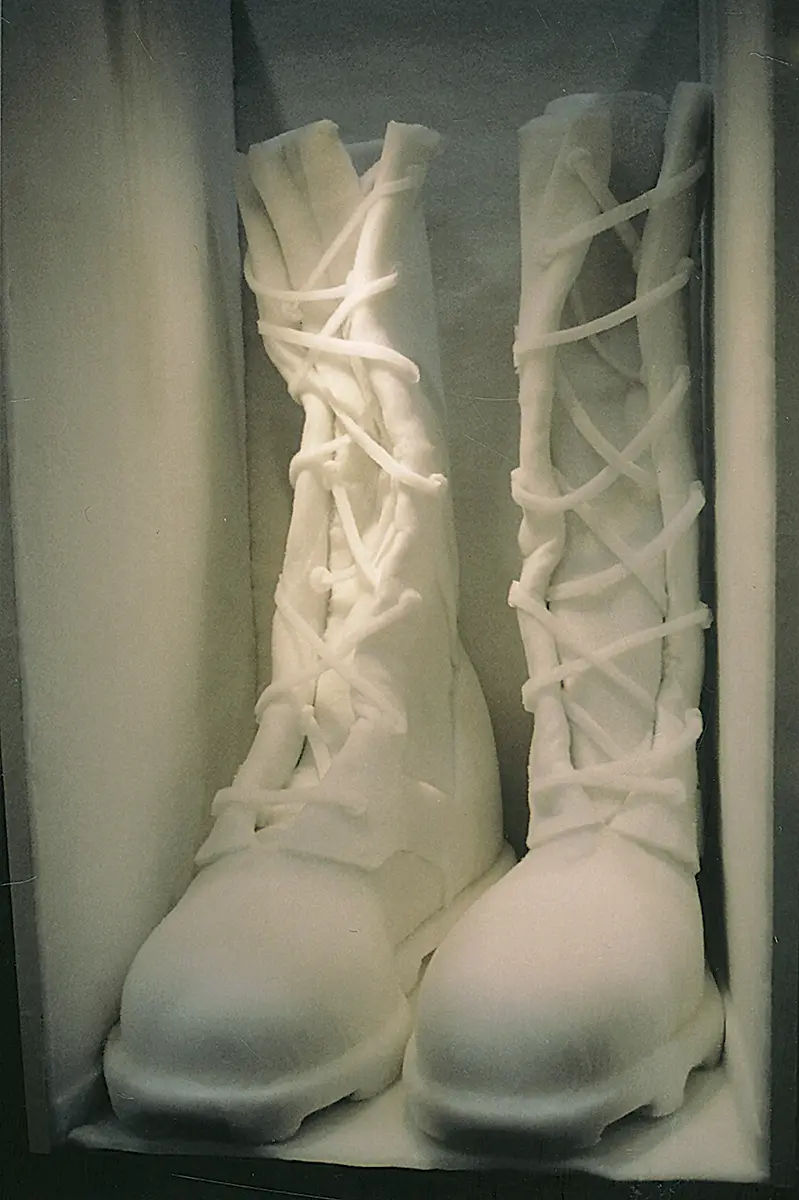
More subdued than Scope, Pulse offered a fresh and exciting selection of art at the 69th Regiment Armory Building on Lexington Avenue and 26th Street, site of the original Armory Show of 1913 (the International Exhibition of Modern Art, which first brought international modern art to the United States). Pulse included 61 galleries, among which several were invited to participate and other, emerging spaces were chosen by the jury and included in the “Impulse” section, which offered smaller booths. Despite the space limitations, galleries placed there presented memorable works, such as Ronald Morán’s enormous army boots covered in white cotton at Mackey Gallery; Collectibles by Jennifer Dalton at Plus Ultra, a set of gold-plated figurines accompanied by plaques bearing the names of international collectors, their profession, and collecting preferences; and intricate drawings by tattoo artist Duke Riley made with a hypodermic needle at Magnan Projects. Other artists included were Angel Marcos at Ernst Hilder, with excellent large-scale photographs of Havana, and Isidro Blasco at DCKT Contemporary. Blasco was also responsible for one of five commissioned installations at the fair, as was Milton Rosa-Ortiz, who presented the prominently placed and critically acclaimed mobile That’s Not Art. The work is composed of bullet casings like those used by the U.S. Army in Iraq, which are hung on threads and positioned in such a way as to approximate the shape of Marcel Duchamp’s Fountain, the notorious upside-down urinal which forever changed the history of art. Reminding the viewer of the original function of the building, Rosa-Ortiz simultaneously renders homage to the 1913 Armory Show and to the victims of war, firmly grounding the object in the present day. The artist achieved an admirable balance between content and form; the piece unfolded dynamically, like a Futurist sculpture, mesmerizing its spectators who sought to see it from all angles.
Lastly, an account of the notable works at the various New York fairs would not be complete without mention of Magdalena Fernández’s Mobile Drawings and Carolina Sardi’s evocative video Walking Towards Water presented by Douz and Mille at DIVA and the video Sync by Marcos Brambilla screened by Christopher Grimes at LA Art shows a dynamic edition of images in three videos focused on erotic scenes, audiences clapping, strokes and fights, accompanied by an energizing soundtrack comment on environments of seduction, shallowness, and violence.
These fairs along with the Whitney Biennial and numerous special events for Armory Show VIPs that took place around New York, such as visits to private collections, guided tours of exhibitions, panel discussions, and parties galore, made this an exhilarating week.
TATIANA FLORES
Ph.D. in Art History from the Columbia University. Assistant Professor of Art History at the Florida State University.