
The conceptual axis connecting Thomas Glassford’s recent installation at the Museo Universitario de Ciencias y Artes (MUCA) with its title, Cadáver exquisito (Exquisite Corpse), seems to be the reconfiguration of the museum space based on its own architectural elements, allowing for the hybridization of national artistic moments.
Glassford’s installation, which opened on January 21, 2006, consisted of removing a translucent acrylic panel that was added to the museum in the early seventies and covered the original modernist structure to cast the exhibition gallery as a white cube. The artist placed the panel inside the exhibition gallery as a minimalist Mesoamerican ball game.
Spatially appropriating the Surrealist game Exquisite Corpse, Glassford recovered the idea of working with fragments of previous works, in this case, three emblematic discourses in Mexican architecture: the Mesoamerican ball game, the functional architecture of Ciudad Universitaria, and post-minimalism. His installation is not only a machine that produces stylistic relationships, but it also forces the viewer to rethink the history of identity discourse in Mexico, from the grandiloquent glorification of the pre-Columbian past to the repeated, failed attempts to reach Western modernity, either by the imitation of architecture developed by the Bauhaus school or through the assertion of a postmodern self-awareness.
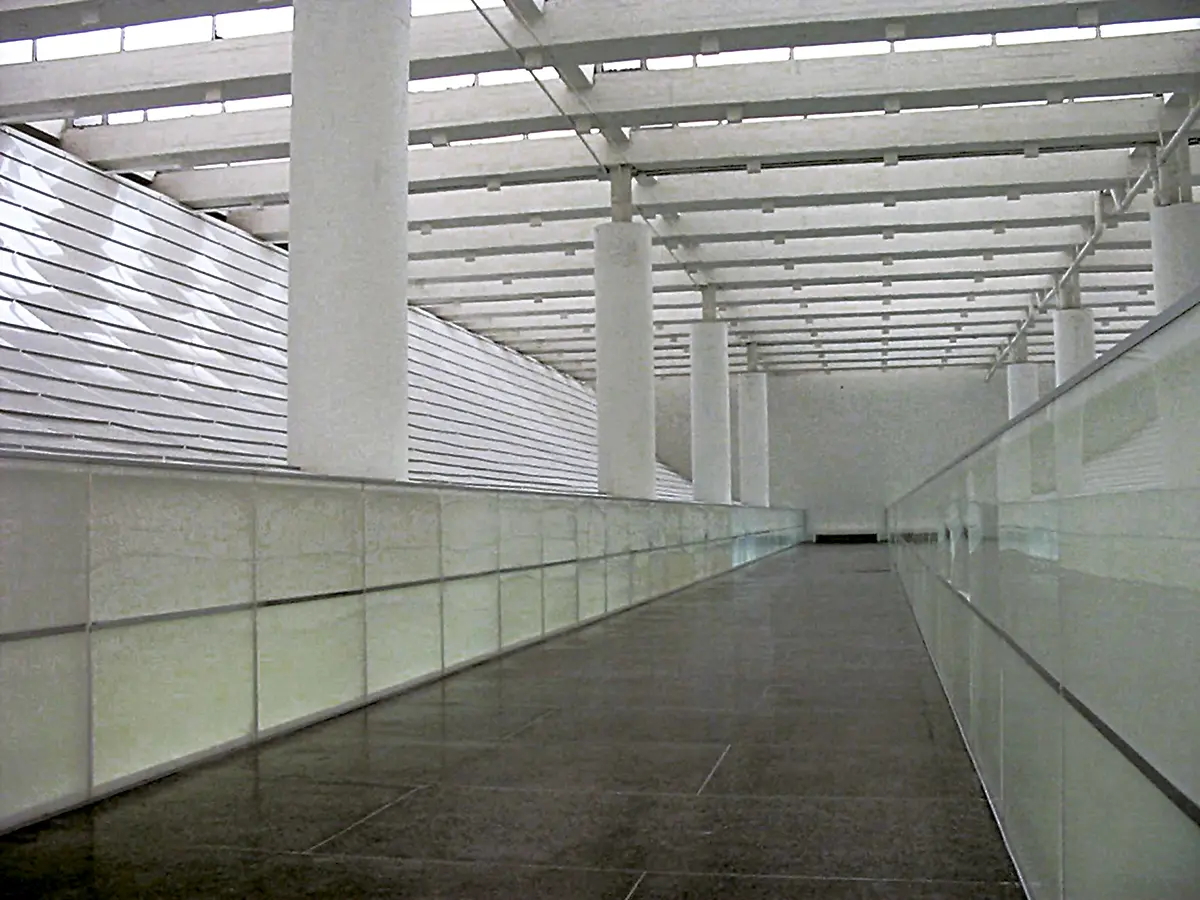
It is especially interesting to note that an acrylic panel was removed from the gallery space but not from other areas of the museum, like entrances, offices, and bathrooms, because it allows the viewer to understand the two architectures, the original one, and the pseudo-modernizing adaptation. In the former, there are references to industrial architecture, while the latter works as a simple pastiche of the 1970s ideal museum.
In this work, Thomass Glassford interprets the idea of the museum not as a space for the contemplation of objects but as a place for personal reflection, where the visitor is conceived as an essential part of the work. Suddenly placed at the center of the ball game, the visitor is no longer a passive spectator but an active player, the center of the work of art. In this work, the viewer is confronted with himself in a space that forces him to remain silent. This space immediately generates awareness of one’s own body movements because as the viewer walks through the exhibition, he feels more in touch with himself. Thomas Glassford placed a bench at the end of the hallway, and from there the viewer can experience the whole work and discover, to his astonishment, the way that other viewers behave inside it and, strangely, repeat his own behavior.
Cadáver exquisito is a work of art where light and sound are essential elements. After removing the acrylic panel from the museum’s ceiling, it was evident that the original architecture by José Villagrán García, Alfonso Liceaga, and Xavier García Lascuráin planned the use of natural light in the space. Thus, Glassford’s work is illuminated from outside by natural light that changes as the day progresses and from inside the ballgame’s translucent walls by artificial light. This light inside is reminiscent of science fiction—perhaps a spaceship by Kubrick, a Calatrava-designed building, or the way that followers of the UFO phenomenon imagine that extraterrestrials helped the Maya to build their ball games.
The show includes two more pieces from Glassford’s earlier work: Valley (1989), a small box-spring cut in half by a tin ridge, and Floater (1990), a chromed floating device mounted up high on the wall. Both works make discreet comments on the artist’s creative strategies at different points in his career. Recycling and re-signifying everyday objects are among the most prolific lines of exploration in Thomas Glassford’s work, and the work always alludes to the body in one way or the other. The viewer soon discovers that Valley repeats the shape of Cadáver exquisito but at a human scale. Also included in the show are two videos: one pedagogical, showing the process of building the work as well as showing interviews with the artist and the curator of the show, Patricia Sloane; and one resulting from a real-time projection of the work, as if from a security camera, which allows a viewer to observe the installation and another viewer’s behavior from outside.
This show was originally conceived as a retrospective. Thomas Glassford chose instead to present new works that directly relate to the viewer and to the space because, for him, the idea of a retrospective exhibition is associated with things that are dead, with posthumous tributes. Thomas Glassford is interested in life transformations—not the homage-receiving corpse, but the intrinsic play of the Exquisite Corpse.
LARISA ESCOBEDO