
The Brazilian artist Vik Muniz uses photography to document his fascination with the power of images and questions of meaning and relationship between the real and representational. As normal associations dissolve in a scheme of identities whose rules range from the ephemeral to the reconstructed, Muniz confounds the viewer with his astonishing subjects, materials, and excursions into the history of art. This critical survey of approximately one hundred works from his most significant series, produced throughout his career from 1988 to the present, is an amazing adventure into the ways of seeing. Organized by Peter Boswell, the Miami Art Museum’s senior curator, the exhibition will travel to Tampa, Seattle, San Diego, and Montreal. It is accompanied by what must be considered one of the most significant publications on the artist, a 204-page book, Reflex: A Vik Muniz Primer, which features new writings by the artist that recount his development and reveal the multiple inspirations behind his successive series. The artist’s impressive accumulation of knowledge is expressed in the numerous quotations that accompany his text and demonstrate how he applies “[M]an’s penchant for projecting his understanding of forms onto the physical world is a faculty that has been developed to ensure his survival since the time of his hunter-gatherer period."1
As Muniz probes the nature of visual representation through his many series, the viewer must also consider the relationship between the image and the material in which it is rendered and go beyond the immediate response to the subject itself. Neither the subjects nor the materials from which they are created are unintended. At first, the works of Muniz appear as documents, essentially portraits or subjects that communicate something about people or places in a convincing, contemporary manner, in which their identity or meaning is paramount. Upon closer examination, these subjects are not what they seem and photography has been manipulated to subvert their identity as much as to reinforce its meaning. To borrow the word used by Alfred Stieglitz to define the photograph as a symbol, or metaphor, the subject becomes an “equivalent.” It is recognizable, but it is only the starting point, for the photographer charges it with extraordinary meaning that puts equally extraordinary demands on the viewer. Muniz calls this approach to art “the worst possible illusion.” This illusion creates tension in the relationship between the identity of the subject and the material in which it is rendered. There are issues of scale, familiarity, magnification, and memory. Each series presents new materials, new metaphors, and new equivalents, each more provocative than the next.
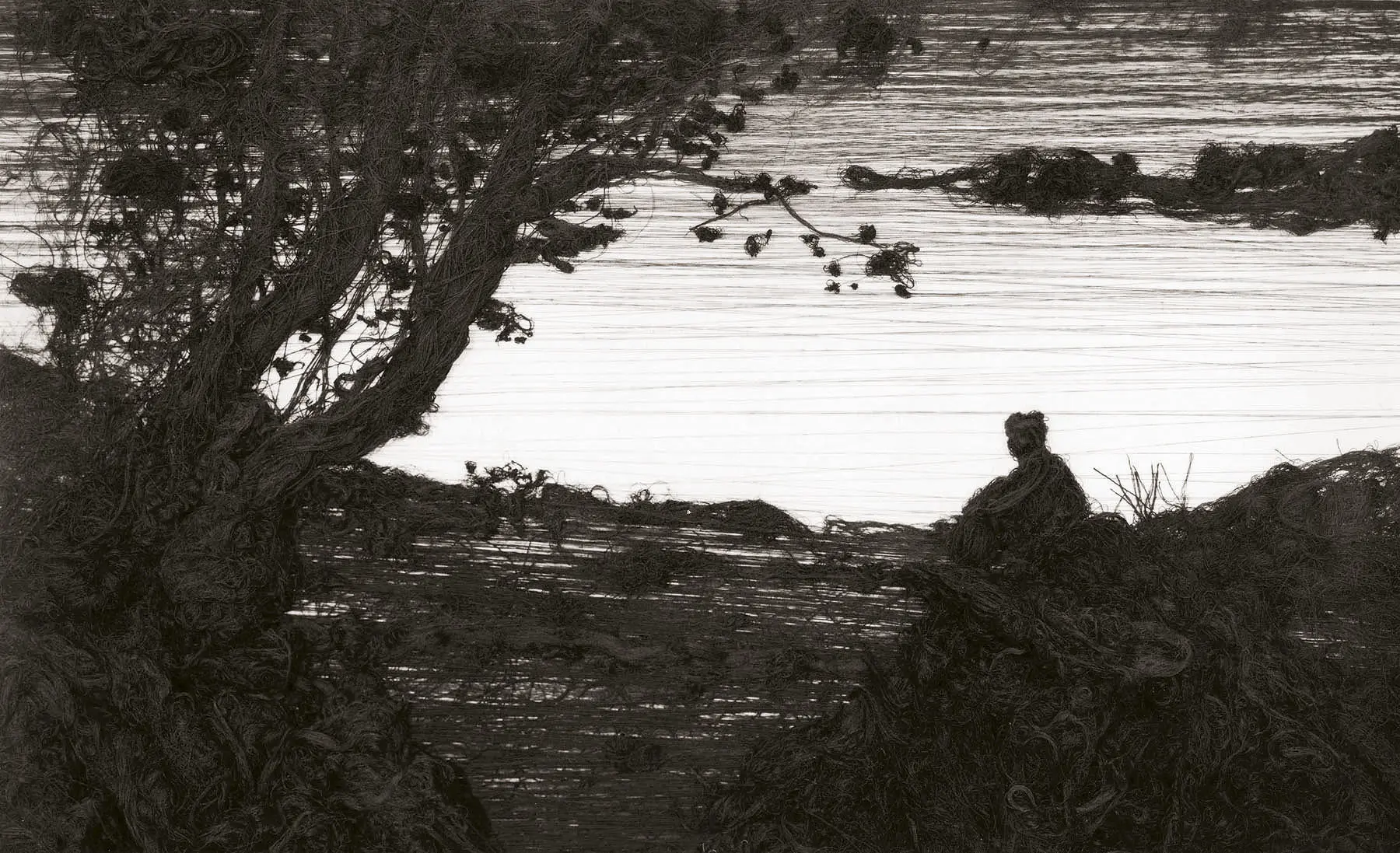
His works are created from photographing a variety of materials such as dirt, diamonds, sugar, wire, string, chocolate syrup, peanut butter, ketchup, and general junk. His subjects may be children of the Caribbean, news stories, art, history, or just fragments from the detritus of everyday life. For the past ten years, Muniz has moved beyond the exploration of photography and its potential for invoking new methods of documentation to a more critical assessment of the elements of representation, especially as they are revealed through the history of art and its methods of painting. For the Pictures of Thread series, the titles indicate the yardage needed to reinterpret masterpieces, such as Le Songeur, After Corot (16,000 Yards), 1996, and Apple Trees, after Gerhard Richter (4,000 Yards), 1998. The photographs look like black and white reproductions of the paintings, but up close the fact that the photographs are of images made from thread adds new sensual associations. The photography is so distinct and enlarged that the threads are sometimes like clots of hair, built up and layered and swirled to the contours of the original painting. There is something disturbing about the thread that distracts from the landscape as much as it provokes questions about the technique involved and Muniz’s obsession with working with the material. Also, there is the photography and the scale to add another layer to its complexity.
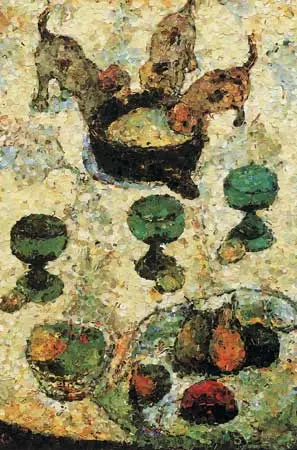
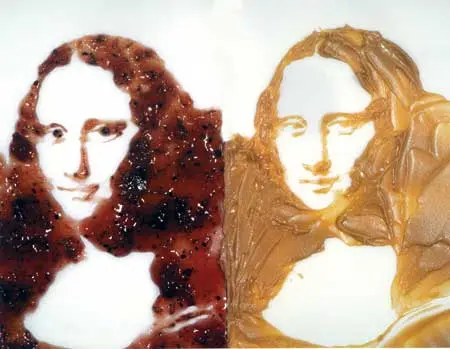
For his Pictures of Soil, other familiar images take on a different meaning through the incorporation of materials like dirt, twigs, and leaves into novel recreations of the originals. The Trout, after Courbet, 1998, and Snake, 1999, demand close inspection and, from a close perspective, they lose identity as the debris composing each photograph distracts the viewer. Not even Double Mona Lisa (Peanut Butter and Jelly) (After Warhol), 1999, or the Raft of Medusa (Pictures of Chocolate) 1999, are safe from his material interpretations. If the photograph is an illusion, the camera is Vik Muniz’s metamorphosing machine, and Steiglitz’s equivalent has become both rooted in the subject and yet has gone beyond it somehow due to the confusion of surface appearance. The questions and complexities abound in Muniz’s multi-layered concepts about the power of images and the myriad manifestations as real or ephemeral, permanent or transitory.
The transitory nature of image-making is captured in the latest installment of Muniz’s celebrated series Cloud Cloud, based on his observations of clouds as the “perfect vessels for meaning; they invite interpretation.” He began making sculptures out of cotton and fishing wire for a project that escalated into shapes for a series based on his own version of Equivalents, in the early 1990s. At MAM, the project extended beyond the museum’s walls into the sky. Using a skywriting plane as his tool, Muniz created a line drawing of a cloud in the sky above Miami on consecutive clear, bright blue days. By drawing an image of a cloud in a place where we would expect to see a real cloud, Muniz once again underscored the difference between an object and the image of an object. Whether inside or outside of the museum, Vik Muniz challenges our ways of seeing, and the familiar becomes something for contemplation according to an entirely new set of rules and associations.
NOTE
1. Reflex: A Vik Muniz Primer, p. 35. More than a catalog of an exhibition, the book is a remarkable investigation into Muniz’s unique world of artistic perception that serves to further elevate the quality of MAM’s excellent retrospective.
CAROL DAMIAN
Professor and member of the Directive Board of the Department of Visual Arts at Florida International University, Miami.