
The first retrospective exhibition of the Argentine artist Xul Solar (1887-1963) in the United States was installed at the Museum of Fine Arts Houston. Like many other members of the Latin American avant-garde, Xul undertook a European cultural pilgrimage between 1912 and 1924. But the idiosyncratic interests of Xul Solar made his pilgrimage unique. In addition to art, Xul Solar’s interests were mysticism, occultism, and astrology. Not surprisingly, Patricia Artundo, the principal curator of Xul Solar: visions and revelations, states that in order to understand Xul’s oeuvre “it is indispensable to define Xul Solar as an esoteric and occultist.”
In Europe, Oscar Agustín Alejandro Schulz Solari soon became connected with avant-garde groups. Towards the end of 1912, he bought Der Blaue Reiter Almanac (1912). The Munich-based group of artists of Der Blaue Reiter included Russian painter Wassily Kandinsky, Franz Marc, August Macke, Alfred Kubin, and Gabriele Münter. They were interested in revealing important “spiritual truths” using the forms inherent in medieval European and other primitive forms of art, including folk and children’s art. Xul found in this group of German Expressionists a way to conciliate his artistic and esoteric interests.
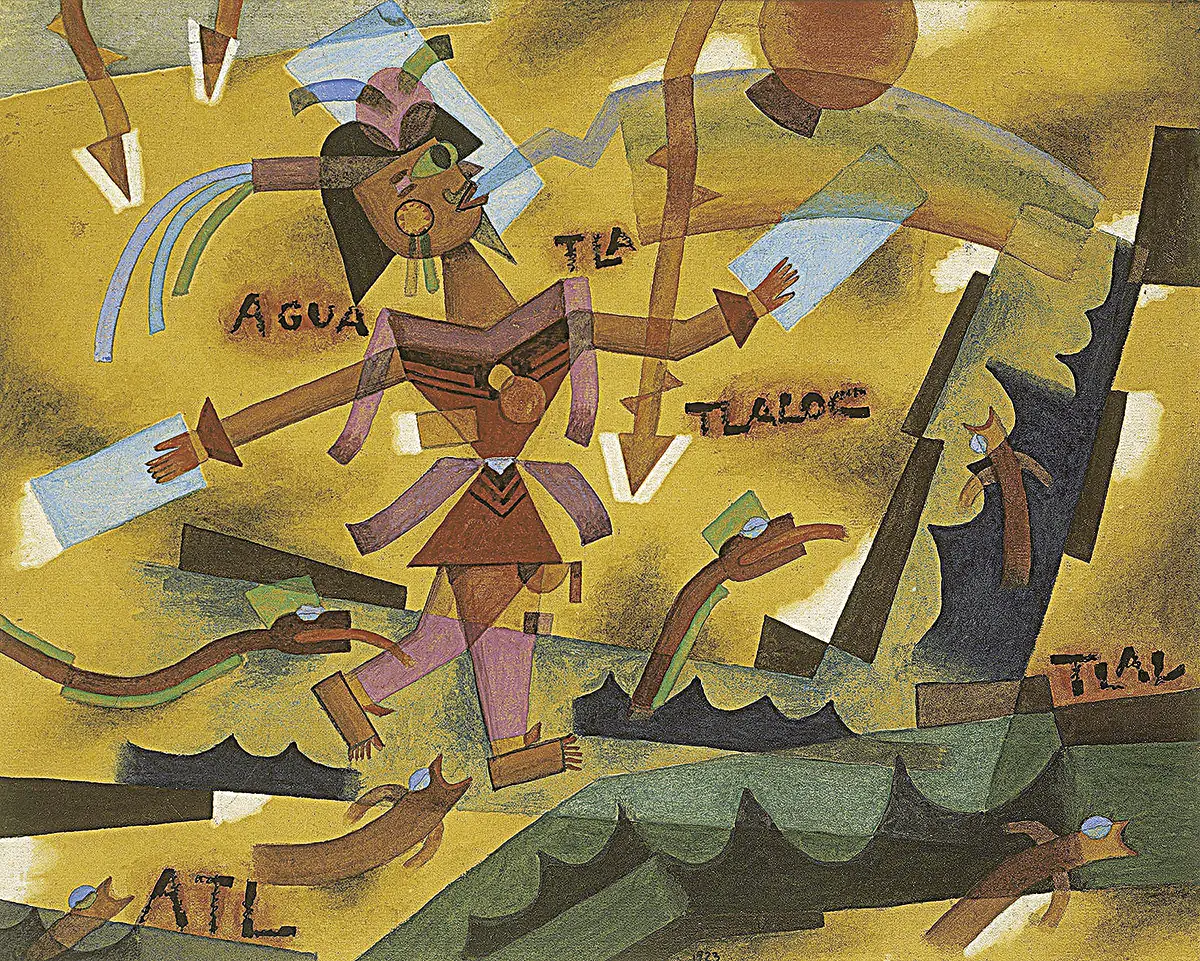
By 1916, Schulz Solari had adopted the name Xul Solar, which not only simplified “Schulz Solari” but also was a nom de plume that augured his future as a spiritual guru. “Xul” is “lux” spelled backward, so his adopted name amounts to “solar light.” The modification of his own name also signaled the birth of an obsession with reforming languages that would last his lifetime.
In a 1924 trip to London Xul met the occultist Aleister Crowley (1875-1947), whom British tabloids called “The Wickedest Man on Earth” and who signed his texts with the satanic cipher 666 and the epithet “The Beast.” Artundo states, “We know that Xul’s encounter with Crowley was decisive in his life, inasmuch it gave him a method (…) to have visions, derived from the practices of the hermetic order of the Golden Dawn, a technique ‘of using symbols as a means of obtaining controlled astral visions’.” In 1929 Crowley wrote to Xul, “Your register as the best visionary that I have ever examined still subsists today, and I would like to have this group of visions [his San Signos based on the I-Ching] as a model.”
The re-insertion of Xul in the Argentine art world was not easy but it was facilitated by the friendship he established with Jorge Luis Borges. Xul’s works were published in the avant-garde magazine Pancho Fierro. In addition, he illustrated Borges’ book, The Language of Argentines (1928). In Memories of my friend Xul Solar, Borges commented, “Xul was the man most capable of friendship I have ever known. I think I owe him the best hours of my life, reading and arguing, and above all, letting him teach me.”
Borges’ animosity towards the Peronista regime is well known. A few months after the peronistas came to power they sought to humiliate Borges by “promoting” him from his post at a Municipal Library to “Poultry Inspector.” Borges resigned and shortly thereafter stated, “Dictatorships foster oppression, dictatorships foster servitude, dictatorships foster cruelty; more abominable is the fact that they foster idiocy.” It was only Borges intellectual stature and the mediation of some intellectuals close to the regime that afforded him some degree of protection. It is less clear what prompted Xul Solar to take sides with the Peronista regime. Annick Louis has pointed out that “The period of the first Peronista regime marks for Xul a moment of great expansion in the artistic field and of participation in the public sphere connected to the State apparatus.” There is evidence that Juan Domingo Perón as well as his wife Evita held astrological beliefs. Was Xul involved with the Perons as a sort of guru? Was Xul one of the regime’s insiders who protected Borges?
In 1940 a new series of works by Xul called Grafías based on stenography
had surfaced. Previously in his paintings, Xul had introduced words in Neo-Criollo, myths, and esoteric symbols. With the Grafias he was to negotiate meaning through a mixture of shorthand and ideograms. In spite of the formal appeal of works like Grafía antica (1939) and ¡Xamine todo retene lo bon! (1961), the uninitiated viewer cannot help but feel that the works are not only hermetic but unnecessarily cryptic. In fact, Gradowczyk plainly states that the meaning of the first Grafía (1935) “has not been decodified yet.”
Since his return to Buenos Aires, Xul’s esoteric activities had continued in crescendo. In 1929 the Keppler Lodge, part of the Fraternitas Rosicruciana Antiqua, had granted him the title of “instructor.” In the thirties we find him conducting all-night astrological and meditation sessions with friends and adepts. In fact, he met his future wife, Micaela Cadenas (Lita) in one of these sessions. In 1940 he became a member of the Martinista Order under the name of “Brother Nil.”
Throughout the thirties and up to 1946, Xul painted numerous landscapes that are arguably his most enduring legacy. Gradowczyk has called them “mystical landscapes.” In some of these paintings, objects, beings, and symbols subsist in a flat pictorial space as in País (1931) and Boske y yogui (1931). In others, there are varying degrees of perspective clues that place images either in a semi-abstract or an imaginary dimension that is not unlike our world. These paintings may also be compared to Chinese and Japanese landscapes where “enlightened ones” gain wisdom through, meditation, ascent, and isolation.
In 1957 Xul Solar described himself as “…painter, writer, and a few other things. Duodecimal and 'cathrolic' (ca –cabalist, tro –astrologist, li –liberal, c–cooperative or 'thingist'). Not an inventor but a re-creator, world champion of Pan-Chess and other serious games that almost nobody plays; father of a 'Pan-language' that means to be perfect but hardly anybody speaks and godfather of a vulgate without populace; author of useless graphics that hardly anyone reads; exegete of twelve (+one total) religions and philosophies that almost nobody follows.” While this self-description betrays certain skepticism about his own utopian projects, his mysticism always drove him to seek transcendent truths through mystic symbols and esoteric practices.
FERNANDO CASTRO R.