
Entrada libre para siempre, the most recent installation presented by Alexander Arrechea (born 1970), contributes to the perception of a social reality manipulated and controlled by the mechanisms of power, one that has historically been accepted and is rarely questioned by the majority. Arrechea’s work is on view at the Museo Patio Herreriano de Arte Contemporáneo in Valladolid from June through September 2006. It is located in the gallery reserved for solo projects, specially commissioned by the institution due to the unique characteristics of the exhibition space, which was formerly the chapel of the Counts of Fuensaldaña in the old San Benito Monastery.
Visiting the exhibition promotes associations with the space as a spiritual refuge, a sacred place where one seeks peace and freedom. However, the history of especially the Catholic religion is heavy with many violent acts and dark periods that make it impossible to reach a total state of purity. Traditionally, one assumes or ignores these unsavory episodes. Arrechea presents a new, more all-encompassing view in the apparent contradictions and the symbolic content of his structure. In this work, politics, ideology, and religion follow a common path.
The year 2003 was one of the transcendent changes for Arrechea. He decided to distance himself from the group Los Carpinteros after more than a decade of collaborative work, and he began explorations and reflections about the official spheres directly related to surveillance and control over the masses. Even before starting his individual work, these ideas were already part of his interests as an artist and as a social being. In his first work developed that year and exhibited in the United States two years later, he designed a structure in the shape of a tree, using the branches to mount twenty-two surveillance cameras. The images they captured were broadcast over the Internet. It was a mediated and contextual installation, with the projected recording captured in the exhibition space. Arrechea confessed that in El jardín de la desconfianza (2005), “I am not only talking about surveillance. There are new categories . . . the idea of the object as something that is not autonomous.”1 He established the link between realities and apparently irreconcilable situations, depending on the context that generates them. The viewer could move from being stalked to being a stalker, from being controlled to exercising control. Roles and expectations shifted, creating new spaces based on virtuality.
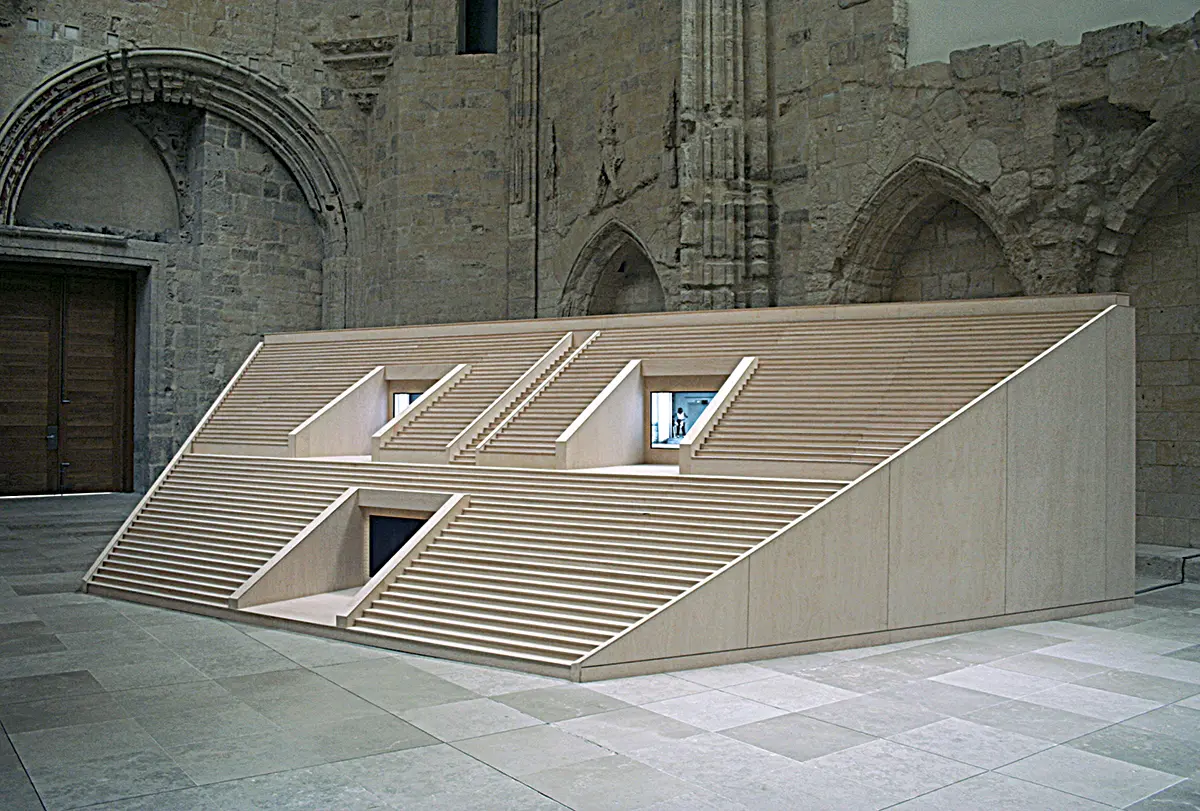
Arrechea has an undeniable ability to create spaces with a marked theatricality, linking installation and video to achieve that goal. Entrada libre para siempre features live videotaping of the public as it enters the museum and a wood fragmented structure that recalls a sports stadium. Rows of bleachers are broken by three openings where the video monitors are placed. The images of visitors arriving are constantly reproduced, creating the sensation of a massive concurrence, and the whole concept is reinforced by the audio component.
The artist’s intention is that viewers perceive only the angle of the work that appears as sculpture—a mere three-dimensional representation. Viewers are only aware of the larger scenario and discourse after placing themselves in the arena and becoming part of the spectacle: they are transformed into protagonists in the phenomenon of both exercising surveillance and being subject to it. A change in role is denied by the work’s design, which blocks real access to the seats while revealing the existence of the security cameras. The work manifests the intention of exploration by the image and its projected meaning and compares institutions as different as a museum and a sports arena. The similarity between these does not rest on their functions but on the potential for socio-cultural control present in both spaces.
The effect is amplified by an architectural typology based on acoustic and visual resonance. In this work, a perfect form of ascending, concentric circles are suggested by the installation of only one section of seats. Arrechea legitimizes the sports arena, historically the stage for glorious events, by providing a select virtual public accustomed to enjoying the fine arts. The work has been installed in an ideal location since former liturgical practices have left traces of their power in the space. The restoration of the old chapel respected its former beauty, and ultra-modern architecture was erected where the stone was lost, allowing natural light in. It is a unique mix that sharpens the senses. Arrechea reveals unequivocal signs of political, cultural, and ideological manipulation through the relationships between his forms and the concepts that emanate from the institutions involved.
NOTE
1.From a telephone interview with the artist by Rosa Lowinger in 2005.
ELVIA DIEGUEZ