
If one had to state a single issue that has indelibly marked Ecuadorian artistic production of the last decade, it would probably be the issue of migration. In a relatively short span of time, an astounding number of Ecuadorians have migrated abroad, mainly to Spain, Italy, and the United States.
The obstacles imposed on these migratory flows and the pressure on citizens to leave because of the continued deterioration of domestic conditions transformed the “exporting” activity into smuggling, and illegal activity is known to be fertile soil for the emergence of opaque and lucrative commercial networks.
At the same time, the money sent home by emigrants and its impact on the economy were serious macroeconomic figures, becoming the country’s most significant revenue source outside of oil. At some point, the drama of migration lost its human face, and the plight and its social consequences were displaced to the realms of yellow police-blotter journalism and of financial analysis.
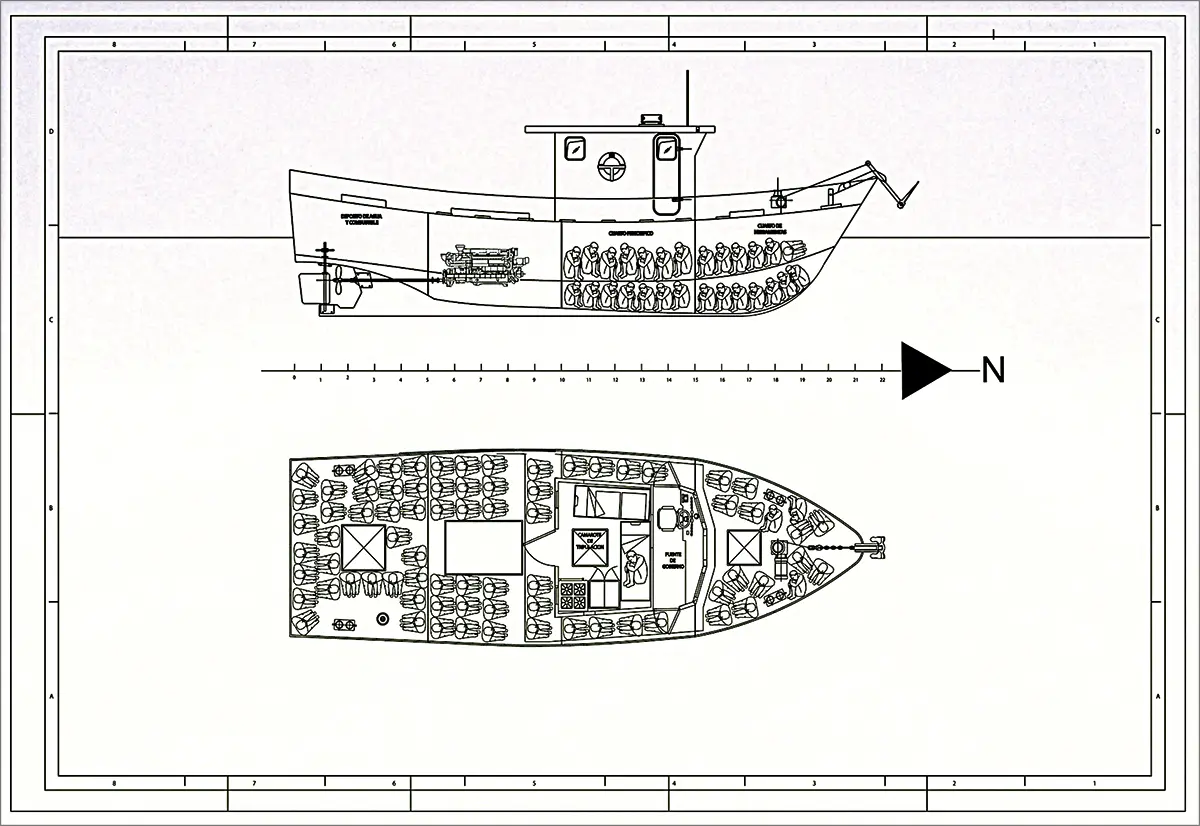
Subtly bringing this phenomenon into the aesthetic field is Antropométrica, an exhibition by Allan Jeffs (born 1973, Santiago de Chile). The show presents a densely marked group of blueprints executed with the cold, methodical calculation of industrial design, perhaps a trace of Jeffs’s experience in architecture school. In these blueprints, many pieces of the migration puzzle are transcribed in detail, especially those alluding to the means of transportation used in human smuggling, which incorporate the perverse efficiency implied in the relationship between passengers and available space.
Here, one notes illustrations of slave ships that, from around 1540 to 1850, were loaded with as many human beings as possible to maximize profit; an incisive trans-historical dialogue is thus established. But the design, the labeling, and the support of these drawings bring to mind the exquisite heliographies produced in the early 1980s by the Argentinean artist León Ferrari; the architectural gaudiness and the population densities and flows represented could be interpreted as a visual echo—with claustrophobic undertones—of the city of São Paulo, the megalopolis where Ferrari settled in exile during the military dictatorship. At a different level, a personal significance colors Jeffs’s work, given his own migratory status as a member of an exiled Chilean family that settled in Ecuador during the Pinochet dictatorship. This makes possible broader readings beyond the specifics of the local context and toward a vision that is continental in character.
Ferrari’s refined letter-based drawings did not refer, however, to a social situation as urgent as Jeffs’s. What was emphasized as anonymous masses in Ferrari gain a true face in Jeffs’s work, which is subjected to a process of de-identification, and is the element that makes this kind of artistic reconnection valid and pertinent.
As an interesting poetic counterpoint to the rational calculus involved in his blueprints, Jeffs included in the center of the gallery the projection of a video on an architect’s table: an imperturbable close-up of waves on the high sea.
Many Ecuadorian artists have produced a large number of works that have nonetheless failed to truly interrogate the migratory phenomenon or to move us toward a position capable of translating the intricacies of the issue, even given the Free Trade Agreement that currently gives abundant fodder to our op-ed pages and which veils the implicit cynicism of a formula by which goods circulate freely between countries but people do not. The majority of artistic works have been unable to transcend mere expressive representation, either nostalgic or anecdotal, which appeals to old and tired ways of aestheticizing society’s marginalized individuals and their contexts. There is an ethical dilemma in representing the Other as passive and in sentimentalizing poverty without making the gesture an effective act of consciousness; in other words, it is always questionable to exploit socially extreme conditions for the production of objects whose purpose is aesthetic enjoyment.
Jeffs’s work has the merit of disengaging itself from these approaches to representation, and in that sense it is outstanding. Despite the fact that its topic has been used and abused to excess, the Antropométrica series, although coming somewhat late, is relevant and visually solvent.
RODOLFO KRONFLE CHAMBERS