I met Carlos Amorales some years ago when he was living in Amsterdam. At the time, he had developed a reputation for his wrestling-themed performance-art spectacles that involved professional wrestlers as well as social fighters like Superbarrio, a Mexican pseudo-superhero who emerged as a spokesman of the civil society organized after the 1985 earthquakes. These days, Amorales lives in Mexico, his career is going full sail, and the diversification of his artistic activities has seen him create initiatives such as the Nuevos Ricos recording label, which promotes contemporary music groups with a sound mix that includes local sounds, regional cultures, and global beats.
In his latest exhibition, which originated in Madrid and is now displayed at the Museo Universitario de Ciencias y Artes of the Universidad Nacional Autónoma de México, Amorales demonstrates the daring that characterizes all of his actions and poses a question that is also the show’s title: ¿Por qué temer al futuro? (Why fear the future?). Following his habit of confronting reality through the power of the image, Amorales is one step ahead with a vision of the future that is bleaker today for those of us living without a charted path.
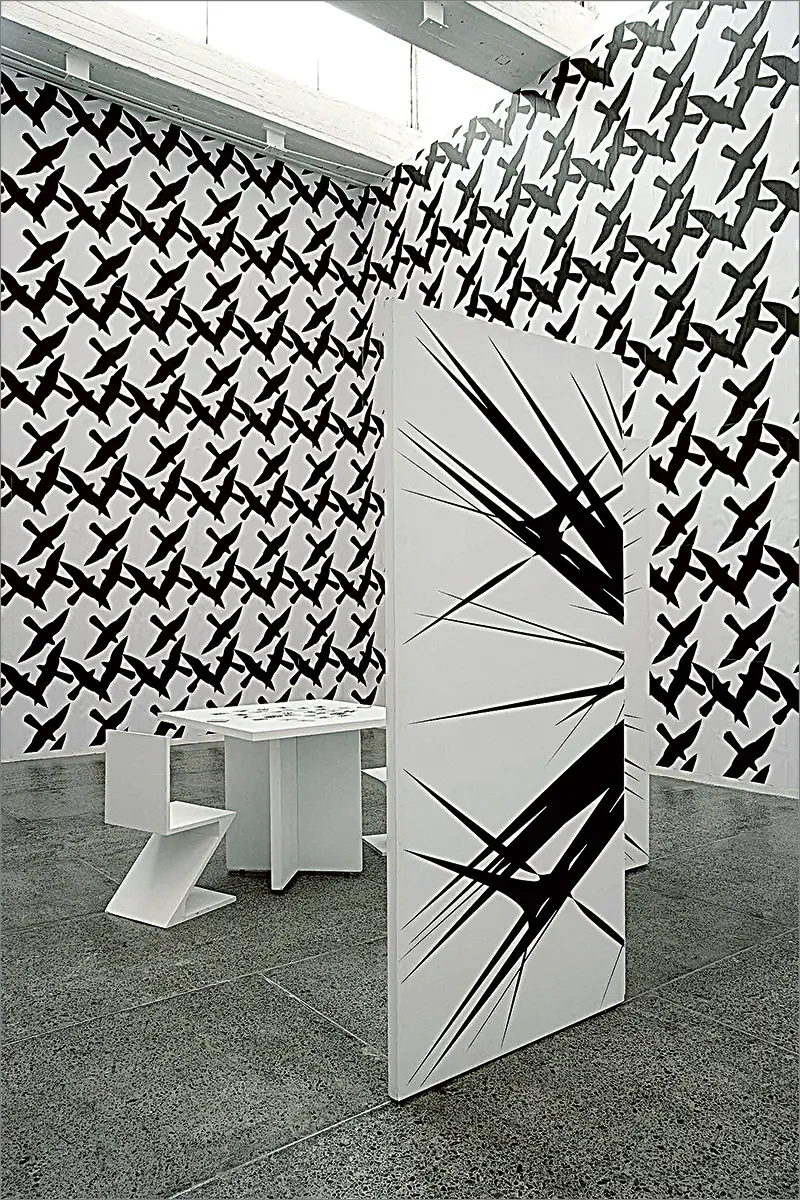
As a symbol of the times, the invitation to the show displays a new version of the peace dove printed on the black outline of the number “68”—the emblem for the 19th Olympiad, held in Mexico in the bloody year of 1968, a year of revolution and repression that marked a whole era and several generations. But in Amorales’s version, it is not a dove but a generic bird, a black shape of the type stuck on windows of tall buildings to prevent birds from crashing against them.
Carlos Amorales’s proposal is more closely linked to an interpretation of the present than it is to the future. Unlike the work he created for the Dutch Pavilion at the Venice Biennale in 2003, where he installed a sports-shoe factory (maquiladora) so that the European public was able to experience first-hand the conditions of such places, this exhibition reads more like an allegory of what we would all like to know: what are the feelings of a world emptied of utopias, devoid of leadership, and subjected to the vagaries of uncertainty? These questions are posed with particular emphasis by Mexicans, Venezuelans, Cubans, Bolivians, Chileans, and Brazilians, as well as the world in general.
The show opens with a foggy forest drawn on the gallery’s walls, over which fly white birds in metal mobiles like light gray spots against the horizon. Amorales’s work is characterized by the use of hues and outlines set against cold backgrounds. The viewer easily absorbs these simple forms, which bring to mind the earliest cave paintings and the most sophisticated notation systems such as urban signage. This reduction of representation to basic shapes, which has come from the cave to drawing and from drawing to photography and the first film prototypes, triggers the mind’s interpretative mechanism.
In the second gallery, hundreds of shapes cut from paper sheets are displayed on a group of tables. These are digital drawings that show the universe of symbols used by the artist like an alphabet to spell out the future. There are figures of wild animals such as wolves and hyenas along with human figures dancing, raising their arms, and leaning around in dresses or jackets, tussled hair, and faces covered by masks. There are also outlines of modern airplanes, complex spider webs, tree branches, anthropomorphic animals, and elements of cityscapes. At the end of the gallery, two tables display the entire alphabet drawn in symmetrical elongated lines with a graffiti-like, expressionistic style. The arrangement of the figures in each table has alphabetical order and each appears perfectly aligned and isolated from the rest, following a precise linear order.
This repository of archetypal images that emanate from every day and the anecdotal is used by three fortune tellers to read the future, to conjure ominous symbols, and to call propitiatory ones in front of an omniscient client registered in the video; the client speaks with poetic gravity about the futures that await him. For many, these divinatory practices are as valid as weather or financial-futures forecasting; human beings are obsessed with knowing and quantifying the future.
The skeptics doubt, the weary obsess, but all participate with curiosity in order to know what the future holds, even if it is only to confirm and disapprove.
For Amorales, the future is a game, a free association of ideas, and a revelation of symbols. As in his previous installations, he has outfitted a gallery with a table and two chairs for people to take the maze and test their reading capacity, not the tired reading of cartomancy but the reading of images. Although the criteria of popular methods of divination are ambiguous, a video in the next gallery demonstrates the process of the Rorschach tests used in clinical psychology to interpret personalities through individuals’ descriptions of a series of inkblots. Revealing personality, character, or temperament, the blots form faces, animals, and symbolic figures, products of the mind’s creative freedom and associative faculty.
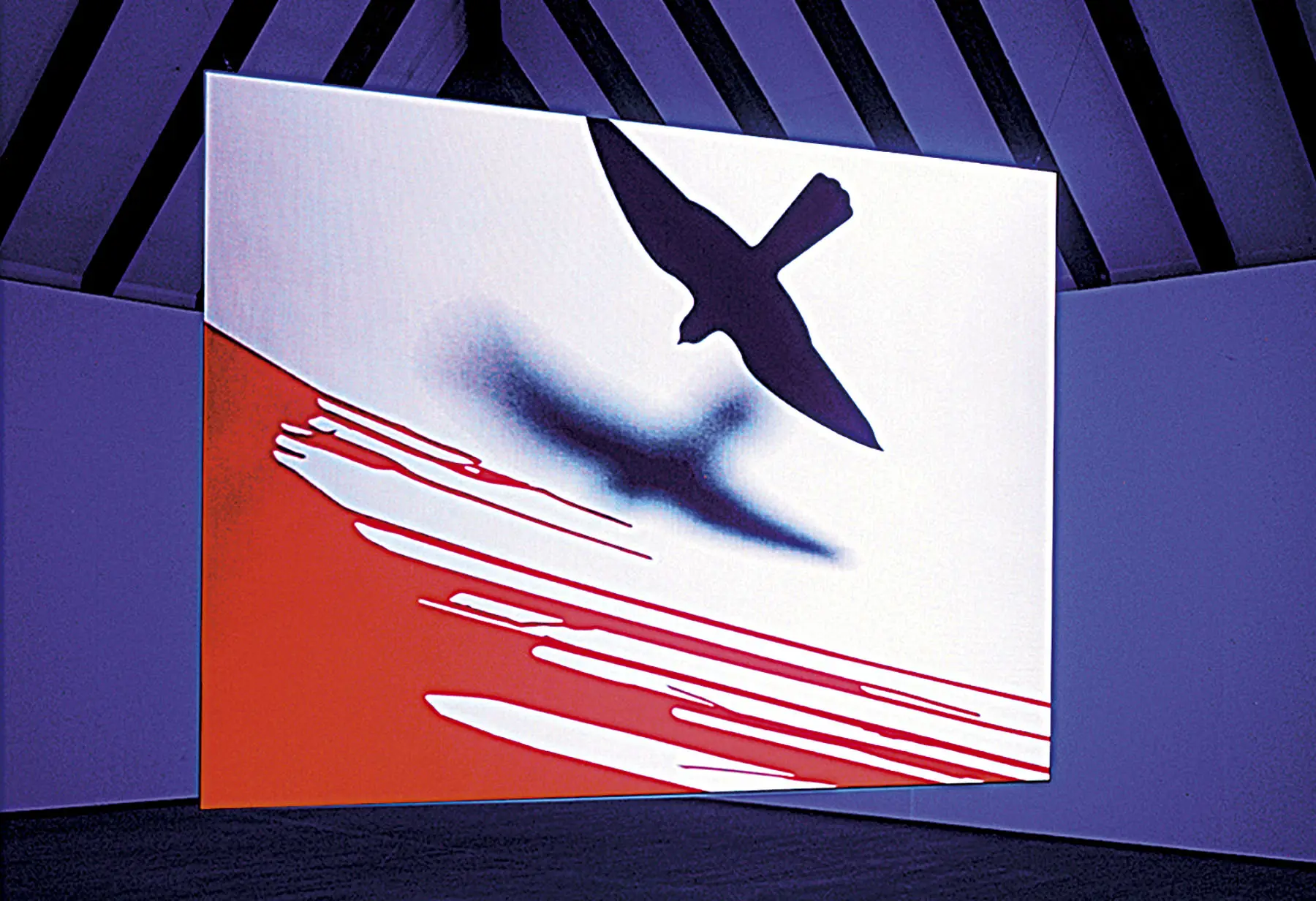
In the last gallery, interpretation takes a narrative form with a video sequence produced in collaboration with André Pahl. Here, the effect of the images is more poetic than symbolic; one after the other, we see sequences of airplanes landing amid trees, monkeys that swing against a horizon of dripping red blots, werewolves that raise their heads to the sky, or a blackbird exploding to pieces; all of this is accompanied by José Serralde’s hypnotic piano score. The video is a sum of all the elements encountered in the previous galleries, expressions of shadows and light that create the illusion of allegorical situations, where one can find a thread or an answer to personal concerns. Few can escape the evocative power of works of such simple formal beauty. Behind the screen, we see a pianist playing the music for this act of divination that is, as the title indicates, a black mirror on which each of us will project ourselves.
The game proposed by Amorales summarizes the will to believe and to be envisioned that derives from images, which is highly characteristic of non-European cultures, where politics, money, love, or long periods of misfortune are seen as fate. In the Americas of magical realism, humor, and resignation, the future is a product of chance, alien to any designs imposed by the globalizing hegemony that has installed the present as the only imaginable time. The work of Carlos Amorales demonstrates that this is absolutely relative and asks why one should fear the future.
JOSÉ MANUEL SPRINGER
Mexican writer and art critic.