
When Milan Kundera asserted, “the contradiction between weight and lightness is the most mysterious and equivocal of all contradictions,” he was placing Man in the position of a metaphysical weightlifter. Similarly, he displaced the oratory of the balancing act to the realm of History.
This inextricable contradiction of The Unbearable Lightness of Being reappears in Eduardo Ponjuán’s work first in the use of roofing paper as a primary material in 2003, with Limbo shown in Havana Gallery and Koan shown at the Museo del Ron, and reaching to that glimpse into the human mind that was Lo tengo en la punta de la lengua, seen at the Museo Nacional de Bellas Artes in 2004.
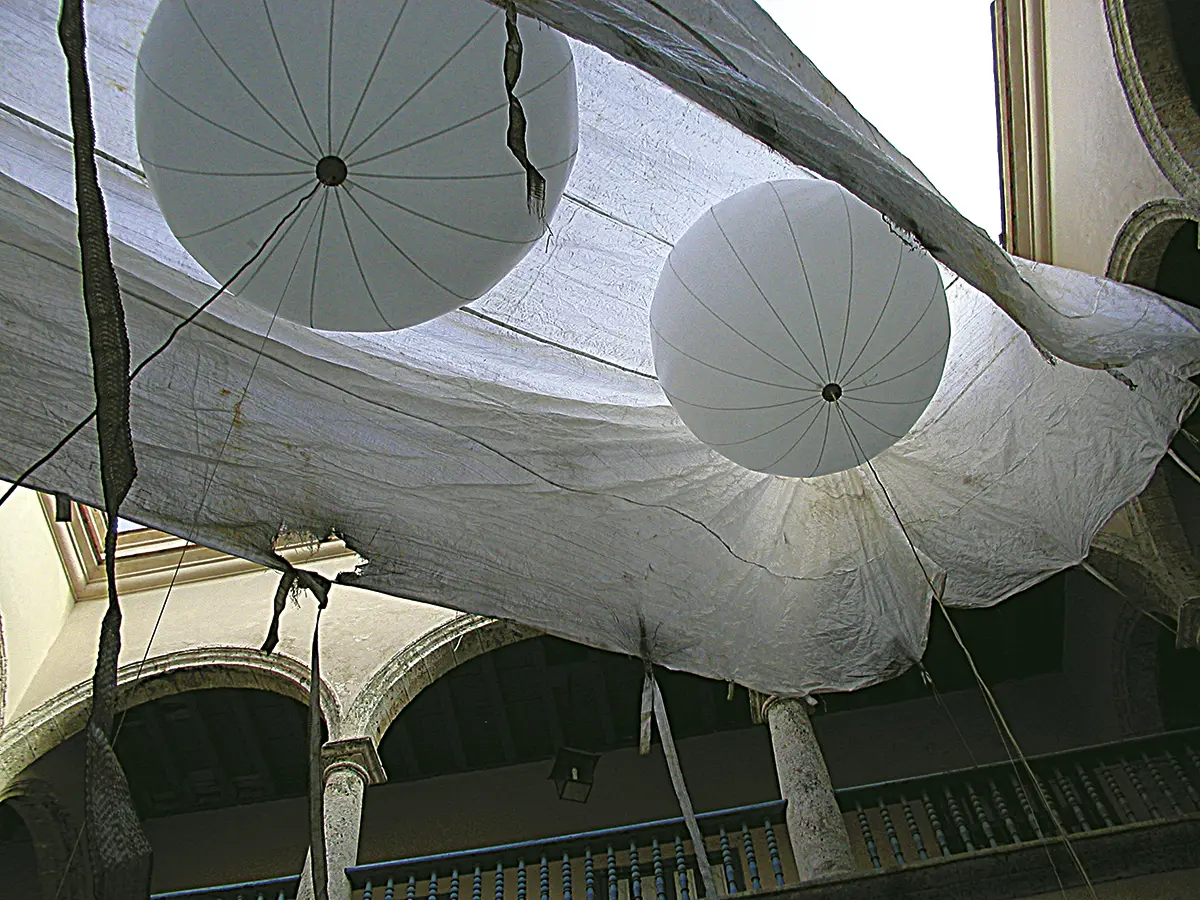
He has returned with Opera Rex, his recent solo exhibition at La Casona, from March 27 through April 2006. With this show, he entered the roster of Cuban artists invited to the 9th Havana Biennial. The show, based on two different installations, is directly related to the arrival of a large number of Yutong buses and twelve locomotives that the Cuban government bought from China. The contrast between the weight of the motor pool and the lightness of the covers used to protect it during the long trip suggested to Ponjuán the manipulation of these materials that contain a strong symbolic charge.
Acaso yo hablo en chino featured the synthetic cover of one of those locomotives. It displayed the traces of its journey to the island, including saltpeter, grease, and cuts. The interior of the gallery was taken over by this structure, similar to an enormous field tent, moving and suspended in the air. The silver color of this cover was prodigal in hues and shades, and it was inscribed with red Chinese and English text about the object it had been protecting.
The viewer lifted the edge of the cover to enter an asphyxiating, startling environment. The interior perspective shifted the light that entered through the gap between the work and the floor, resulting in oscillating movements in the dark. The center of attention was the reflection of a video projection that offered a virtual 360-degree view of the city that was filmed from the mirrored image in the drum of a periscope’s dark chamber. The projection could have been a machinist’s view from a train cabin or the viewer’s toward the external world. Distorted, misleading, and arranged on an irregular texture, it allowed one to intuit fragments of the city, buildings, people in the streets, and a ship at bay. The litany in the audio reinforced the feeling of movement in Acaso yo hablo en chino. Was it a locomotive? A watchtower?
High on the central patio at La Casona was Opera Rex, arranged diagonally from the building’s roof to the first-floor eaves. Formerly providing protection for a Yutong locomotive during the trip to Cuba, the white rectangular cover with its ropes, traces of oxidation, and grease was pure lightness. It was impossible to deny its visual impact, with the flip-flopping motion from the wind, the luminosity that concentrated throughout the day, and the ambiguity of three large PVC balloons floating inside, fed with helium from tanks placed on the ground. It was a flash, a utopia, an unfolding dream. It possessed a beauty that was difficult to explain and understand. It was impossible to determine whether the very white structure above one’s head was a mechanism to prevent the ascending balloons from escaping or whether the latter supported the density and rigor of the mass above them.
The public that was able to intermingle with these performing constructions—which were portraits, perhaps, of certain circumstances—probably perceived their slippery nature and meaning. Any assertion or negation will always be from the territory of doubt. However, the Opera Rex exhibition returns me to Kundera, given the artist’s references with the materials—their scale and their time—that he chooses. The heavier a material, the more fragile and diffuse are the zones to which his exercise moves: the recreation of Zen’s meditative insolubility, the enigmas where thought, memory, and their exceptionality are born in the mortar that is us. On the contrary, when he lightens matter for his operational stratagem, he makes possible the chronicle or narrative, like ballast for what occurs. The weightier the state to which he refers, the lighter the matter becomes. From inside, the printed words and the sound of Eduardo Ponjuán’s “architectures” mixed with words that were actually spoken; the noises in the streets took place in actual life, and the echoes of art were lost.
CARIDAD BLANCO DE LA CRUZ