Writers use figurative language to convey metaphors instead of the literal meaning of the words employed. Similarly, with his show titled No todo lo que vuela se come (Not everything that flies is eaten), Esterio Segura suggested an allegorical discourse, complemented by the titles of his works, in which he seemed to express that “not everything I say is what it really is about.” It was an invitation for the viewer to look closer at what was seen at first glance.
In Cuba, it is common to attribute to the Chinese—whether accurately or in error—the idea that anything that walks, slithers, flies, or swims can be eaten. By stating the opposite, Segura suggested: “Don’t swallow all of this” (i.e. don’t accept uncritically). In this exhibition, he revealed himself to be less eclectic than he is usually assumed to be and more in touch with the “international style” of a minimalist aesthetic, although an undercurrent of social, historical, and political commentary remained, albeit in a more veiled form. His peculiar way of handling humor was also missing.
The concepts within each sculpture, digital photograph, or installation were presented in a highly aesthetic way. Airplanes, birds, and winged objects dominated the show. Each of these elements symbolizes multiple meanings in reference to flight: a sense of freedom, of communication, of transgression, of going beyond the capacities of human beings. But most things have a positive and/or negative side, depending on the spectator’s point of view. Thus, wings and the flight they imply are permeated with good and bad connotations. To corroborate this, it suffices to check Jean Chevalier’s Dictionary of Symbols, compiled with Alain Gheerbrant.
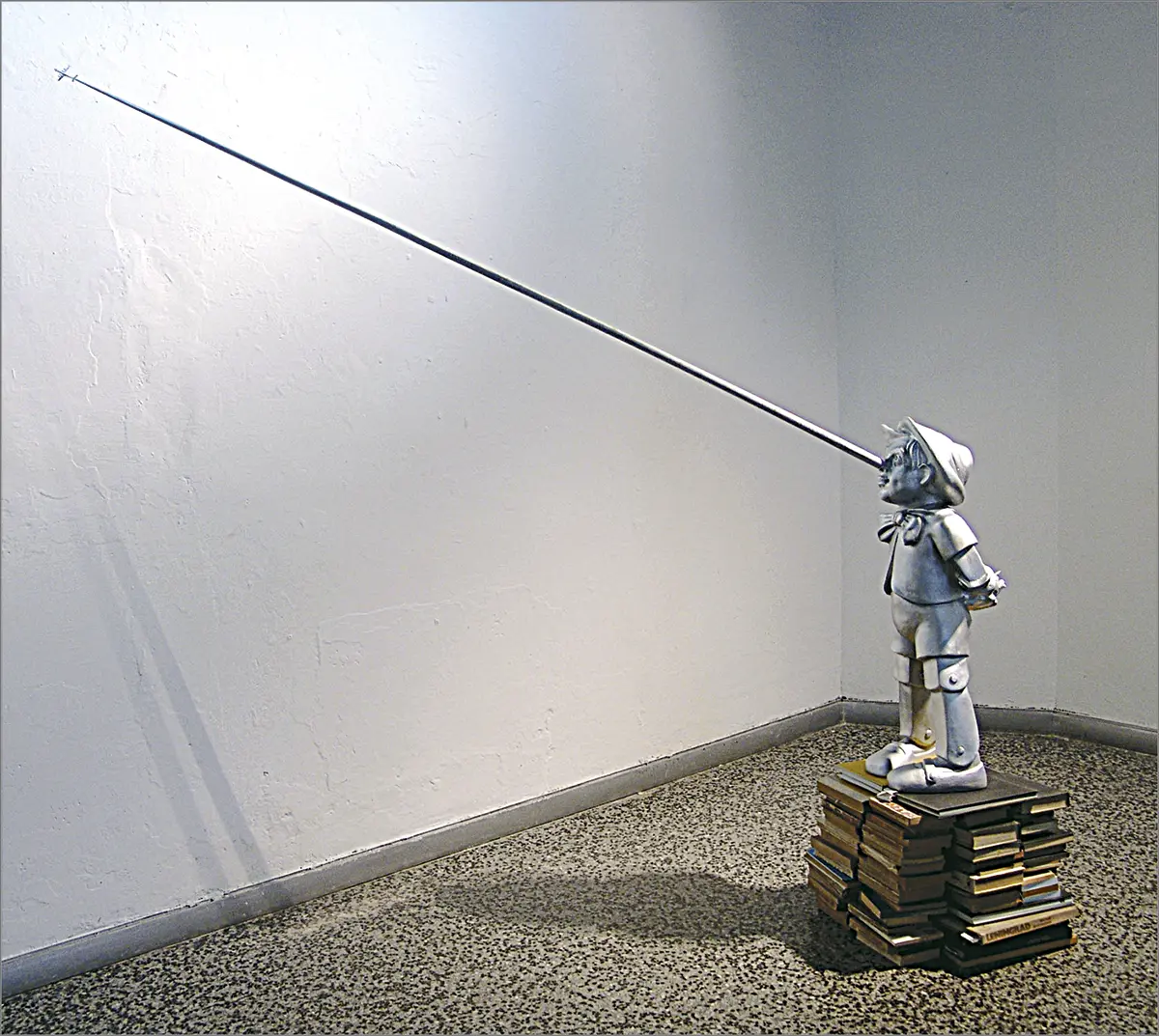
In Segura’s exhibition, the majority of the works were executed in various materials. In a work titled Papá… ¿de qué color es la sangre de los heroes?, a winged spear entered the wall as if it was a body, and blood dripped from it. All of it was silver, the show’s dominant color. Nearby, a cute Pinocchio balanced a small airplane on the tip of his long nose while hiding another one in his hands crossed behind his back. This work was titled Pinocho y Napoleón cuentan la historia. Almost directly across from it, a caiman—a recurring reference to Cuba—was also winged and asked: ¿Dónde se puede esconder el deseo si de la tierra se evapora el alma? (Where can desire be hidden if the soul evaporates from the earth?)
In the installation that gives the show its title, thirty-five medium-sized winged objects shared the stage. Híbrido de colibrí was the title of a patinated bronze bird, an imitation of an airplane, which seemed to be drinking from a flower. Segura photographed a similar image, which was tattooed on his wife’s pubis with the flower surrounding the navel, and exhibited it as El ombligo del mundo. In Conversación sobre aeronáutica con Ana Mendieta, Segura showed the metallic structure of an airplane in flames in the manner of the Mendieta’s silhouettes. This was part of a performance in which the airplane rested on a kind of trench and, like a flight attendant, Segura fed his colleagues from a barbeque. According to him, Cuban artists live “entrenched” in airplanes. While earlier they sought to emigrate, now they travel. They sell their works abroad, enjoy fellowships and residencies, and acquire a name in international events. In Cuba, nobody has enough money to purchase art. In another digital photograph, Segura showed a wing composed of paper airplanes made by some neighborhood kids. It was a highly plastic image, laconically titled Vuelo blanco sobre fondo negro.
According to the dictionary mentioned earlier, dreams of flying often end in nightmares of falling; they are symbolic expressions of real failures. The dictionary states: “It is interesting to observe […] that space flights, interplanetary projects […] can obscure the inability of great nations to address human problems of social and economic development. Unwilling or unable to use their immense resources […] to the benefit of Man, they fly above the Earth. Entire collective psychology is revealed here, one where the will to assert power in the skies compensates for feelings of impotence on Earth. There is something infantile in such scientific gigantism, a testament to this society’s poor adaptation to the solution of its own problems. It is as if it were incapable of accepting itself in order to manage its own destiny first. It relaunches the myth of Icarus and flees from itself, thinking it soars in the sky.” Esterio Segura represented this power as a screaming, winged hippopotamus.
ERENA HERNÁNDEZ