
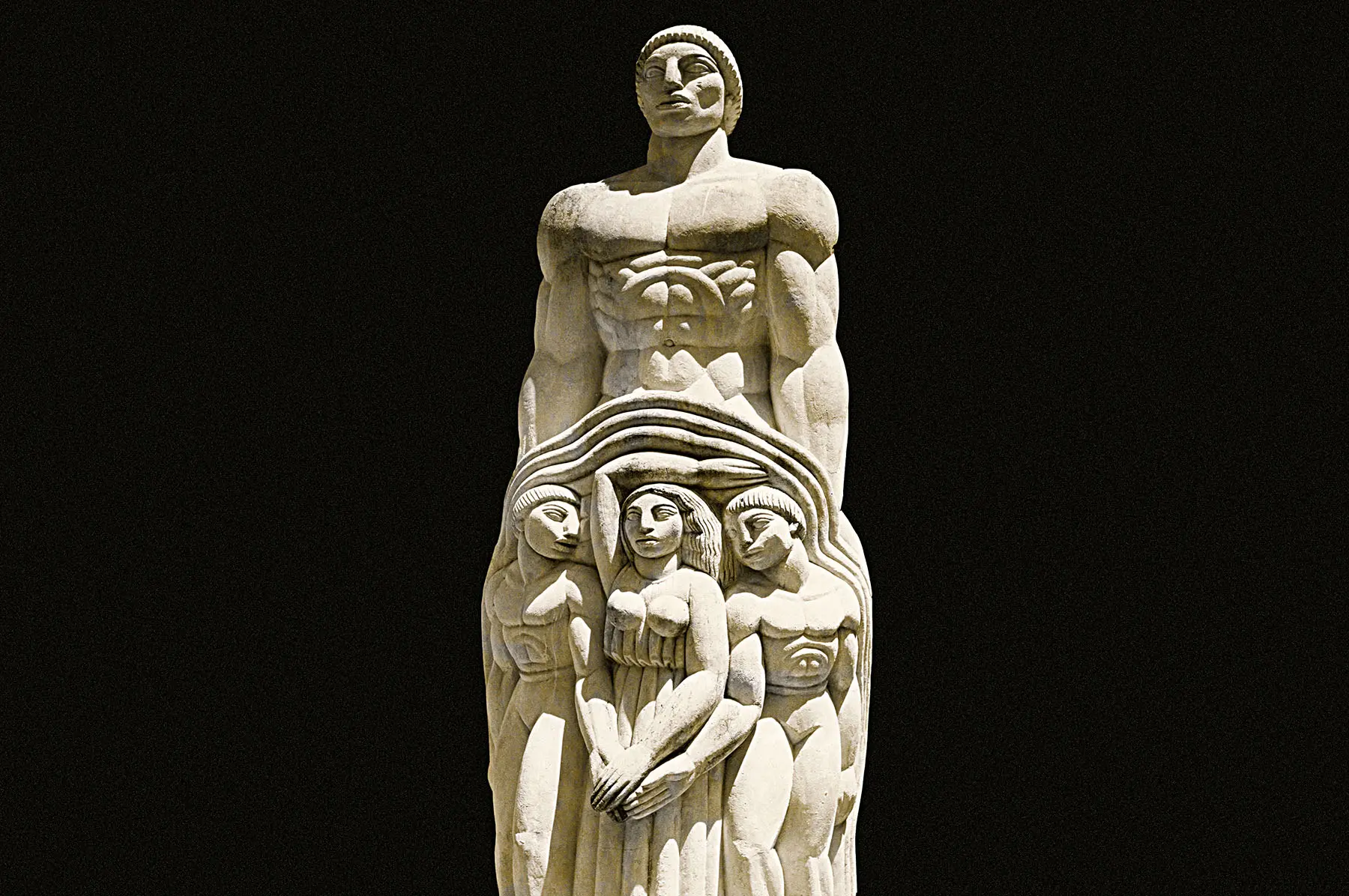
If it weren’t an incontrovertible truth, saying that Francisco Narváez is Venezuela’s most important sculptor would be a cliché. The transcendence of his work, which has been proclaimed by all critics, is based both on its embodiment of an unprecedented modern aesthetic in the Venezuelan art scene of his time and on its spirit of renewal, which flowers from a constant and powerful artistic imagination.
Without close precedents, Narváez’s early work introduced modern Venezuelan sculpture and a more properly national sculpture. Later, he conquered practically all the foundations of modern sculpture; he did everything to be expected in a modern sculpture and more, reaching the very limits of the genre. His work in bronze even intimated an approach to the conceptual implications of sculpture.
Narváez’s career traces a path that encompasses the issues of modernity—promoting it, actualizing it, and perhaps anticipating its exhaustion—which makes him the most influential artist in the development of Venezuela’s artistic culture in the twentieth century.
Narváez Before Narváez
Francisco Narváez was born in 1905 in Porlamar, the capital of the state of Nueva Esparta in the western part of Venezuela. He was the son of a renowned cabinetmaker, and he was able to practice woodcarving since childhood.
In 1922, he was sent to Caracas to study at the Academia de Bellas Artes, where the teaching of sculpture was circumscribed by the dictates of the European academic tradition. The dominant technique was wax or clay modeling of naturalistic figures, ideally destined for a bronze foundry but usually resulting in plaster. The subjects were portraits, naturalistic narrative sculptures, or essays for monumental projects to fulfill the official desire for grandiloquent statuary. Venezuelan sculpture during this time demanded a renewal that would remove the pomposity and make it more accessible, fresher, and more its own character.1
In 1928, Narváez traveled to Paris. There, he studied at the Julien Academy, visited museums, and developed an interest in ancient sculpture. He also studied modern movements, especially the work of Rodin, Maillol, and Bourdelle. It was then that he created what was Venezuela’s first modern sculpture, La Pescadora (1929). The gulf that separates this work, with its synthetic, almost archaic features, and all of the country’s sculpture prior to it is immense. In this work, not only did narrative cede the stage to a new code but also forms, techniques, and materials were renewed. In La Pescadora and other works of the same period, one already glimpses the stylistic features that were to characterize Narváez’s entire production: an ambition to synthesize, a rotundity of volume, hieratic, sensuality, material pleasure, a taste for symmetry, and a love of carving. Equally, they reveal an interest in vernacular themes, which developed further after his return to Venezuela in 1931.
The Creole period (criollista)
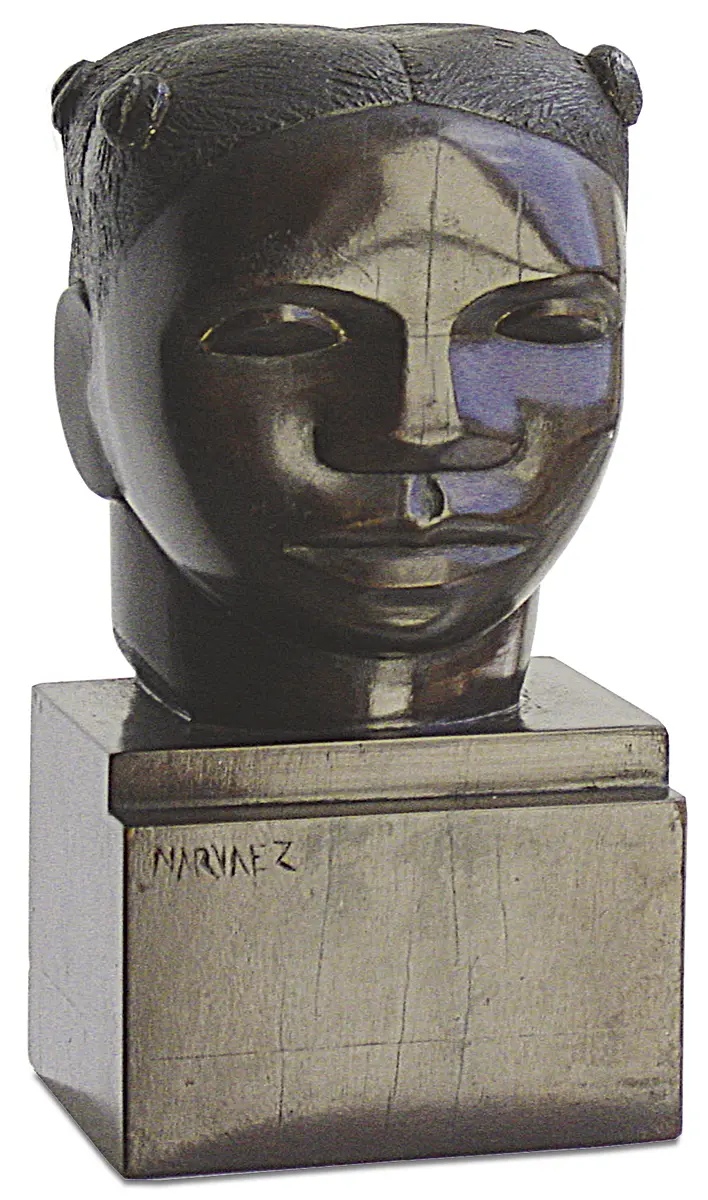
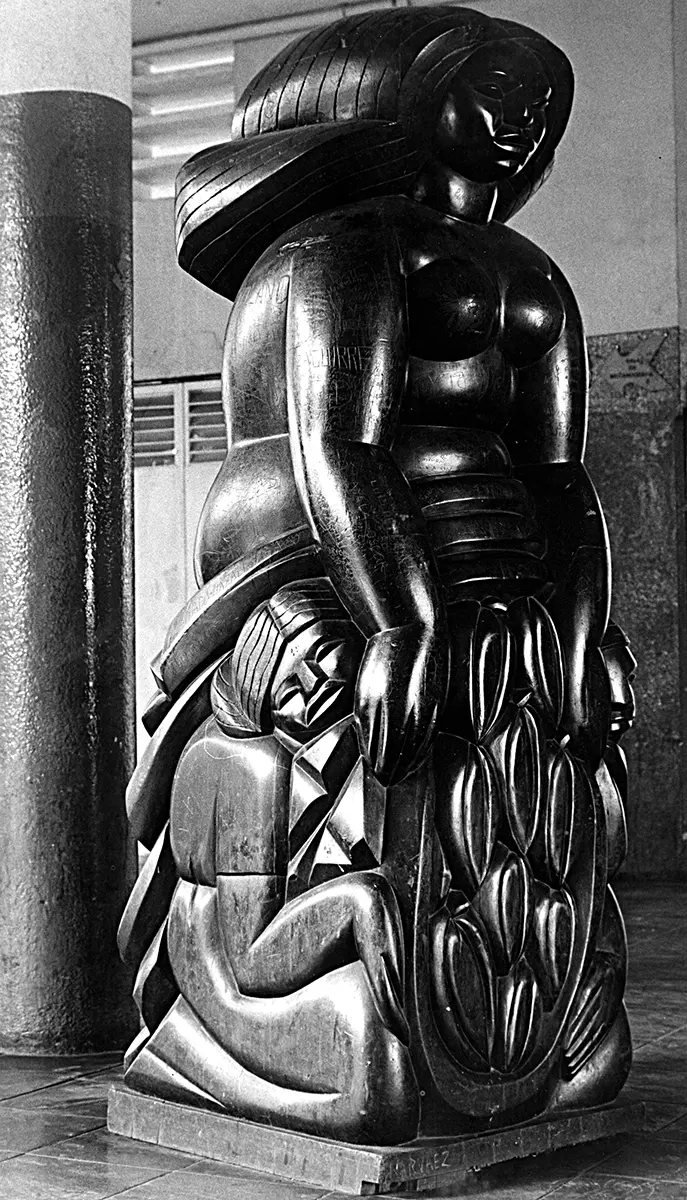
The period that critics call criollista is related to the creation of an autochthonous typology and runs through the mid-1940s. However, what prevails in these works is not an interest in portraiture or local commentary. They represent people with black or indigenous features, as well as the work implements of the lower classes in small-town Venezuela, and become pretexts for volumes of stylized elegance, signaling a break with the narrative character of previous sculpture in favor of expressive form and matter.
Here, Narváez displays his technical mastery as a carver. He uses minimal resources, saving details to achieve a notable synthesis in forms that represent their essential features. The Creole women, blacks, and Indian women that populate these works are men and women engaged in their daily routine, but they are also compact masses, concatenations of curves and volumes, and smoothly shifting light reflected on polished surfaces.
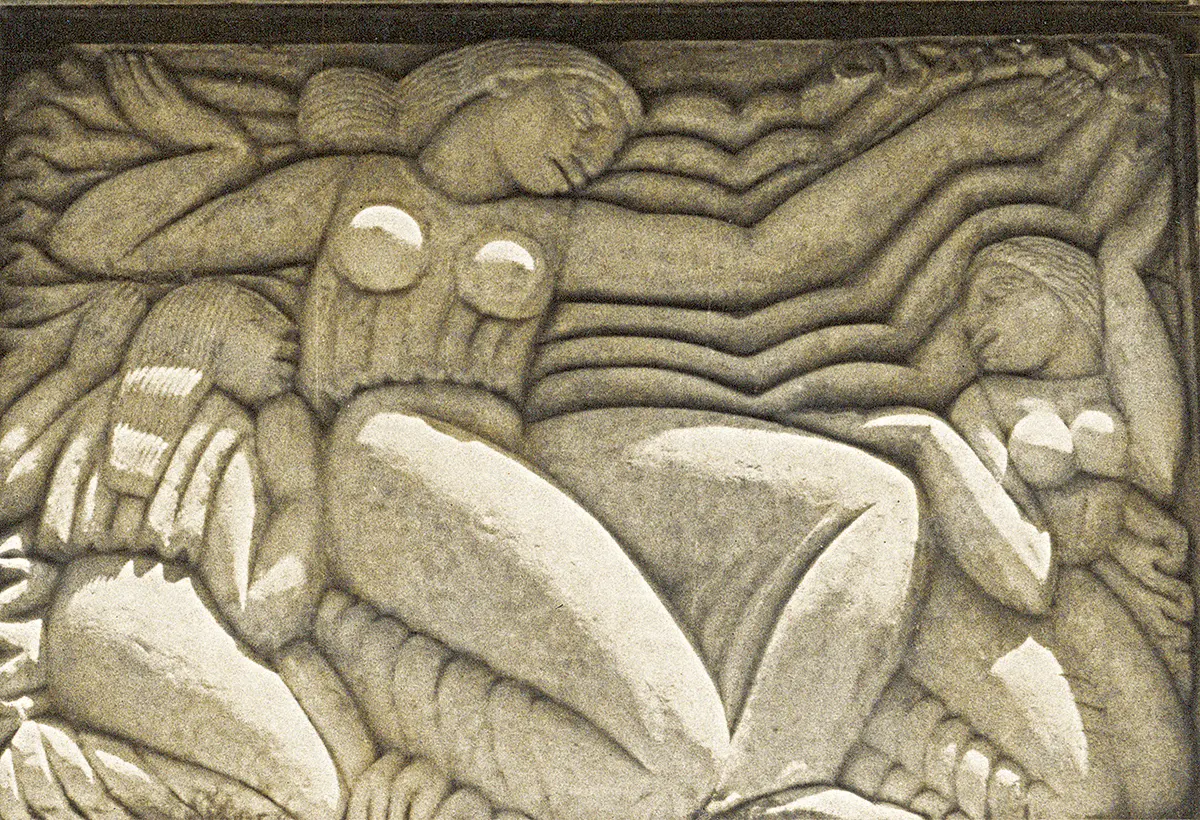
A recurring theme in this period is water, which the artist worked both in freestanding sculptures and in urban projects. In this period, Narváez received important commissions for public works in the city. The first one, the Fuente de Parque Carabobo (1934), reflects a novel urban concept and a new treatment of an indigenous theme, expressed in a synthetic and modern way with sinuous and repetitive lines that contrast with the bodies’ ample, solid shapes. At the same time, Narváez moves away from the commemorative by introducing play and vitality in consonance with the fountain’s movements.
In 1936, after the death of the dictator Juan Vicente Gómez, Venezuela was starting to awake from a long cultural slumber. Architectural and urban plans were inaugurated with the goal of transforming Caracas, and Narváez played an active part. He was invited to participate in numerous projects that materialized in civic sculptures that have been part of the life of the city ever since: façades for the Museo de Bellas Artes, the Museo de Ciencias, and the Colegio de Ingenieros, the relief La Educación for the Francisco Pimentel school, and others. In 1943, commissioned by Carlos Raúl Villanueva, Narváez created the fountain Las Toninas, one of his most famous public works, located in the El Silencio development in the heart of Caracas. This was, undoubtedly, a time of splendor for Venezuelan sculpture.
“New Forms”
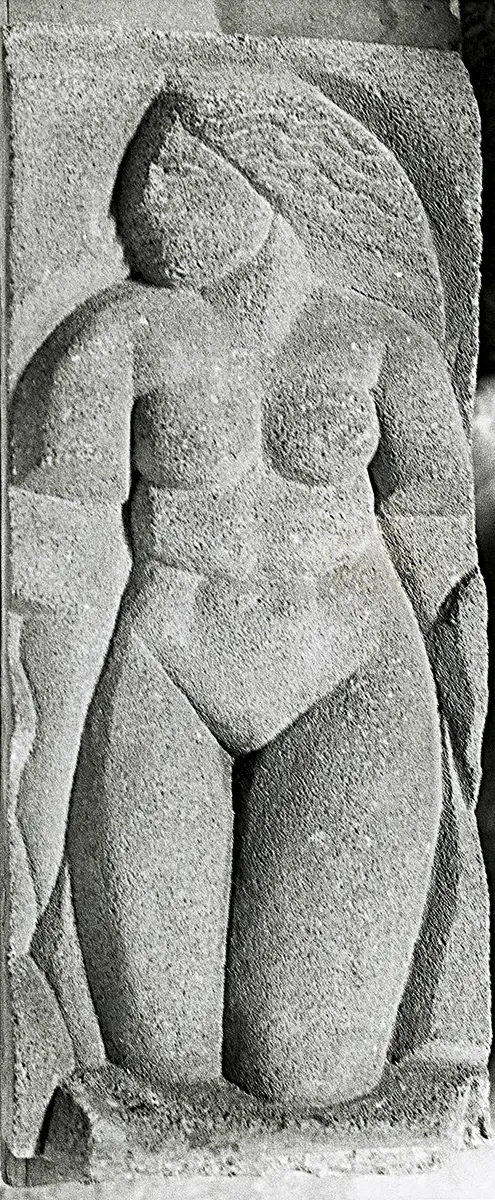
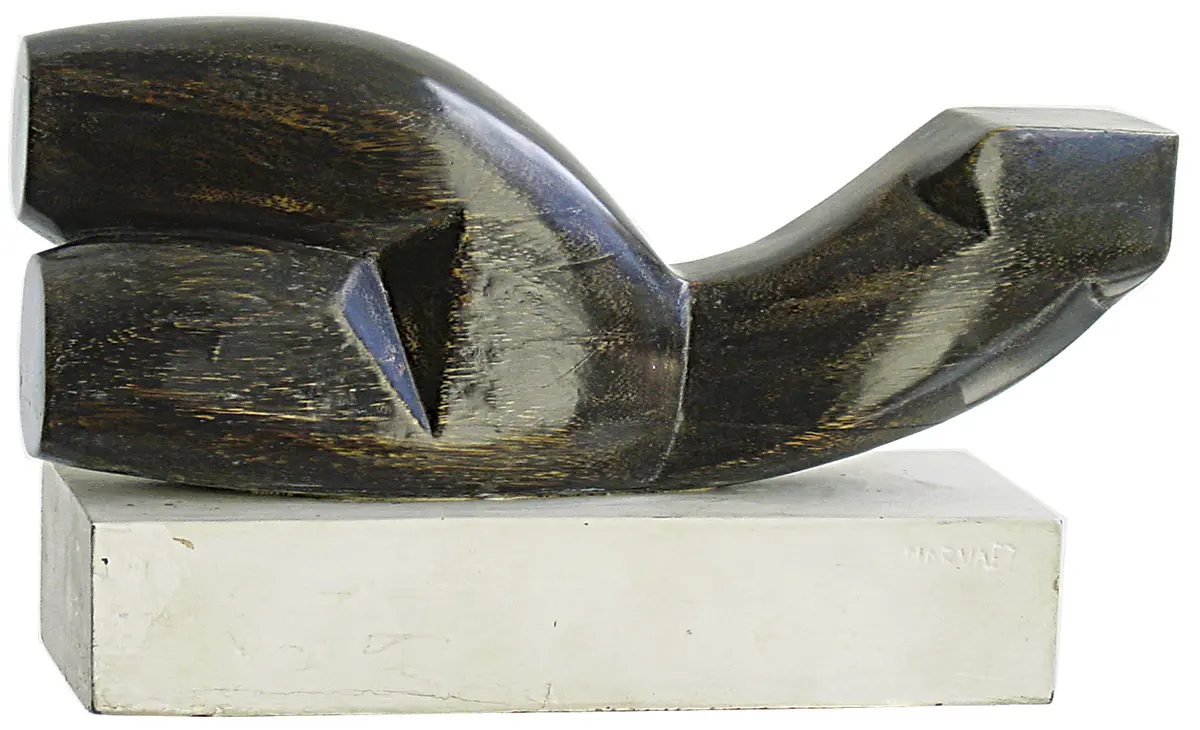
In the late 1940s, the ambition to synthesize that characterized Narváez’s spirit led him to seek the essence of the human form through formal works rooted in modern sculpture. In this period, the sculptor allowed himself to flirt with organic abstraction without completely doing away with references to the figure. This was a period of extreme formal and conceptual delicacy and of passionate attention to the material. Narváez worked with autochthonous wood and stones. Although one might think that such an interest in matter would be translated into its untouched, original presentation, nothing is farther from the period’s refinement, when the artist let his materials speak via exquisite technical solutions. Working in wood, Narváez emphasized polished surfaces to clearly reveal the veins and also to let light describe the volume as it slid around the curves. With Cumarebo stone, a material that rejects polishing, his handling of surfaces leads one to value the rock’s fine porosity in relation to the suppleness of the volume, which resembles a soft, absorbent, and pliable body.
During this period, Narváez’s perseverance in the technical carving and his formal anchoring on the human body were taken to their extremes, both by accentuating carving as the construction of volume by extraction and by the use of the torso as a recurring yet elusive motif. This synthetic impulse opened the door to his next period.
“Abstract Forms”
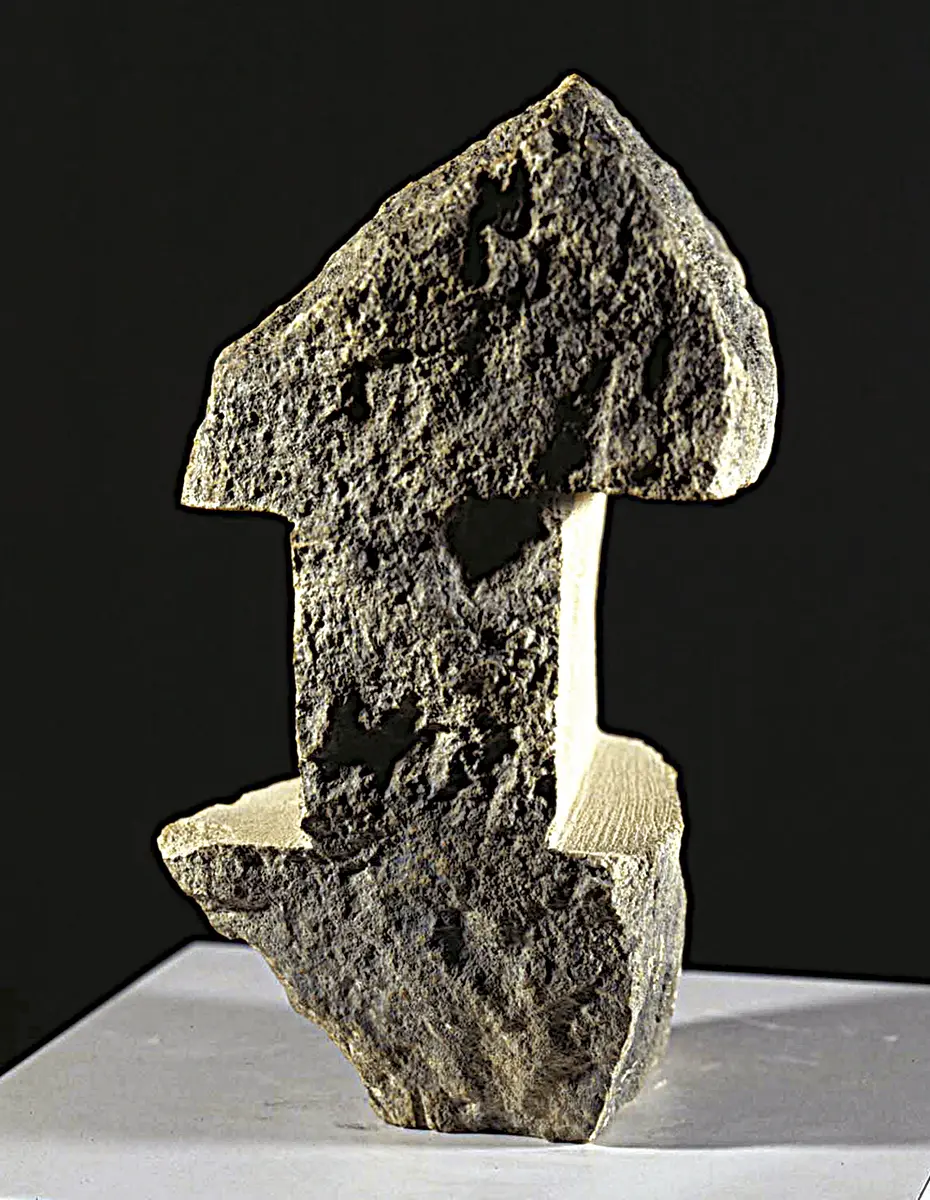
Narváez was Venezuela’s first abstract sculptor. His intense trajectory in sculpture as direct carving and his deep knowledge of materials and form led him to the conviction that these elements possess an eloquence all their own. He reached his abstract period in 1970, the culminating point of his oeuvre because it returns to sculpture’s very origins. It comprises works devoid of accessories, broadly geometric, and constructed of superimposed blocks where the form is extremely simplified. In their absolute simplicity, these works seem to have been created under the desire, expressed by Narváez, to make his sculpture be just “rock upon rock.”
In these works, matter plays a special role as an expressive, pure element. Indeed, the titles of Narváez’s works of this period refer to the materials of which they are made. Samán negro, Caoba, or Piedra de Cumarebo direct one’s attention to the quiet expressiveness of the pieces of wood or rock of which they are composed.
The Concept
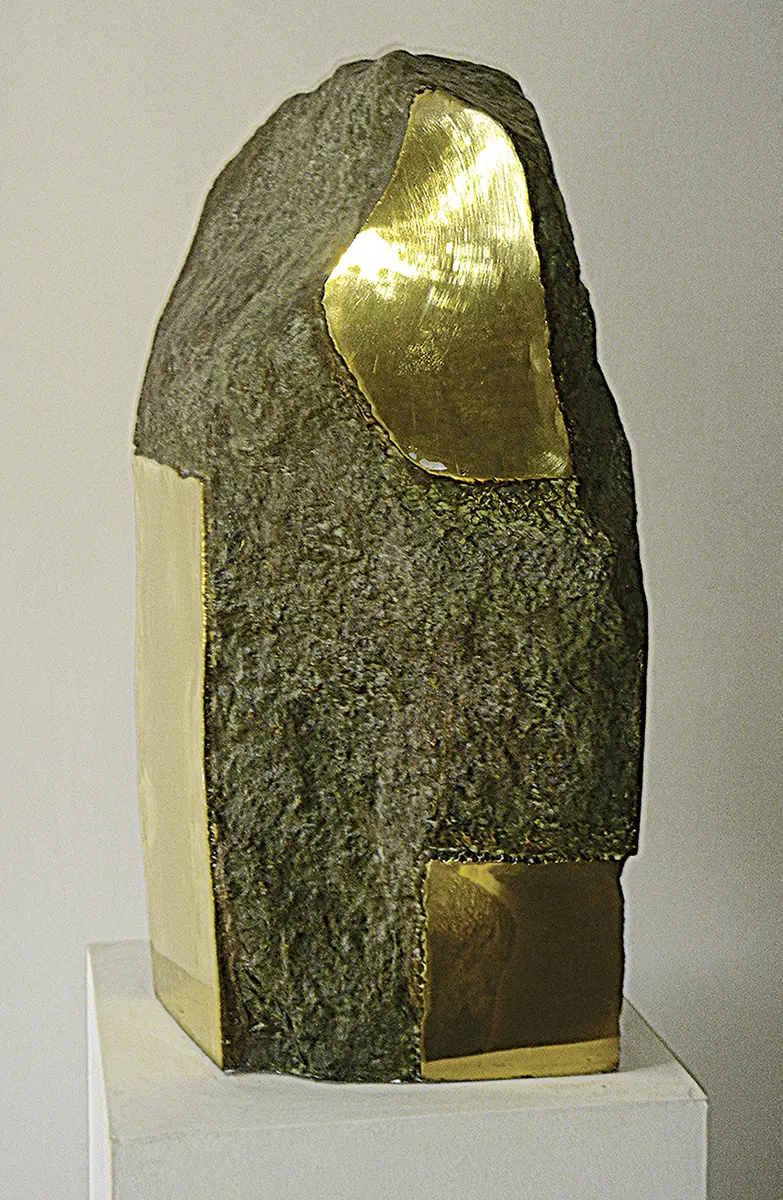
Many critics have dismissed Narváez’s late-period bronze molds modeled on his abstract works, deeming their concessions to the marketplace or a creative misstep. One could ask whether an entire life lived in the rigor of excellence and fealty to art would have allowed that kind of license. Was Narváez betraying himself toward the end of his life? It is a highly improbable hypothesis.
In her article “Francisco Narváez: Bronzes to reproduce stone on stone,” María Elena Ramos sketches a thesis that points toward a better understanding of this moment in Narváez’s career and a deeper understanding of his work as a whole.2 Ramos points out, “Narváez remained until the end a lover of strong matter. But the concept and relativity found a way in nonetheless. And they found it, fundamentally, in that relay of languages, in that interplay of ‘nature that is’ and ‘nature that seems.’ And also in that passage from mastery over unique matter, confronted with which the artist is artisan, to the giving away to an ‘other’—the smelter—of his unique matter for a product in which the artist is no longer artisan, but designer, conceptualizer, inventor... Without understanding these moves through conceptual torsion... it becomes difficult to accept enthusiastically his late work."3
For Ramos, the key to perceiving this period resides in understanding the act of reproduction from a conceptual perspective. Engaging in the creation of those bronzes, Narváez seemed to have begun to explore the potential of sculpture as artifice and with that, the material’s replicating abilities and the characteristics of bronze smelting as an indirect technique.
This distancing from carving also implied a distancing from the modern attachment to form and material, which led Narváez to peer intuitively into the conceptual strategies of the postmodern discourse. Narváez moved away from sculpture as an artistic act in order to perceive it as a language capable of speaking about itself and commenting on its own strategies of concretization.
After Narváez
Taking a humble but lucid look at his significance in Venezuelan culture, Narváez found his greatest achievements in the realm of teaching, which he practiced for decades. His teaching was certainly a cornerstone for the modernizing aspirations of an entire generation of artists, whom he educated not only in the theoretical and practical bases of modernity but also in the ethics of a true artist.4
Also, Narváez’s example permitted the updating of woodcarving, a technique that had remained practically abandoned since colonial times; in that sense, he made it possible for carving to become one of Venezuela’s great sculpture traditions, alongside iron welding.
But his broad, all-encompassing influence transcends the borders of his pedagogy, extending to the most diverse areas of national life. If one believes that art educates through form, Narváez’s contribution through his civic works, located mostly in hubs of transit, museums, and schools, is undeniable.
As we commemorate the 100th anniversary of Narváez’s birth, the need to study this extraordinary artist’s relatively unexplored work is evident. There is also a need to find in the genius and depth of his legacy the simple certainties he once expressed: “I do not work on figures, but volumes in space, which is what, in reality, sculpture is.”
NOTES
1. In 1977, Narváez said: «In the years when I began to work in sculpture and painting, there was in Venezuela, yes, a plastic activity, but it was still in its formative stages... In sculpture, it was the opposite. There were good sculptors, but not forward-looking ones, dominated by a fin-de-siècle academicism based in Paris and in its official salons, with the conventional and conformist consequences that are to be expected.» From Rafael Pineda, La escultura hasta Narváez (Caracas: Ernesto Armitano Editor, 1980) 267.
2. Galería Ateneo de Caracas, Narváez: El gran escultor latinoamericano regresa al Ateneo de Caracas (Caracas: Galería Ateneo de Caracas, 2000). Catalogue of an exhibition held May-June, 2000.
3. Ibid., p. 54.
4. Also, Narváez’s example permitted the updating of woodcarving, a technique that had remained practically abandoned since colonial times; in that sense, he made it possible for carving to become one of Venezuela’s great sculpture traditions, alongside iron welding.
KATHERINE CHACÓN
Venezuelan art professional, critic, and researcher.