Frogs, snakes, crickets, monkeys, bats, and other animals rule in the fantastic mythology created by Francisco Toledo (born 1940, Juchitán, Oaxaca), who is considered the best-recognized living Mexican artist. Such fame has to do with his unique style, characterized by a recapturing of indigenous traditions and filling them with metaphors, dreams, and eroticism, sometimes with irony, humor, and irreverence, but always with magic and mastery.
Besides his artistic work, what has also brought great acclaim for Toledo is his activity as a cultural promoter and founder of several cultural centers in his native state, such as the Museo de Arte Contemporáneo de Oaxaca, the Instituto de Artes Gráficas de Oaxaca, and now the Centro de Artes in San Agustín Etla, a small village founded in the sixteenth century a few kilometers outside the city of Oaxaca.
This art center is unique in Latin America, bringing together art, ecology, and community development. It hosts Taller del Alacrán, the point of origin of Toledo’s forty recent pieces exhibited at the Finance Ministry’s Museo del Antiguo Palacio del Arzobispado, in Mexico City. It should be noted that the artist hasn’t shown this type of work in twenty years and that these were created specifically for the current show, as part of the 12th Festival de México in the city’s historic downtown.
Francisco Toledo has demonstrated his skill in different media such as printmaking, quilting, and mainly painting, alongside his long-standing work in ceramics, but in recent years his creative interest has centered around the latter medium that is usually more closely associated with handcrafts than with sculpture. Mexico possesses a long tradition in pottery, dating from pre-Columbian times, and throughout the centuries pottery pieces have had ceremonial, utilitarian, or decorative uses.
In recent years, renowned sculptors such as Javier Marín and Paloma Torres have used clay from Zacatecas or Oaxaca as the raw material for their sculptures, far from any association with artisanal handcrafts. They have achieved outstanding results, with their colors, textures, and sense of dynamism becoming fertile soil for experimentation and for the implementation of more materials and kiln techniques to achieve expressive effects.
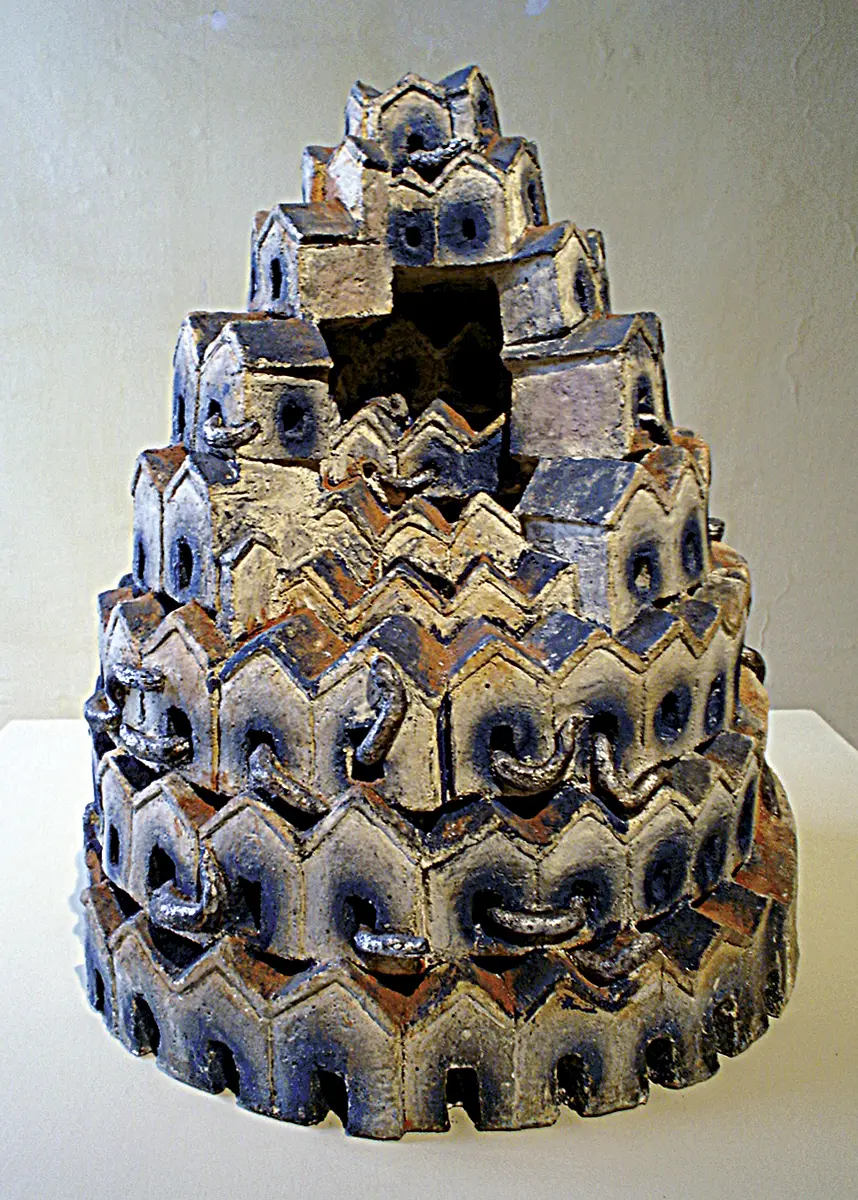
Within this reassessment of ceramics as an expressive medium, Toledo is able to give the works that compose this show a highly plastic character, through textures, curled and twisted compositions, and the various shades acquired by the material as it is modeled and baked. It is these textures and shapes that awaken in the viewer a “tactile gaze” with which one travels the projections, smooth surfaces, and rugged areas presented in each work.
Pottery requires great skill, since it is characterized by chance. If materials are not composed well or the firing temperature is wrong, the results won’t be positive. There is always an element of surprise as pieces come out of the kiln; most of the time, one doesn’t know for sure what colors the enamels or other surfaces will be, and ceramists must possess a certain intuition and great control over their materials. The resulting works have a unique character, bringing together technique and theme into a set of dearly held symbols and meanings that are close to tradition but also current and expressive.
Toledo is able to obtain ideal shapes and textures. His works are outstanding not only for their visual appeal as one sees and discovers them but also as a group of characters and elements that might form a single narrative or exist separately as myth- and mystery-filled stories. We see frogs grinding beans and other indecipherable ingredients; an ark; the bell of Dolores, the symbol of Mexican independence; some alligators; bats in large plates; and even a cooking pot inside which there is a deer witnessing, in horror, his own transformation into soup.
These mythical characters, which are Toledo’s usual fauna, give birth to a new fantasy-filled reality, since one recognizes everyday elements such as pots, plates, small houses, and stone mills. These elements give shape to an imaginary world where the viewer is surrounded by visions and evocations of the Juchitán of Toledo’s memory, one pregnant with the ancestral Zapotec legacy that arouses great interest and fascination.
Now, with the opening of his workshop and his interest in teaching and experimenting with various traditional media, these ceramic works will be part of the beings and environments that compose the vast universe of Francisco Toledo’s art.
ISAURA RUIZ