
This has been a very important year for Glexis Novoa. He was one of the recipients of the prestigious Cintas fellowship, and his work has been exhibited simultaneously in two important museums: at the Miami Art Museum (MAM) as part of the Miami in Transition show, and at the Lowe Museum, where Glexis Novoa, Visionary Artist was mounted.
The Lowe Museum show consisted of fifteen works selected from 1994 to the present. It also summarized the media explored by the artist during that time, from paper and canvas to marble. One of the works was created specifically for the show; it was titled Too Late, probably in reference to the time he had to finish it, and it was a site-specific project, drawn directly onto the museum’s walls. This kind of site-specific work has become a sort of personal trademark for Novoa; his shows of recent years have generally included at least one site-specific project.
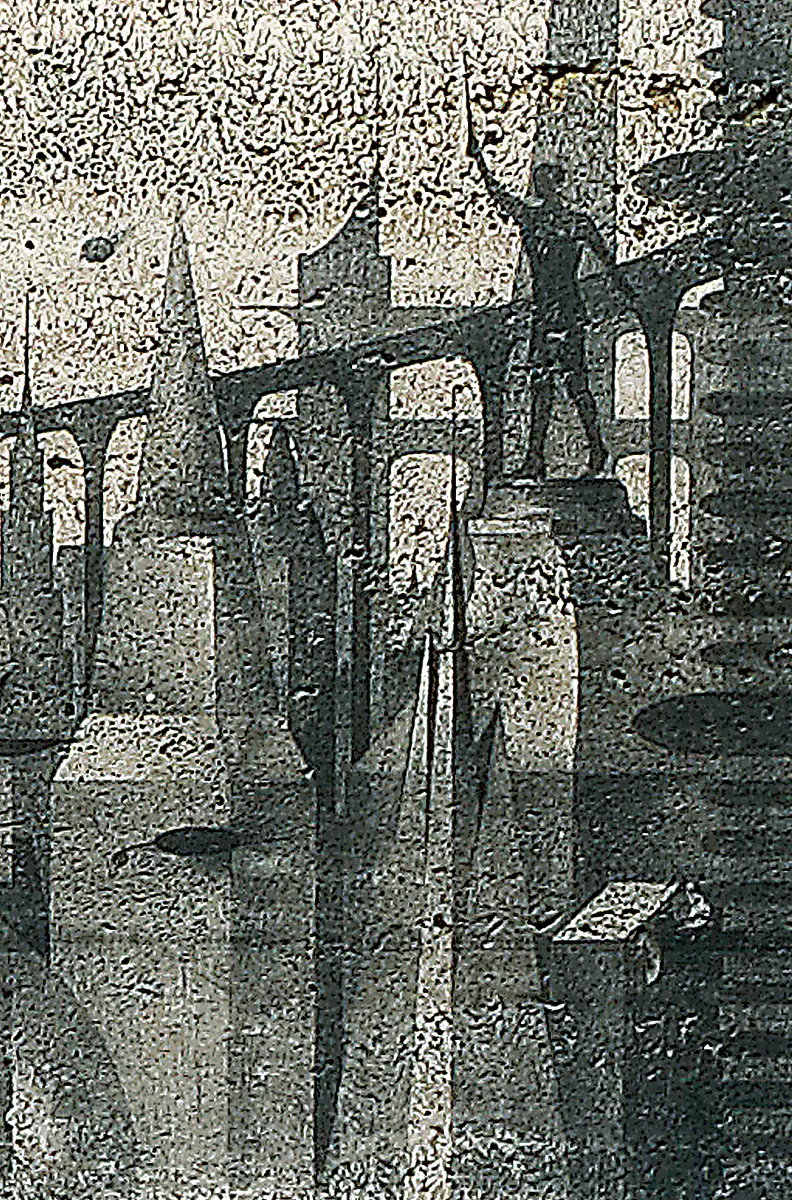
In his early works, Novoa took the issue of power as his central topic, and he referenced the paraphernalia that constitutes and institutionalizes power. His concern for this issue is still present, but the referent has changed; he is now more interested in architecture as a vehicle of power. Certain buildings and monuments from various cities become icons that identify them. It is precisely these icons that Novoa has captured and incorporated into his images, commenting on how they are, have been, or at a given moment become expressive of power.
The works in this exhibition were focused on architecture and its function in the definition of a city as an inhabitable space and as a concept of human creation. One of the earliest pieces was La Habana Hoy from 1998, a kind of futuristic vista of the city that highlights the Maine monument, the Morro, La Giraldilla, and Havana’s iconic colonial arches as indicative elements.
Other works recreated vistas of Miami on the basis of photographs taken or appropriated by the artist. These photographs were painstakingly drawn on marble or canvas and later other elements were carefully added or taken away. Other artists have created images of idealized cities, and the majority coincides in the representation of empty, perfect, cold, uninhabited spaces; a view from a distant point. It is a kind of stage, or perhaps a proposition of the ideal city, a futuristic view that is part apocalyptic and part technological. Witnesses to this are, for instance, an untitled 2001 work created for the MAM show, and Endurance City from 2003. While the untitled work displays a floating city with an amalgam of icons, which can be interpreted as Novoa’s prophecy of what will become of civilization, Endurance City shows another view of the city, more compact and resembling an industrial complex, seemingly situated in the middle of the desert.
While Novoa has continued to work on this theme consistently through the period covered by the show, one can discern formal shifts in his works. The earliest works retain formal elements of his previous periods, such as prominent angular structures. Starting in 2001, Novoa’s right angles softened and made room for more rounded, less aggressive shapes.
Novoa’s works on marble have attracted considerable attention thanks to their flashiness. According to an interview, Novoa remembers having started to draw on marble in 2000, when he was invited to do site-specific work for the Centro de Cultura de Barcelona. Initially, he was to execute it on a wall, but the option of doing it on marble was presented. From this experiment emerged Inundaciones, an 84-foot long work in the institution’s lobby. Satisfied with the result, Novoa decided to continue exploring the technique. Besides offering attractive support, marble also affords the chance of exploiting the surface’s “accidents,” which has not gone unnoticed by the artist.
These works are a kind of journal where Novoa has illustrated the cities he has visited and the ones where he has lived. They are like collages of icons from many cities, a pastiche of parts of Miami, Havana, Moscow, and Barcelona—a kaleidoscope, a juxtaposition of images, urban globalization.
IRINA LEYVA