
Before Dan Flavin, there was Gyula Kosice, as any Latin American-focused art historian loves to point out. One of the founding members of the Madí art movement in Buenos Aires during the 1940s, Kosice was also the first artist to use neon lights as a medium, in playful abstract compositions that upset the boundaries between painting, drawing, and sculpture. Dan Flavin’s neon sculptures from the 1960s, associated with Minimalism in the United States, are far better known. They too folded the pictorial into the sculptural and also made use of architectural space to engage the viewer in new and unexpected ways. An heir to this legacy is Iván Navarro, who had his London solo debut at the Union Gallery last spring. Like his predecessors, Navarro employs neon lights but not solely for the sake of form; what distinguishes his use of the medium is that he introduces recognizable content and political subtext to create a wholly unique body of work that positions him as a very relevant voice in contemporary art.
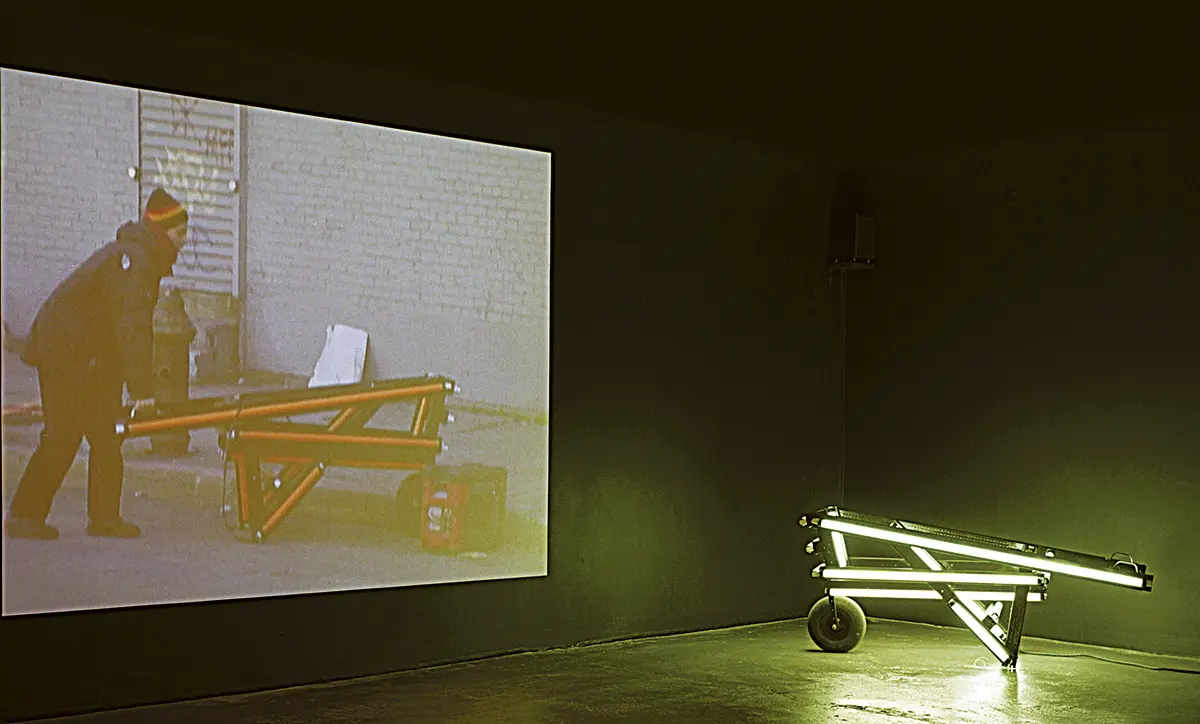
The exhibition at Union, No soy de aquí, no soy de allá / I am not from here, I am not from there, featured works from 2002 to 2006, thus giving the London public a sampling of Navarro’s output during these fertile years. The two most recent works were also the most different from each other. One, titled Blade Runner III, was a large-scale floor installation made of small, spinning light bulbs in the shape of the five intersecting Olympic rings, and the other was called Flashlight and consisted of a video and a sculpture of a wheelbarrow made of green neon light bulbs. Blade Runner III was installed alone in the front room of the gallery. Because of its large scale, interlocking forms, moving white lights, and placement on the floor, it immediately evoked a mood of meditation and reflection. The choice to use the color white was a departure from Navarro’s original plan; his first intention was to employ the five Olympic colors, which would have created a wholly different, livelier effect. The whiteness, however, transmitted a sense of melancholy and loss, as though the five rings symbolizing world unity could only stand as a mournful reminder of the impossibility of ever achieving it. Furthermore, the light bulbs were positioned within circular white paper covers, and the combined effect resembled nothing so much as a candlelight vigil. The reference to the classic American cult film Blade Runner in the title was enigmatic but perhaps was meant to compare the dystopia of the movie to our own contemporary condition.
Navarro’s video, Flashlight, I Am Not From Here, I Am Not From There, is eight-minute-long documentation of a performance, which took place on the wintry streets of New York, set to a song by Facundo Cabral interpreted by Julio Iglesias. It begins with a solitary young man who opens a car’s fuel tank and proceeds to steal the gasoline with a hose in order to fill a generator. He then connects the generator to a wheelbarrow made of red neon light bulbs and turns on the lights. He wheels it a few paces and then stops in an alleyway, removes the light bulbs, and changes their casing from red to blue. Continuing on his way, he walks the desolate streets and every so often stops to change the color of the lights. Day turns into night, and during the last scene, he is shown pushing the wheelbarrow over desolate train tracks and disappearing into the distance.
The rhythm of the video is strongly influenced by the slow pace of the soundtrack. The song No soy de aquí, no soy de allá begins with a spoken poem with a theme about resourcefulness and adaptation to life’s conditions. The narrator states, “I like to walk / but I don’t follow the path / because what is certain holds no mystery” (Me gusta andar / pero no sigo el camino / pues lo seguro ya no tiene misterio). The actions of the video’s protagonist are very much attuned to this idea. As the song continues, the chorus repeats the phrases, “I am not from here, I am not from there / I have no age or future / and being happy is the color of my identity” (No soy de aquí, no soy de allá / no tengo edad ni porvenir / y ser feliz es mi color de identidad). The phrase “color of my identity” resonates with the constantly changing color of the lights that make up the wheelbarrow. The solitary, anonymous character adapts to his surroundings, making the best of what little resources he has to navigate through a cold and alienating world.
In his new works, Navarro oscillates between adopting an almost purely abstract visual language in Blade Runner III to embracing linear narrative in Flashlight. The other sculptures in the exhibition, many of which are already known to those familiar with Navarro’s oeuvre, tend to fall somewhere in between. These include two glass tables entitled Joy Division I and II (2004 and 2005), with bases of a neon swastika and a star of David, respectively, as well as the beach chair You Sit, You Die (2002), with a structure formed of neon light bulbs and a cloth seat inscribed with the names of the people executed in the state of Florida from 1924 to 2001. At this moment in his career, Navarro seems to be expanding on the possibilities of the functional design aesthetic that dominated his earlier work and is branching out into new but nonetheless coherent directions.
TATIANA FLORES