
From May 10 through June 9, the Millan Antonio Gallery hosts a solo exhibition by the prolific Rio de Janeiro artist Jarbas Lopes (born 1964), who has been invited to exhibit in the next São Paulo Biennial by Lisette Salgado, the curator. In the exhibition titled Politica DI-VI-DA, Lopes, with his proverbial sagacity and his elegant irony, again deals with the diverse current political models in Brazil. Lopes’s work is the distilled result of discernment made concrete in new and unexpected aesthetic, anthropological, and social meta-languages. These culminate in an installation cycle with a well-differentiated body of work: the series O Debate, in progress since 1998; two sculptures, site-specific in character and forming a spatial and situational whole, titled Para o mal, o para o bem; black-and-white drawings; and the sculpture Agricultura Familiar, Transgénico e o Cu de Mãe, placed in the gallery’s garden.
In the series O Debate, Lopes purposefully manipulates urban detritus and residues—leftovers from the paraphernalia of propaganda and the proselytizing activities of various political elections—in order to give shape to painting objects and to propose an escape from the frame through flexible, interwoven, large-format canvases of braided strips cut from plastic sheets intended for outdoor use. According to the artist, this is “a plastic exercise conceived from the start as a reference to certain politics, as an evolved way of balancing social anxieties and relationships, which we chose to experience as such.”
Indeed, the fractured faces in Lopes’s work simulate a donation of their irregular matter to the evocation of causeless and effect-less afterimages in manufactured blobs. His “made-up” bodies are metonymic links to commercial displays or advertising spots, where camouflaged shapes follow a variety of cuts and incisions. Mouths, lines of teeth, and multiplying eyes appear as corporeal elements in a not-entirely-regular serial progression. They are thus mocking parodies of corporeal synecdoche. Lopes’s driving idea is that, with certain photographic details “appropriated” from other people’s bodies, it is possible to create broader and more forceful images that construct the giant and redundant pictorial blocks, which can only be perceived as a whole from a distance.
In that sense, the Brazilian artist finds common ground between reality and politics, assuming that at times the latter can indeed resemble art. To reconstruct the representations’ status within the “portrait” format, Lopes generates a true symbiosis of disseminated and extrapolated egos, where the “I” disappears and is subsumed by the “Other” in an admixture of distorted gestures and expansive narratives that are incessantly superimposed.
The texture and “granulation” of the enlarged leftovers of electoral struggles are thick and blunt, with a strong physicality reminiscent of handcrafted quilts and rugs. All of this returns the viewer to the reality of things; we are not seeing true photographs but objects that display skewed, fragmented images as clandestine and outsized “traces” of an urgent reality. These works represent fleeting moments of several lives in which Lopes reflects on the ambivalence of photographic language as a fanciful medium that freezes life, stopping on entirely random places, events, and instances. The complex, mutable personalities of his post-organic models allude to a point of view that is ambiguous and polymorphous. The artist functions as an attentive voyeur, intent on revealing the tensions between photographic capture and narrative. The manipulated vinyl sheets were gathered after the 2004 elections and have been marked by precise longitudinal cuts; the material is braided and woven, plotting the dialectic penetration of the image. Everything seems at once familiar and impenetrable.
The cycle of black-and-white drawings, exhibited in one of the lower-floor interior galleries, belong to an older series and reinforce the visual dialogue between the different iconographic bodies.
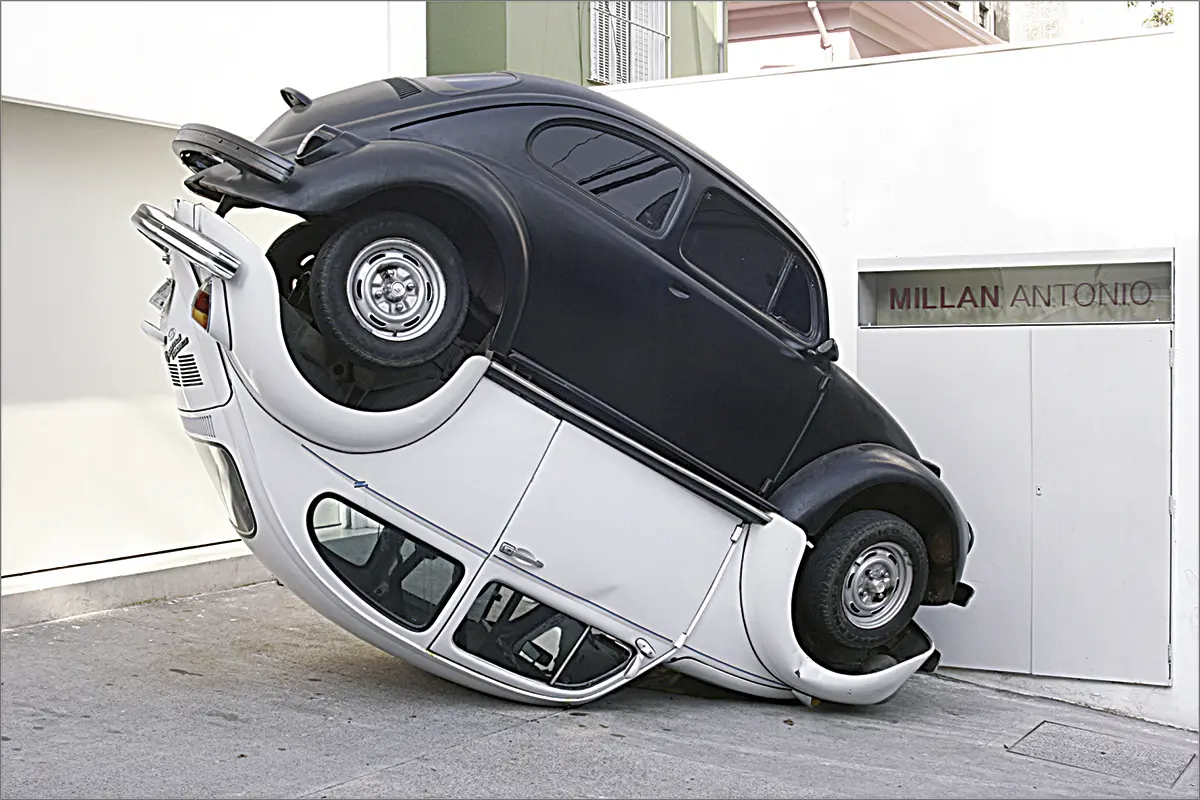
Para o mal o para o bem is a sculptural assemblage that Lopes intentionally placed on the lawn in front of the gallery. It is composed of two Volkswagen cars, one white and one black. The first car retains its original shape but is opened and upside down; the second one has lost its functionality—its windows are darkened, its interior is emptied out, and all of its openings are closed. Here, the artist intends to highlight the allegorical dimension of the sociological object, using damaged and decaying materials. He traces a semantic parallel between cars and South America’s decadent politics in the fossil-fuel age.
Agricultura Familiar, Transgénico e o Cu de Mãe is an ephemeral sculpture, located inside a wooden terrarium in the gallery’s garden and surrounded by fresh plants, like another allegorical object from the O Debate series taking the metaphor of organic collage to the limit.
CLAUDIA LAUDANNO