The installation occupies a large part of the exhibition area and has its own room in the gallery. It is expected to remain on view until the end of the show. It is the first time Castillo has left an installation in place for such a long period; perhaps she never attempted this before due to the ephemeral nature of sand, her primary material. Although the installation retains its original structure, changes can be observed on a daily basis, mainly concerning the work’s size: while retaining its original shape, it slowly shrinks, possibly as a consequence of evaporation. For this installation, created on-site, Castillo used 2,500 pounds of sand. The installation resembles a large crater with smaller craters around it, an image that brings to mind photographs of the lunar surface.
The sculpture, titled La Capital de Crisis Perpetua, was realized in acrylic, part of Castillo’s experimentation with more permanent materials. This work consists of a giant labyrinth, where the transparency of the material creates the sensation of being physically trapped and at the same time visually free.
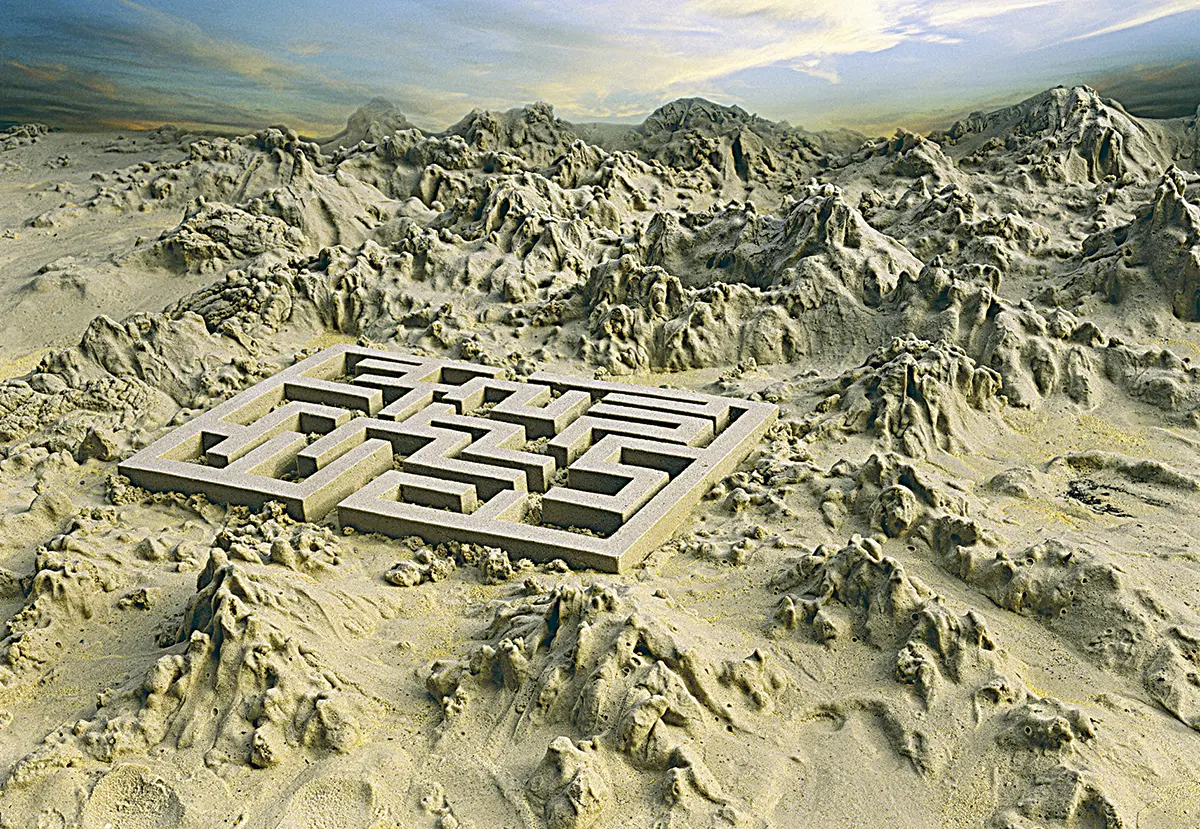
Castillo’s photographs depict sand sculptures. These sculptures are created at a much smaller scale than what the photographs reflect. The images captured in the photographs appear to be of a monumental scale; one never suspects that these are sculptures created at a much smaller scale. What is interesting about these images is that, despite depicting objects of a much smaller size, the photographs do not reveal this tension. Another aspect of their manipulation is that they were created in Castillo’s studio, although they intentionally give the impression of having been photographed in exterior locations.
Castillo’s interest in working with sand resulted from a series of photographs she took of Cuban beaches; her lens was focused on sandcastles. Outdoor photography was challenging especially in terms of controlling the intense light, and this drove Castillo to experiment with interior shots. The process was a gradual one. First, she worked in a garden, where the light was less bright than at the seaside, and finally, she worked in her studio. Currently, all of her work is produced in the studio, with the exception of her installations.
The production of these works is long and laborious. Each work can require a couple of weeks. Castillo uses simple instruments, such as molds, shovels, toothpicks, etc. Once the sculpture is finished, it is photographed and destroyed, and the photograph is more than a memory of the work. The use of sand as her primary material indicates the ephemeral; by using photography, she ensures the “permanence” of the work.
With the exception of the installation, all of the works in this show explore the topic of the labyrinth, unlike prior works that showed an interest in other aspects of architecture. These enigmatic images evoke ancient civilizations, hidden and forgotten passageways that seem to have been rescued from the course of time.
Castillo uses labyrinths as a metaphor to express the different stages of life. Her work represents the classic moment when we all seek direction, the decision in front of crossroads that can irreversibly change the course of our lives. The well-known myth of the Cretan labyrinth reflects a fear of the unknown and the inevitability of the past, a kind of game of chance that could represent the difference between life and death. Castillo’s work speaks about the brevity of time and the dichotomy of luck and fate—about what is premeditated, what is our free will, and what is constructed.
IRINA LEYVA