
Bichus, a show of works by Mercedes Elena González, closed recently at Galería 39. Titled to differentiate it from Gego’s Bichos, this show was the result of four years of research by the artist. New conceptual and formal propositions and some previously present aspects combined to achieve a different, innovative body of work.
In a series known as Neurohilados or Entretejimientos, presented at Sala Alternativa in 2001, González created a macrocosm in small-format works in which canvases or latex sheets were framed by embroidery drums. This was a markedly feminine, intimate reference that at the same time made possible a variety of readings, from the representation of the cosmos—a sidereal map with infinitude symbolized by the format’s circularity—to organic representations in which the see-through, skin-like works revealed capillary or neural networks, images that the artist used to make “writing.” This writing could be read in many directions; visualizing sidereal space was equivalent to visualizing an organic image seen through the lens of a microscope. It was a game where opposites were possible, where macrocosm and microcosm were, pictorially, one and the same.
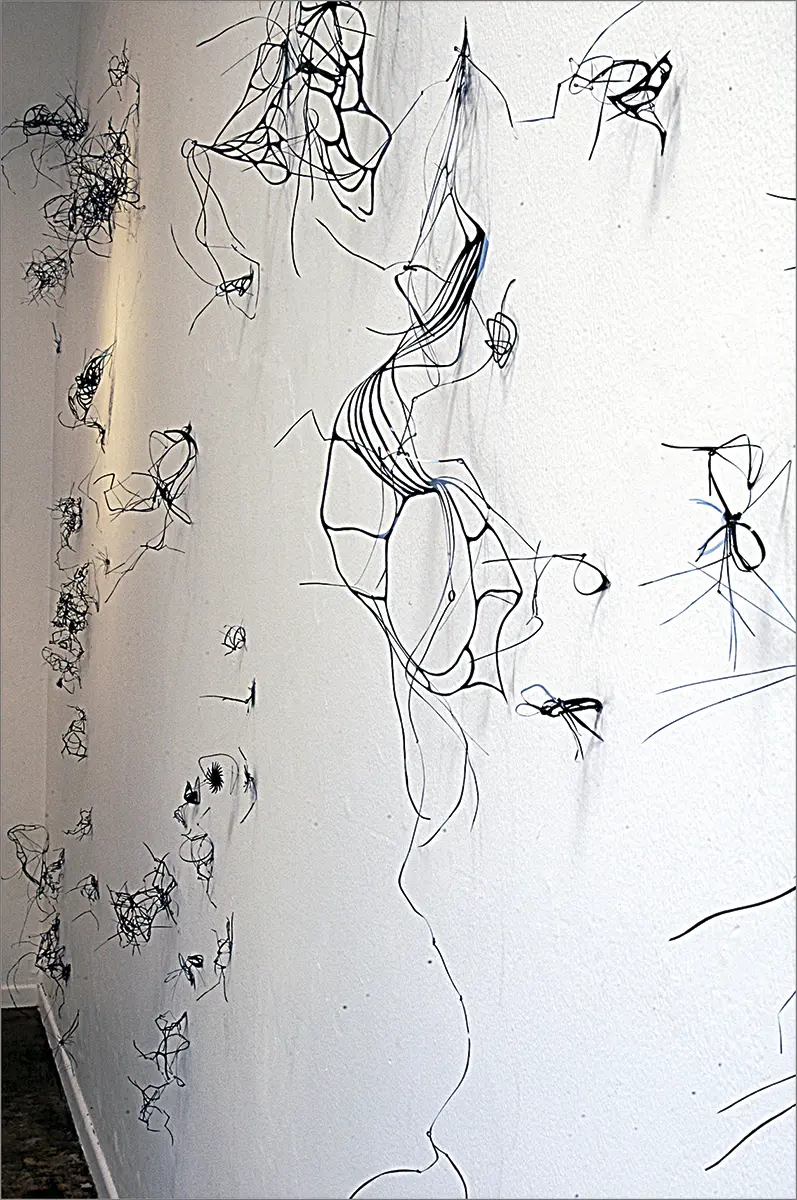
This relationship between art and science continues to be present in her recent work. But, as in her previous series, this is only one aspect of González’s art because Bichus is also a multidimensional work. As with the neurohilados, Bichus refers to biology, neuroscience, astronomy, anatomy—in the use of X-rays—and even dressmaking. The new work differs in that the artist now seeks other non-pictorial alternatives, such as three-dimensionality, by setting these objects in space, first as ovoid reliefs from which emerge branches and filaments and later in autonomous, independent pieces: the bichus proper.
The result was an installation composed of small organic bodies created using X-rays that were cropped with nail scissors and transformed into fine, knotted, intertwined filaments. These were unclassifiable, very subtle, haphazardly occurring bodies, a mixture of insect and microbe or even plants, “organic compositions” that “pose” on a wall or a table. These bichus were hybrids that resulted, paradoxically, from the residue of industrial materials such as radiographic plates, while they were representations of organic bodies.
As with her neurohilados, here the artist used monochromatic resources, working dark elements on the wall’s white plane. In this way, she again “threaded the night” through a new weaving. This new weaving was not done with a brush that “embroiders” treads but with tangled threads of cropped X-rays from which threads or loose parts branched out, the whole forming the bichus body. Seen as units, they were small, fragile sculptures; seen as a whole, they traced new writing that unfurled on the wall. But, in a broad interpretation, they were also another way of understanding drawing. This drawing was conceived threefold: in the outlines created by the sliced X-ray plaques, which, being a dark material, contrasted with the whiteness of the wall and table or base used in the exhibition room; seen as paperless drawing, resulting from the shadows projected by the bichus on the wall, with lines that shifted according to the incidence of light; the real drawing created on paper by the artist, who, aware of the effects of the shadows in the first two cases, took advantage of them to draw. These images showed an impossible, unclassifiable biological world.
This show signaled an important stage in the artist’s development, By “opening herself to space,” she not only progressively abandoned the pictorial resources used in her neurohilados but also explored new materials and the spatial possibilities of these three-dimensional forms offer. These small forms invaded the space indiscriminately and without limits, an action that marked a new starting point for the González as her new steps are larger-format works. The invasive behavior of these works points to a way of seeing and understanding her creative process as one in permanent transformation. Organic, “living,” mutant, silent works are Mercedes Elena González’s Bichus.
SUSANA BENKO