
Remember when art could sometimes serve a political purpose? Over the past eight years, Pedro Lasch, an artist, educator, activist, and cultural organizer, created a body of work that reminds us of art’s relevancy in its larger social context. For his first one-person museum exhibition, Lasch has developed conceptual interactions, which he calls “open routines,” that engage the viewer and encourage a sense of self-awareness and political consciousness.
One series of works titled Naturalizations (Selections) (2002/2006) involves the use of flat, plastic, generic-looking masks of a simple rectangular design with three small horizontal openings—two for the eyes and one for the mouth—that are either fully or partially covered with mirror. In Point-Counterpoint Fusion (Homage to Daniel Buren) (2004/2006), viewers were encouraged to wear masks with stripes that evenly alternated transparently and mirrored vertical bands. Walking around the gallery, the masked viewer was partially exposed through the clear plastic, yet onlookers could also see themselves in the mirrored stripes. As a result, each mask fused one face with another, and one’s sense of individuality—which is often defined by the face—was called into question. As the title notes, Lasch’s work pays tribute to French artist Daniel Buren, who employed the vertical stripe as a visual tool to address standardizations of artistic production. For Lasch, this standardization relates to larger aspects of social identity, often determined by nationality, race, gender, and age, as well as phrenology and other socially imposed conventions of measure, such as those related to beauty standards (e.g., height and weight). In Point-Counterpoint Fusion, one’s appearance, whether fully or partially revealed, meant everything, and the perception of one’s individuality and of one’s larger, socially determined identity seemed to be held in conflict.
Another work, A Sculptural Proposal for the Zócalo (1999/2004), was intended to be a temporary public project. Lasch wanted to take the internal scaffolding that had been used to uphold the infrastructure of Mexico City’s cathedral during its restoration (1989–1999) and place the support system alone in front of the church in the middle of the Zócalo. An Aztec plaza that has served as Mexico’s most significant public square for centuries, the Zócalo is surrounded by not only the cathedral but also by government offices and palaces that were erected during and after Spanish control. Lasch’s project, had it been realized, would have publicly addressed the tensions between the past and present cultures of Mexico and the ongoing interrelationship of church and state.
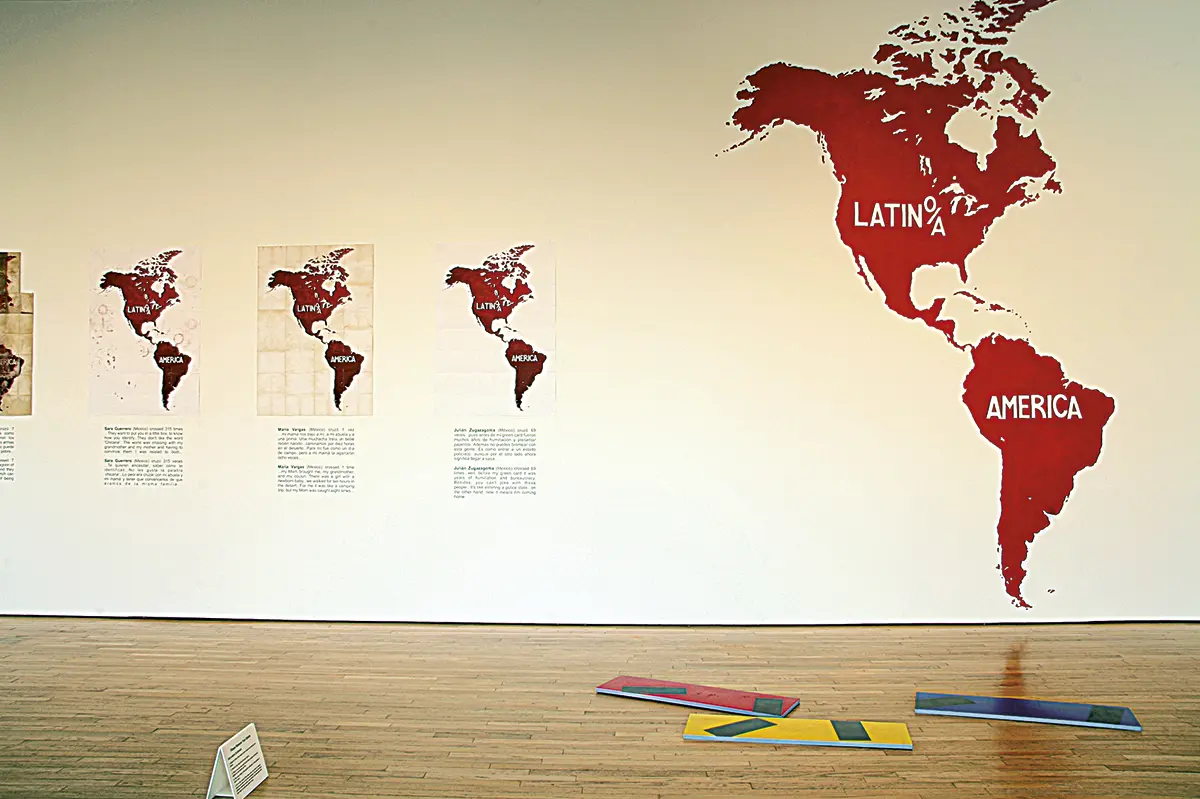
Perhaps the most poignant and timely work in Lasch’s show was his Latino/a America Series (2003/2006), which addressed mapping and migration between the United States and Mexico. Playing with color conventions of maps, Lasch painted both North and South America entirely in red, labeling both continents “Latino/a America” in white letters. Such a gesture refers to the troubled histories of European colonizers and Native Americans, as well as the current situation regarding the reinforcement of borders between Mexico and the United States. In 2003, Lasch presumably distributed forty of these maps to twenty people whom he knew would be traveling between Mexico and the United States. After they had crossed the border, he asked that participants keep one map for themselves and return the other to him along with a personal account of their experience. Thus far, Lasch has received eight of these maps, which were hung in the exhibition in various states of disrepair. Below each map, individual tales were described. One woman recounted how she had traveled 315 times across the border; her worst experience was the time she traveled with her mother and grandmother. Because they represented different races, authorities refused to believe that they were all related and stopped them from questioning.
Although Lasch’s work encourages political awareness, it is necessary to ask a few tough questions: How provocative is the work? Is it strong enough to affect social change? Does it merely preach to already-converted leftist thinkers? In the end, time will be the judge. However, in a day when apathy seems to dominate the social mindset of U.S. citizens, Lasch’s open call for political art that involves the viewer and addresses larger social issues at stake for many Americans—wherever they live and whatever their nationality might be—seems to fill a noticeable void in much art produced during this decade.
CRAIG HOUSER