
Titled Maestro de los sueños, the first exhibition of works by Rodolfo Morales to be held after his death in 2001 is currently presented in the Carlos Pellicer Gallery in Mexico City’s Museo de Arte Moderno. The show will remain there until August 6, when it will travel to the northern part of the country, to Bogotá, Colombia, and finally to Los Angeles, California. Among the more than 200 examples of his work gathered here—predominantly large-format oils and drawings—the highlights are precisely those that escape the conventions of framing, objects such as decorated columns, paper-and-cloth collages, space dividers, and a breakfast table painted in Morales’s unique style. Although his landscapes tend to describe the border between waking and dreaming, his atmospheres are somewhat unreal. These images speak of a bucolic arcadia. They are the poeticized recounting of his native town, Ocotlán de Morelos, Oaxaca, which is represented with an iconography that can be contemporary or from the nineteenth century and unique to that province: steam locomotives, civic events, typical dress, and national emblems of the Republican past.
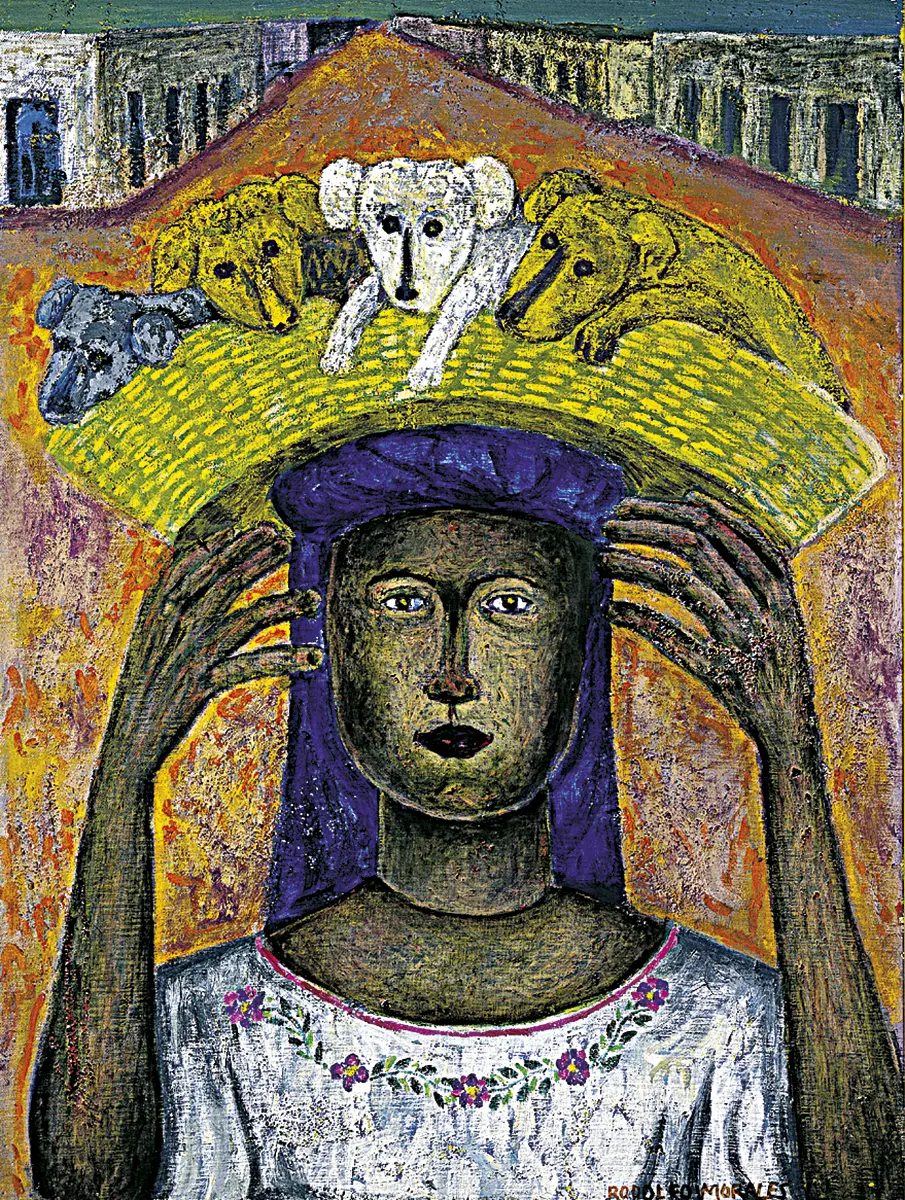
Morales’s painting normally has been referred to alongside that of his Oaxacan compatriots Rodolfo Nieto and Francisco Toledo—as if one’s place of origin should in itself explain anything—but critics still pigeonhole it with the same terms used six decades ago to talk about a generation deemed naïve. It is often compared to the geography of Mexican Nationalism as illustrated by Rufino Tamayo, María Izquierdo, or Antonio “El Corcito” Ruiz. Even if Morales’s painting indeed denounces the past (such as the poverty of his town and the corruption of local authorities), romanticizes the present (by depicting Ocotlán with dreaminess and primness), and demands a better future (with a provincial’s mistrust and critical distance from the government), this exhibition offers the long-awaited opportunity to renew the interpretative lexicon used to explain the Oaxacan artist and his work. This implies that Morales’s oeuvre is much more than an emotional universe connected to an invented tradition that is shared only by his compatriots. Thus, five fundamental entities populate Morales’s imagination: the silence in which he lived, his hometown’s women and flowers, the street dogs, his house open to the public and to the debate of social problems, and the topography of the Mexican town. References to the dream world to explain the imaginative universe of an old provincial are attempts to illuminate the meaning of landscapes that are metaphysical (with empty streets fading into the distance), the absence of men (as only women and animals seem to inhabit the town we see), and the coexistence of the real with the fictions that characterize any patriotic history.
Paradoxically, in relation to his intense social and political work, Morales seems to paint the portrait of the collective imagination, the way that is preferred to think about a town and its history through two centuries—a subjective way, without sketching sociological notes about the State’s reality. But Guillermo Sepúlveda, the curator, lacks imagination and has opted for the picturesque catalog without establishing any kind of dialogue between the works or suggesting readings based on the concatenation of iconographic series.
While the show’s museography is exemplary, there seems to be no particular order to the sequence of works. The internal logic of this exercise is not chronological, formal, or thematic; it seems the show wants to be exhaustive. Similarly, the inherently plastic and versatile space offered by the museum’s circular structure remains unexploited.
In a certain sense, Morales’s painting is anachronistic for the Mexican public, and this has also affected the show’s lackluster critical reviews in Mexico. Morales’s painting belongs to a type of art that was common in Mexico between 1920 and 1950, a peculiar system through which the ideas of “Mexicanness” and “the Indian problem” were transformed into explicit statements, resulting in a manifesto that builds itself, solidifying the political and cultural borders imposed by the State. It is the lyricism of a regime no longer in power, the explanation of a sequence of periods in Mexican history that define it racially and culturally from the cornerstone of its indigenous element found in towns like Rodolfo Morales’s. It has been buried and regarded with contempt for five centuries, and it is what is worth salvaging from the arts of the colonial period, the modern period, and the present. These themes are what Morales seems to portray, but for many today it has no meaning beyond that of illustration for tourists or of an artisan’s elegy.
CARLOS MOLINA