
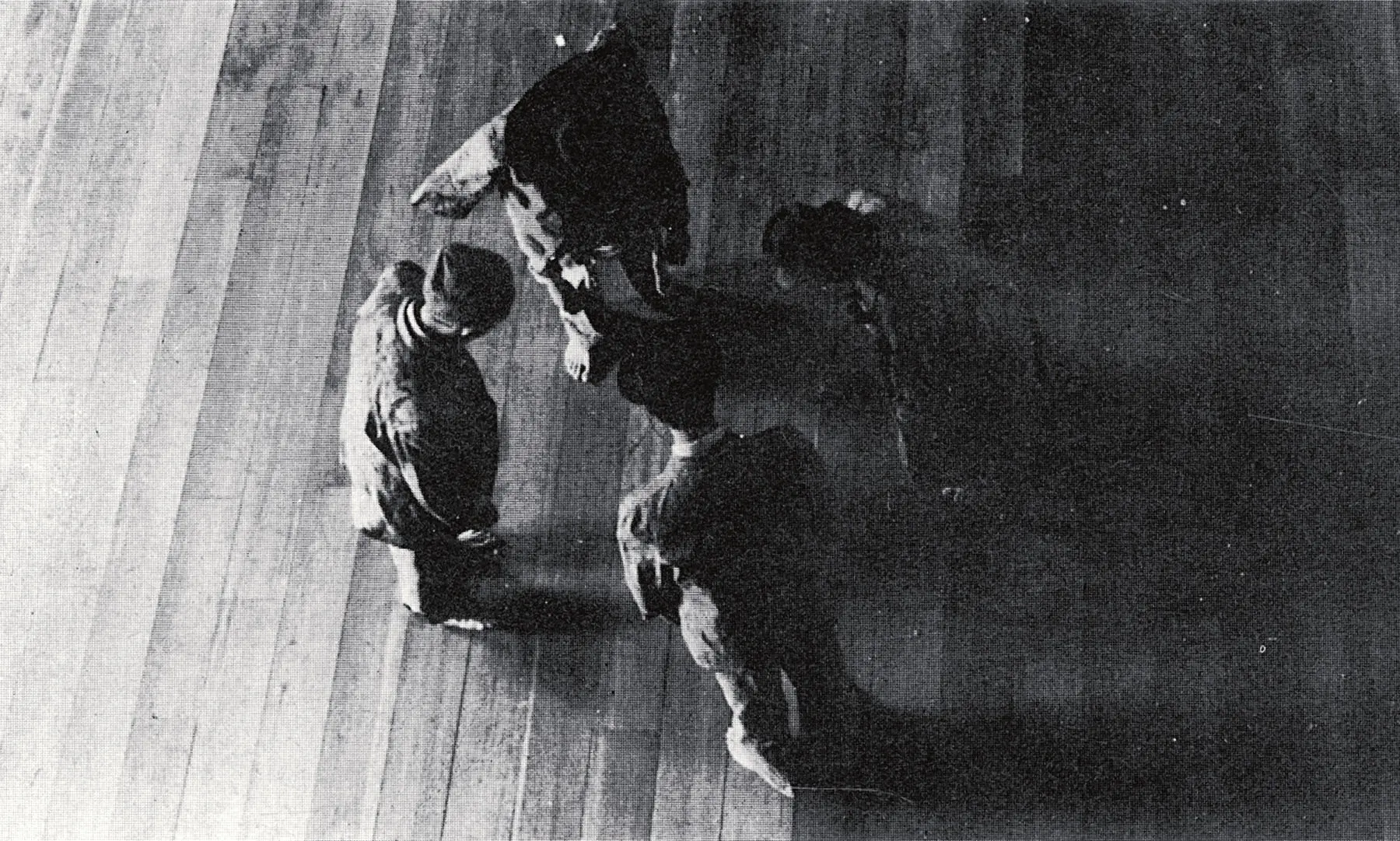
Rolf Abderhalden introduces elements from the visual arts into his theater productions and brings his theatrical experience into his video installations. This feature of his work becomes understandable when we look at his work’s formative process, where he approached the theater through a practice that privileges the body and the relationships it establishes with space. His first studies took place at the École des Hautes Études in Lausanne, Switzerland, where he specialized in art and therapy from 1976 to 1980. Later, he was admitted to the Jacques Lecoq International Theater School and the Laboratory of Movement Study in Paris (1980-–1982) and to the National Drama Arts Academy in Rome. In 1987, after returning to Colombia, he worked at the Universidad Nacional’s experimental visual arts workshops, where he found fertile ground in the field of visual arts to develop his experiences acquired in Europe. At the same time, and after producing two plays with his sister Heidi in Switzerland (Blacamán in 1985 and Casa Tomada in 1986), he formed the Mapa Teatro group, which has had intense activity in Colombia and abroad.
The first time I saw a Mapa Teatro play was in 1990 when they presented De Mortibus: Réquiem para Samuel Beckett. What most intrigued me in this production was the importance given to color and texture, painterly elements that play a role as central as that of the actors in the Mapa Teatro staging. De Mortibus is a play for four actors who perambulate around a stage with very high walls. Fine gray dust covers the floor, objects, costumes, and the characters’ skin. In this cold, desolate space, small suggestions are traced: a peek out, handkerchief-like, from a character’s pocket and brings a touch of humor to the gray scene; an intensely blue lapel contrasts with two red stains, one from a red rose carried by one of the characters and the other from lips that open and close anxiously. The cold atmosphere of the play becomes more intense toward the end when the light turns whiter and suddenly it starts to rain on stage. Water soaks the bodies “that move forwards and backward, that go up and down as needed. Walking sometimes slowly, sometimes limping painfully, sometimes quickly. Gestures that come in sequence between... fragments of conversations. Long silences interrupted by words and music."2 The touches of color and texture are elements taken from Beckett’s work. Abderhalden finds that “there is a theory of color in Beckett in which everything resides in gray . . . and all of a sudden there explodes a red stain, or a yellow stain, finally to be reabsorbed into the gray. It’s like what happens with a palette where there might be a small stain and later it dissolves into gray, and the gray itself becomes warmer or colder."3 Space, texture, gestures, music, silences, and words acquire a material quality, becoming like objects that interact in space as the play unfolds in time. This materiality acts like shapes and colors in painting, forming space, structuring it, and giving it meaning.
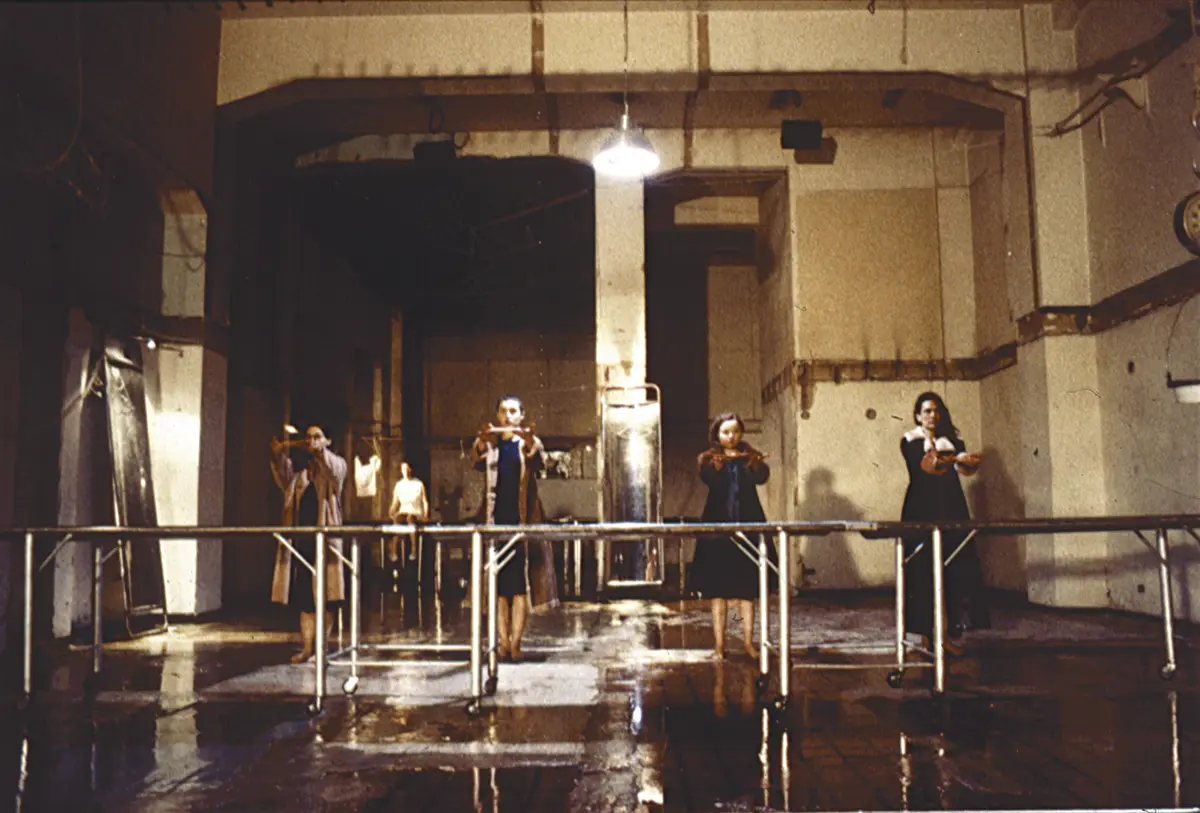
With Horacio (1993) and Orestea Ex-Machina (1993 and 1994), Mapa Teatro’s staging moved in the direction of performance and installation. Horacio originated with a two-page text where Heiner Müller wonders whether someone who kills a relative for the good of the country is a hero or a murderer. Given the nature of this question, the company decided to give the text to people who had that kind of experience; Mapa Teatro produced the work with ten prisoners from Colombia’s central prison La Picota, charging the production with the personal experiences of each participant. From the beginning, this work was not inscribed in the field of theater; it was conceived as an artistic action, a performance, in which the gesture—the movements and actions of the “actors”—opened up a new space for the staging. The conditions inside the prison, where no objects were allowed, resulted in rehearsals with only bodies and voices. The prisoners had to imagine the objects they were to use in the final performance and practiced gestures during the entire year it took to prepare it.
In several ways, Horacio was the trigger for Orestea Ex-Machina, a work that is tightly linked to Müller’s proposals for the handling of text. Müller, Abderhalden explains, proposes to rewrite the classics, to bring the works of the past into our immediate present, carrying out all the operations needed for the text to be fully valid in the current moment.4 Orestea was born from a reading of Aeschylus’s Orestiad, a play that is full of horrible crimes. As Abderhalden notes, in this worktexts are handled like readymades: fragments from Aeschylus’s text interact with passages from cooking recipes and from an urbanity manual.5 These passages are taken from their context, fragmented, “chopped and then mixed.” For example, a recipe’s explanation of how to kill a chicken is given such that this description, removed from its context and joined to the narration of the Orestiad, acquires horrific resonances. Added to this, the urbanity text describes how one must execute movements delicately and with elegance, and the horror is amplified: such refinement highlights the atrocious cruelty of the crimes of past and present. The work ends with the megaphone-aided reading of Orestes’s speech and a recent document on the closing of a Bogotá slaughterhouse.
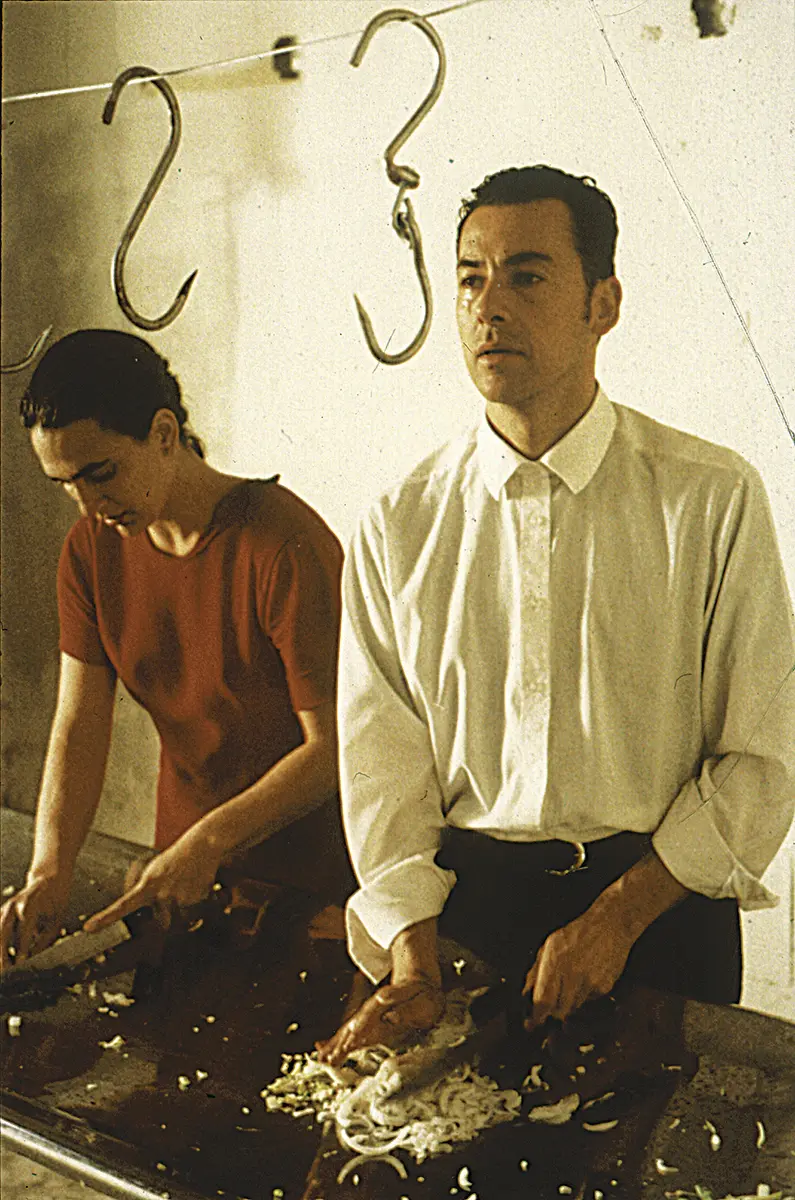
Orestea breaks decisively with the notion of the theatrical stage that persisted in the previous work. This work was conceived for a specific site,6 generating a close relationship between its architecture and the actions that occur there; in that sense, it functions according to the logic of an installation. According to the site’s characteristics, the work was articulated in three spaces. The first one was a deep corridor of about 100 meters that gave the public access and included lights and texts on the walls. The second space, also accessible to the public, was the space of Clytemnestra’s revenge—a site of sacrifice and murder—and it contained the steel stretchers on which the actors sharpened their knives as the public entered. In this way, the “fourth wall,” the habitual distance maintained between viewer and stage, was broken. The viewer’s body was very close to the action, and the noise made by the knives was very clear. Since there was no spatial mediation between the action and the public, viewers didn’t feel like outsiders to the action; their bodies were exposed to the tense atmosphere and the latent danger.
Instead of actors, the participants in Orestea were visual artists and dancers with no experience in the field of drama.7 As in Horacio, Mapa Teatro moved away from the traditional concept of acting and worked within the terrain of the gesture.8 Once again, the focus was on the attitudes assumed by the bodies of individuals taking part in the action. With their eyes crying, these bodies insistently chopped onions; these bodies were not used in the service of incarnating this or that character, they were there with their gestures and attitudes to occupy the space and establish relationships with the site, objects, and words. Each of the participants carried a piece of clothing, a shoe, or a sock that were metaphors for a fragmented body. The furniture was rather unusual; the public sat on airplane ladders, and when these moved backward, the third space appeared: the space of Justice. The actors formed pairs and the women kept the clothes inside armoires. The clothes were gradually brought out to be cut into pieces and hung on abattoir hooks. The experience of Orestea brought to mind happenings designed to give the viewer a total experience, where the distance between what takes place in the work and the public has been erased.
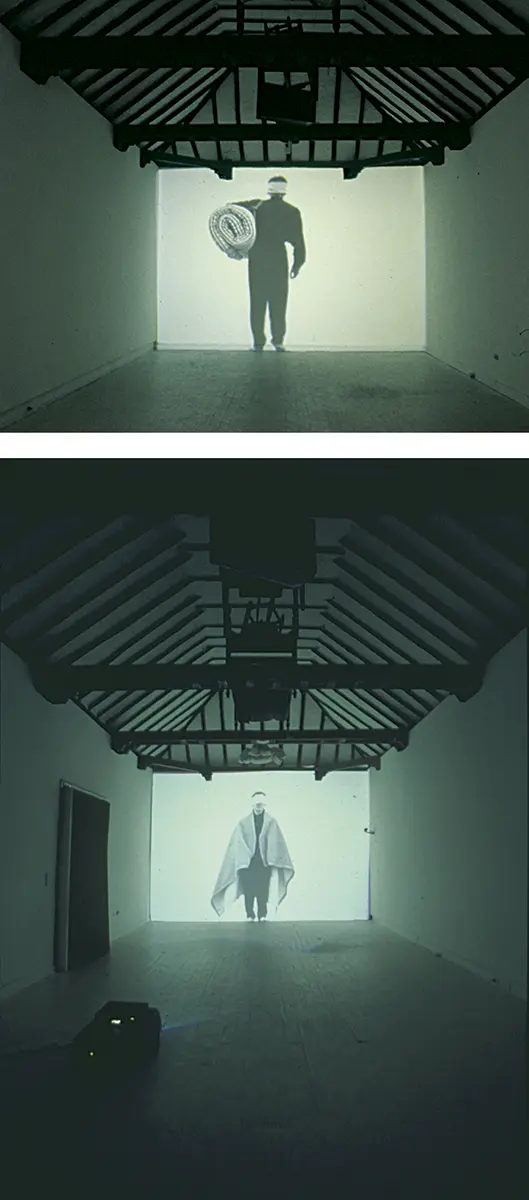
After these experiences, so closely related to the language of installation and art action, Abderhalden presented his first video installation, Camino (1997), which was developed as part of a project titled La mirada expuesta,9 the main goal of which was to work on the relationship between body and space. This is the first individual and entirely visual project where Abderhalden confronts only himself, bringing to bear his experience in the theater. Largely emerging from his own analysis, many subjective experiences—from Beckett’s walkers and Oedipus’s tragedy, explored in collaborative work with the musician Sergio Mesa—converge on Camino. But mainly this work gives shape to an experience that has seeped into his theater productions: the experience of the gesture, the actions of a body that does not act, that does not incarnate a character—a body that displays its own “sameness,” which in this case supports and assumes its action of walking.
For Camino, Abderhalden used the third floor of the Espacio Vacío gallery, an austere rectangle with gray floors, white walls, and high ceilings. “My approach to space,” he says, “oscillated between the path of the body as an involuntary trace governed by the laws of the construction itself—its borders, its planes, it's lighting—and a different logic, one governed by ideas, almost always residues of experiences or of judgments. My first experience with this architecture obeyed the principle according to which only the body is indispensable for the advent of an image in empty space. My essentially dramatic approach to space drives me to generate an action of movement, of duration, which concluded with the temporalization of that space and the spatialization of time.”10
The installation comprised two projections on opposite walls, in which “a blindfolded man, black trousers, bare feet . . . walks slowly in a forward direction, his arms limp, one of them carrying a blanket over one shoulder. They move forward, come closer to each other, and then stop. The man with the blanket raises his arms, takes the blanket, raises it slowly, and it disappears from his arms to reappear in the opposite projection. In unison, they turn and start walking until they disappear and leave the wall empty. In the same way, there appear and disappear—successively and in the same order in which they are placed in the ceiling—the blanket, pillow, bed, chair, table, knife, suitcase, shoes, trousers, shirt, scissors, blindfold. Then the whole thing starts again, ad infinitum."11
In this impeccably executed work, the principle of symmetry, the continuous repetition, the austerity, and the psychological and aesthetic neutrality are the elements that create a moving experience of space, which becomes time through the projection, a slow and repetitive time during which a man simply walks. “The work emerged,” Abderhalden says, “when image and space met at their maximum tension: in a dialog between the virtual and the real, extending into real space (that floor’s empty rectangle) the temporality of virtual space (the video’s projected image.)"12 According to Abderhalden, Beckett inaugurates the tragic feeling of “Man alone with himself, the absence of God and of the others, a feeling he transposed into silence, dispossession, and emptiness.” In Camino, Abderhalden makes that feeling visible, following an interlocution with himself, with his own experience, giving time a spatial dimension and giving temporality to the empty space.
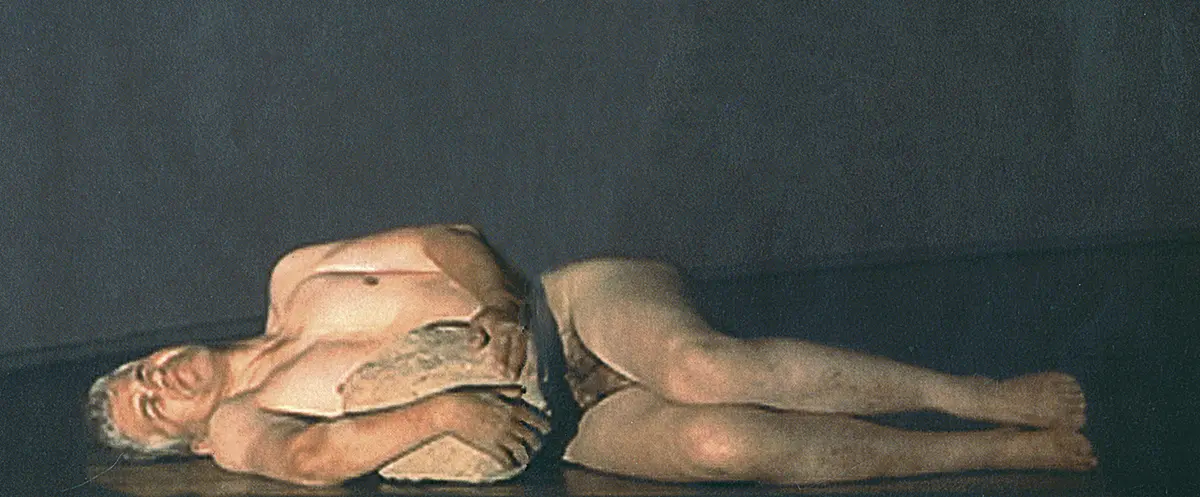
This work is the first in a trilogy that Abderhalden developed in the following years, where he attempted to explore the three stages of Man—childhood, maturity, and old age—and “the loneliness of a subject.” Camino alludes to the adult stage of maturity, while Dormitorio (2000) centers on the figure of an old man.13 In this work, Abderhalden revisits the relationship between text and image by generating a double play. On one hand, he seeks to create an image based on a verbal description by Vincent Van Gogh in a letter to his brother Theo, of the details of his room; on the other hand, Abderhalden seeks an opposition to the description of the painter’s color-filled image. His video installation takes place in an entirely white room; when viewers enter the gallery, they hear Abderhalden’s voice reading a text by Van Gogh. A bed has been placed in the white space, and the image of a sleeping man is projected on it. The work closes with the sound of a bell.
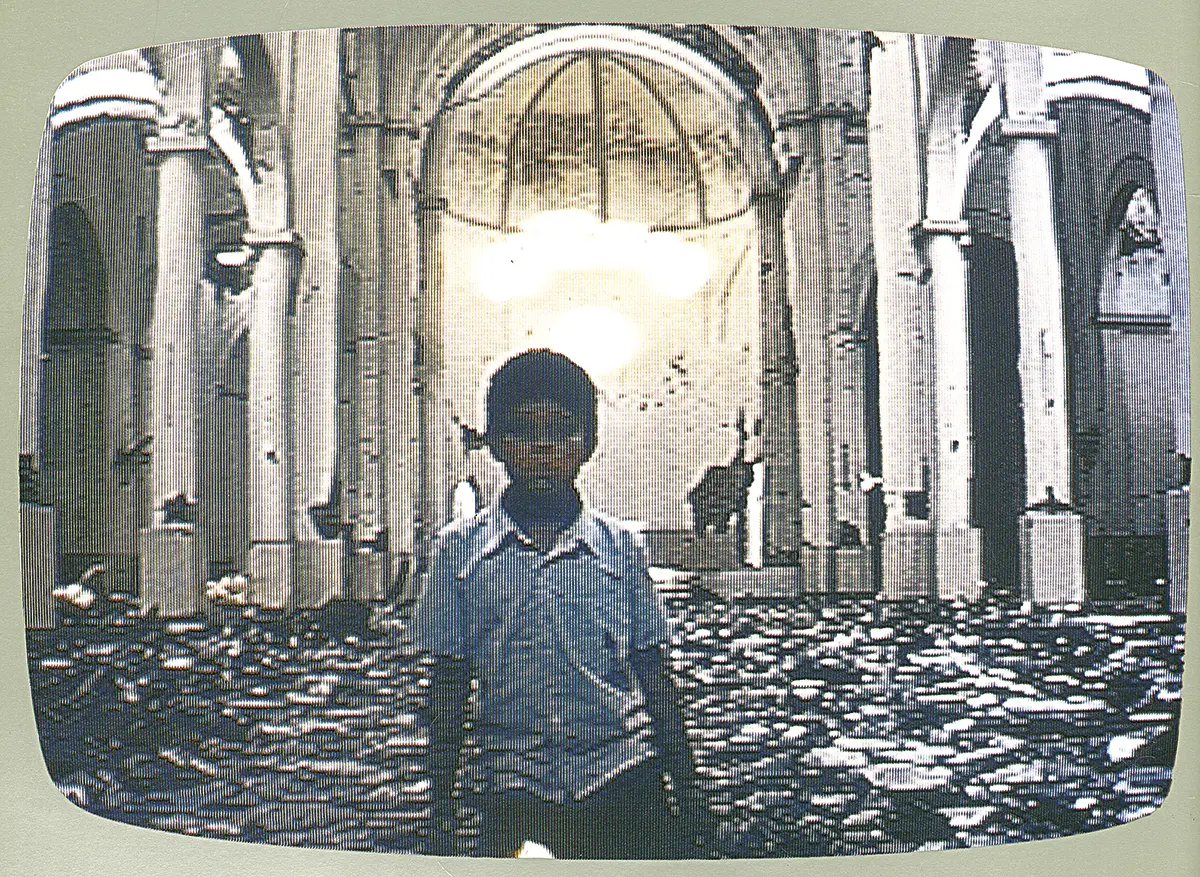
Lo demás es silencio (1998–1999), a video installation focused on the figure of a child, is also part of the trilogy.14 In this work, Abderhalden uses several projections to allude to the earthquake that destroyed a large portion of the city of Armenia and specifically to the drama of a boy who was crushed by a large slab of concrete and survived for several days. The projection presents the inside of a cathedral through which the boy’s family runs; when it is the boy’s turn to run through the space, he stops and is alone and still. The image dims and a mechanism traces a path of fire that advances in the space, and thus the story ends on a dramatic note.
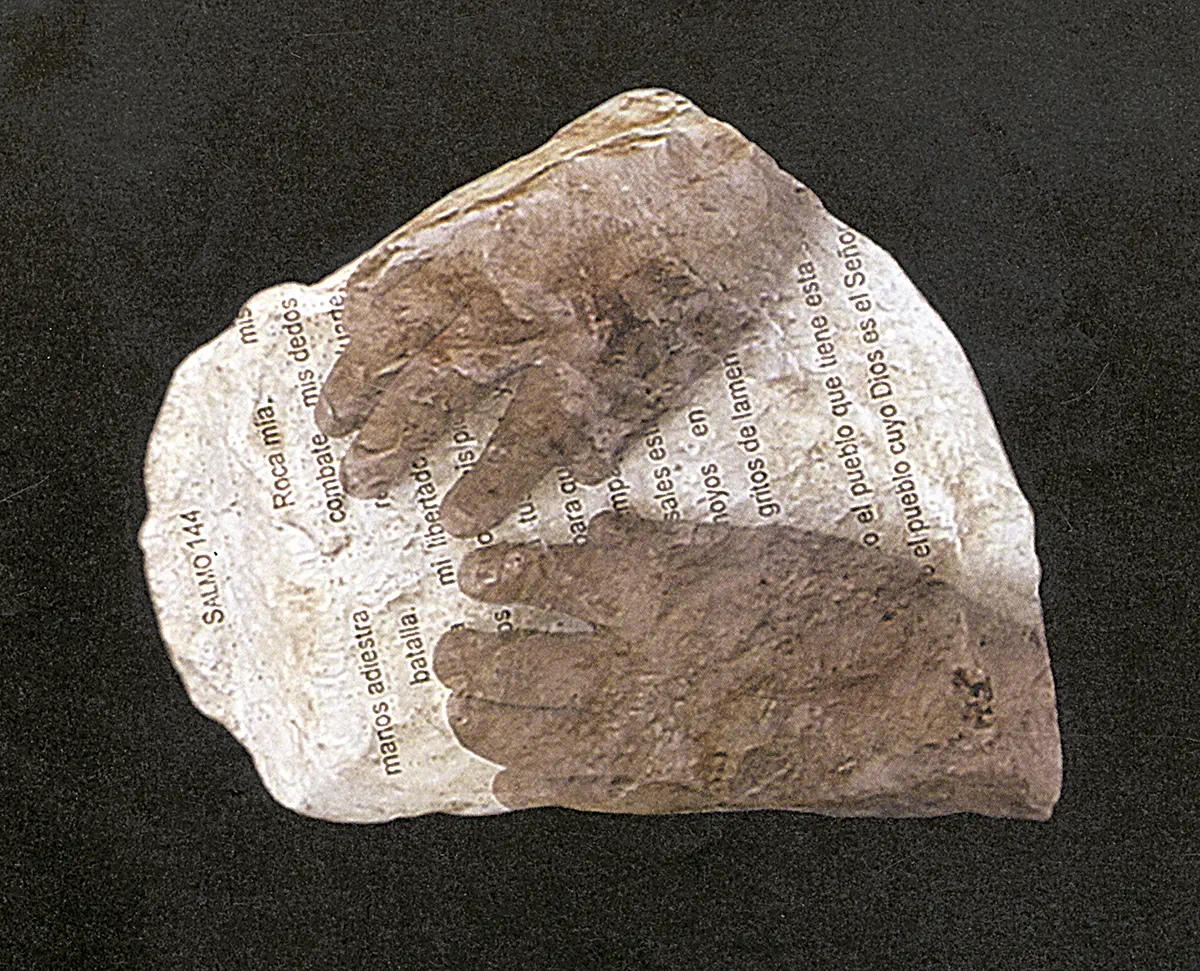
Sanatorio de la Capilla de Indios, Abderhalden’s most recent work presented in the 40th National Artists Salon,15 refers to blindness, a topic already present in Camino and in Mirada ciega;16 it also harks back to the origins of his artistic education, his encounter with art through psychotherapy. Abderhalden had access to Sister Josefa del Castillo’s austere room and hard wooden bed during his visit to Tunja in preparation for the Regional Salon.17 It immediately evoked his internship in the Tunja Psychiatric Hospital, and he decided to return to the place after twenty-five years. To his surprise, some of his patients were still there and recognized him without hesitation. This emotional encounter is the origin of Sanatorio, a video installation presented in one of the galleries of the Museo de Arte Colonial, the old San Ignacio cloisters. Here, the gallery is dark except for three projections. The church’s current façade with a condemned door is projected on the same wall through which the Indians entered for mass. A series of images of old ladies standing next to their beds in the hospital is projected inside a niche, and on the altar on the other side of the gallery, their faces are projected as they tell their stories. The installation’s most significant gesture is the fact that all the paintings and sculptures of religious figures have been turned around, their backs to the viewer and the projections. A sense of the blindness of religion suffuses the space; the sacred images refuse to look at the people who act outside the norm. As in José Saramago’s book Blindness, the saint’s blind gaze leaves humanity in a state of utter loneliness, abandoned to its fate and to the most miserable human condition. Blindness in the museum—the site of vision above all—acquires a deep significance and questions the role of art and religion throughout history and the present.
Several years passed between the production of Mirada ciega and Sanatorio, years during which Mapa Teatro devoted itself to Prometeo, a project developed with the community in a marginal Bogotá neighborhood, El Cartucho, which had been transformed into the Parque del Milenio.
The new urban construction erased all traces of the previous inhabitants, many of whom were involved in using and selling drugs. Prometeo relates the memory of this neighborhood through preserving its inhabitants’ stories. This project has originated two on-site actions, two installations, and a staging.18
The moment Abderhalden opts for video installation, space is another component of the work. This leads one to think about the “expanded stage” that emerged in art starting with Allan Kaprow’s happenings. In his visual works, Abderhalden uses darkened places, and on occasion he seeks to surprise the viewer, creating a point where the “dramatic action” reaches a climax—like the dramatic moment in De Mortibus when the rain starts to fall on the four characters.
Rolf Abderhalden’s last gesture in Sanatorio is forceful; the blindness of the images immediately affects the viewer upon entering the installation. That blind gaze asks us to rethink previous works like Camino and Mirada ciega and to understand through a different lens the many narratives and images in Abderhalden’s work, from Beckett and Müller to the stories of marginal citizens about whom our society prefers not to think and whom it prefers not to see.
NOTES
1. Rosalind Krauss, “Sculpture in the Expanded Field,” in Theories of Contemporary Art, ed. Richard Hertz, 215–224 (New Jersey: Prentice Hall, 1993).
2. From the score for De Mortibus: Réquiem para Samuel Beckett.
3. This article is based on a series of interviews with Rolf Abderhalden by the author, conducted from August 2003 to March 2004.
4. From an interview with the artist, November 21, 2003.
5. La urbanidad de Carreño, a school text mandatory for many generations of Colombians.
6. A somewhat abandoned building formerly occupied by a TV studio, Inravisión.
7. Most of the participants were Rolf Abderhalden’s students at the art school of Universidad Nacional.
8. Giorgio Agamben, Notas sobre el gesto. Agamben defines three instances of human action. He refers to the action of: the actor who acts, representing a character; the author who creates or writes a work; and the person who neither creates nor acts, only assumes and resists the weight of his or her attitudes.
9. This project was developed as part of an academic activity with two professors from Universidad Nacional’s school of art: Clemencia Echeverri and Trixi Allina. While the project was conceived in collaboration, each of the participants created a personal installation.
10. La mirada expuesta: Rolf Abderhalden; Trixi Allina; Clemencia Echeverri (Bogotá: Galería Espacio Vacío, 1998), exhibition catalogue.
11. La mirada expuesta.
12. La mirada expuesta.
13. This work received First Prize at the Bogotá Art Biennial in the Museo de Arte Moderno de Bogotá in 2000.
14. This work was presented in the exhibition Puntos de cruce, Johnnie Walker Art Award, at the Luis Ángel Arango Library.
15. Sanatorio de la Capilla de Indios was presented at the Museo de Arte Colonial as part of the exhibition “Un lugar en el mundo,” curated by Natalia Gutiérrez, at Central Zone, Bogotá.
16. Mirada ciega, a video installation presented at the Luis Caballero Awards, Galería Santa Fe, 2000–2001.
17. Arte en Colombia 107 (June–August 2006): 154.
18. One installation, La limpieza de los establos de Augías, was presented at the 39th Artists Salon, 2004. The staging Testigo de las ruinas was presented at the 10th Latin American Theater Festival in Bogotá in 2006.
MARTA RODRÍGUEZ
Professor of the Art Faculty at Universidad Nacional de Colombia, in Bogotá.