For good or for bad, the Whitney Biennial has acquired a reputation in the popular media as the show to bash. This reaction arose after the fallout from the 1993 edition in which one memorable work encapsulated what conservatives thought was the politicization of art in the museum: Daniel J. Martinez’s appropriation of admission tags worn by the public which were printed with the sentence, “I can’t imagine ever wanting to be white.” In the wake of Martinez’s work came polemics that speculated whether the next biennial would be concerned with political issues or with art and aesthetics as if those categories are antithetical. Considering the controversy and negative response to some of the works exhibited in 1993, evidently, there were very few who found the aesthetic in a young, angelic, doe-eyed Caucasian boy wearing one of Martinez’s tags. Right-wing pundits construed it as a “politicized” biennial (organized in an era free of war, 9/11, and Enron), and there was a return to order in the biennials that followed. It seemed that this shift reflected the conservative turn of the broader American cultural landscape.
Most biennials after the 1993 version toned down politics to the degree that the most critical piece of recent memory was Hans Haacke’s didactic sculptural installation, featured in the 2000 biennial, that compared New York City’s Mayor Rudolph Guiliani to Hitler because both censored art. Even the 2002 biennial that was marked by the collective trauma of 9/11, which should have engendered its own level of critical discourse, was a positive contrast to the 2004 biennial. The curators of this last biennial proposed that younger artists were looking back to the artistic styles of the 1960s, 70s, and 80s. This was hardly a new or insightful curatorial proposition; how the 2004 biennial did distinguish itself was through a theme of nostalgia with a subtext that was less about longing or yearning as an existential condition and more about schmaltz. It felt like the biennial’s conceptualization of nostalgia was also about turning the clock back to a milieu when the U.S. was relatively safe from the world’s problems. But this is 2006, and although there were some political works in this year’s Whitney Biennial—some overt, others more conceptual, and others downright nostalgic—its engagement with political issues lay underneath a quasi-literary veneer that explored the collective American psyche in all its myriad neuroses.
One national anxiety that the U.S. will seemingly never be cured of is a fear of the Other. The 2006 biennial struck a xenophobic nerve by including more artists without U.S. citizenship and by paralleling this affront with non-American curators: Philippe Vergne and Chrissie Iles. Even though both have worked in the U.S. for around ten years, their status as foreigners cut against the grain of the nationalism that can unwittingly mar museums and institutions that have geo-cultural affiliations. To be sure, it was a maverick gamble to include outside curators. The result was generally positive, though sometimes it was difficult to see how the works cohered as a whole, and this may have resulted from the exhibition’s amorphous curatorial parameters.
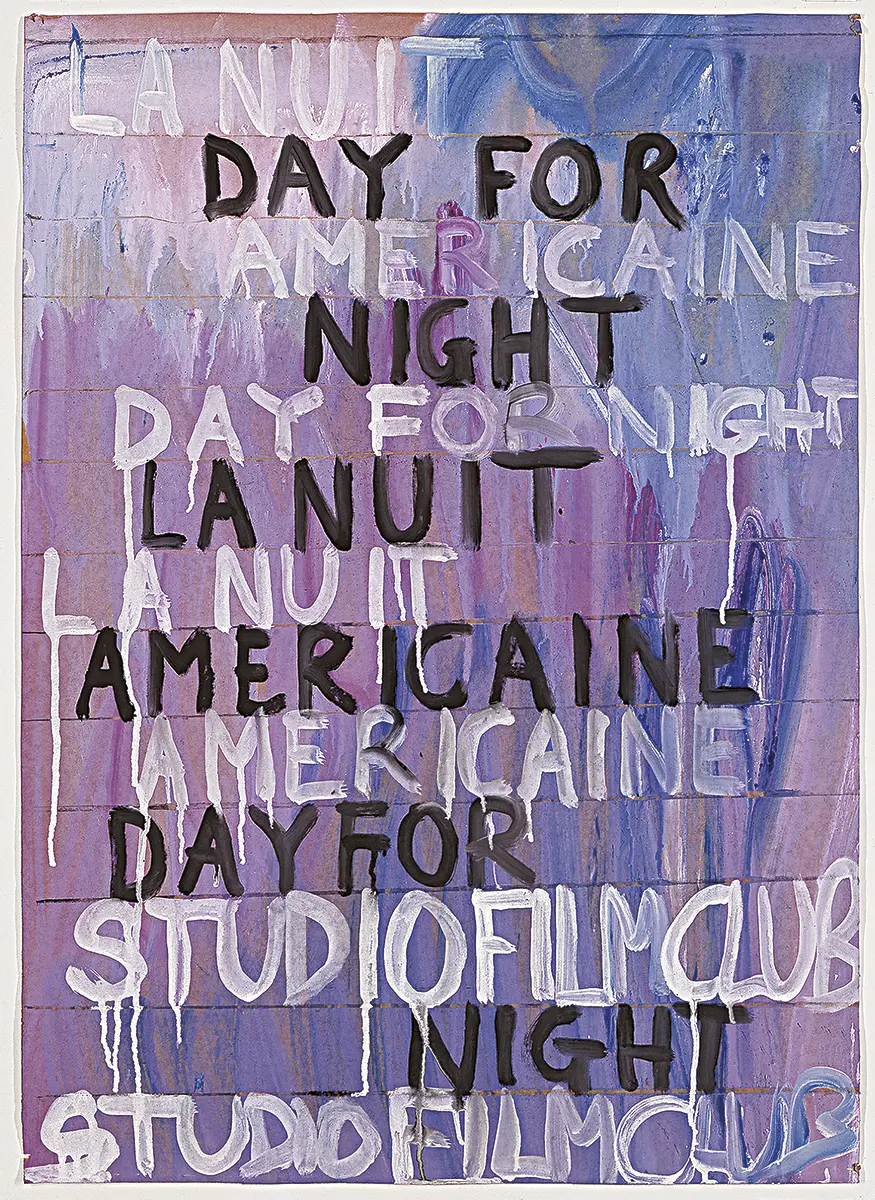
Unlike other biennials named by the year of occurrence, the 2006 biennial had the title Day for Night that was culled from a Francois Truffaut film. The film’s original French title directly translates as The American Night and refers, according to the curators, “to the cinematic technique by which nighttime is shot artificially during the day, using special filters.” In short, artifice became the curatorial operative word from which morphed other narrative threads across the Whitney Museum’s galleries. While the English Day for Night may have only been a marketing decision made with Truffaut, an English translation of the original title would have been a more interesting curatorial point of entry. The American Night would have alluded to multiple associations—dreams, the gothic, darkness—and would have been an uncanny title considering the biennial’s venue, as well as New York, being a portal into that collective neurosis called America. Consisting of ninety-nine artists plus side projects that included even more contributors, such as those involved in the sincere but trite Peace Tower, the 2006 biennial presented painting, works on paper, sculpture, photography, video, films, and installation and did not privilege one medium over another. Like the challenge faced in curating any biennial, there were selections that made sense and others that seemed slightly gratuitous. The former category contained many, including the experimental filmmaker Kenneth Anger, while the latter category included artists who were recognized in other fields and less for art-making, such as the influential jazz trumpeter and composer Miles Davis and the actor Taylor Meade.
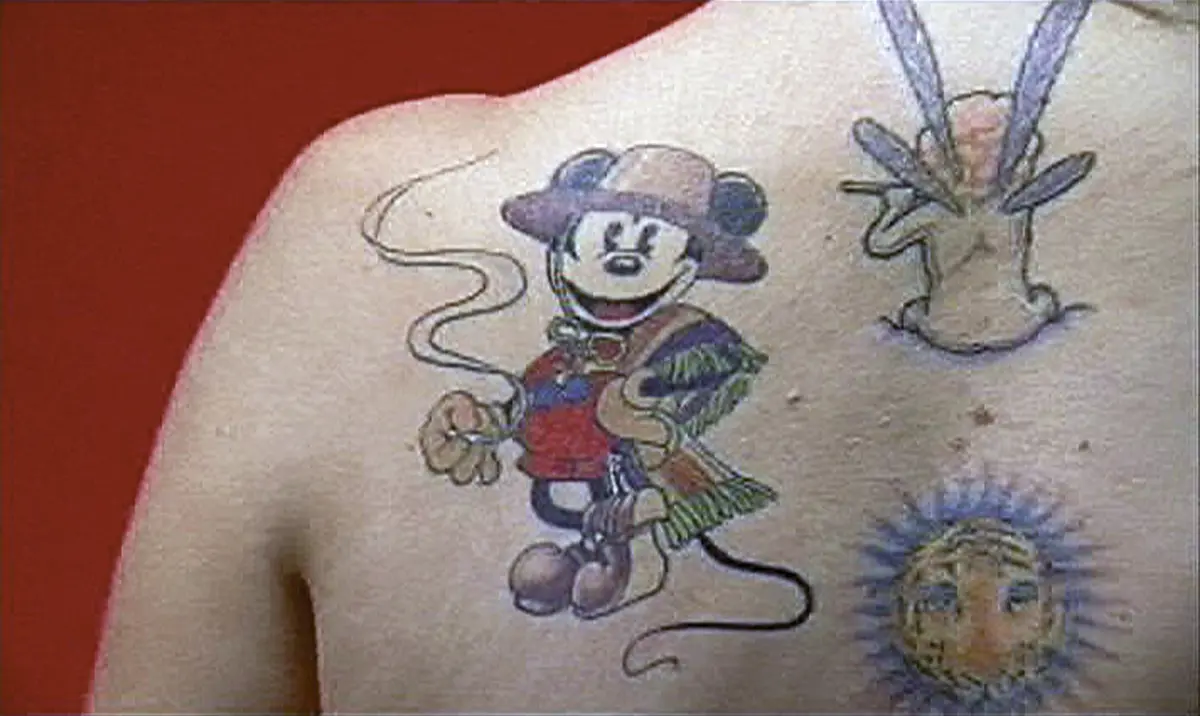
Kenneth Anger’s installation of photographs, memorabilia, and a recent film titled Mouse Heaven (2005) was an interesting curatorial choice and related well to the biennial’s title. As an eleventh-degree member of Aleister Crowley’s O.T.O. (an occult organization that ostensibly transforms same-sex intercourse into a religious rite and body fluids into a Eucharist), Anger was also part of the cinematic avant-garde of the 1950s, 60s, and 70s and was associated with the underbelly of old Hollywood´s deviant celebrities. Anger’s cinematic aesthetic is closer to but more interesting than Stan Brakhage because of Anger’s over-the-top, stream-of-(un) consciousness filmmaking as opposed to Brakhage’s formalist, film-for-film’s-sake esotericism. Anger’s installation was partly an homage to his noted narcissism via signifiers that mark his psychic and cultural constitution which, in turn, were nicely woven into his film’s iconic deconstruction of Mickey Mouse.
Two other cinematic projects also worth mentioning are a 16mm film by Jordan Wolfson and a hypnotic slide projection triptych and an audio piece by Billy Sullivan.
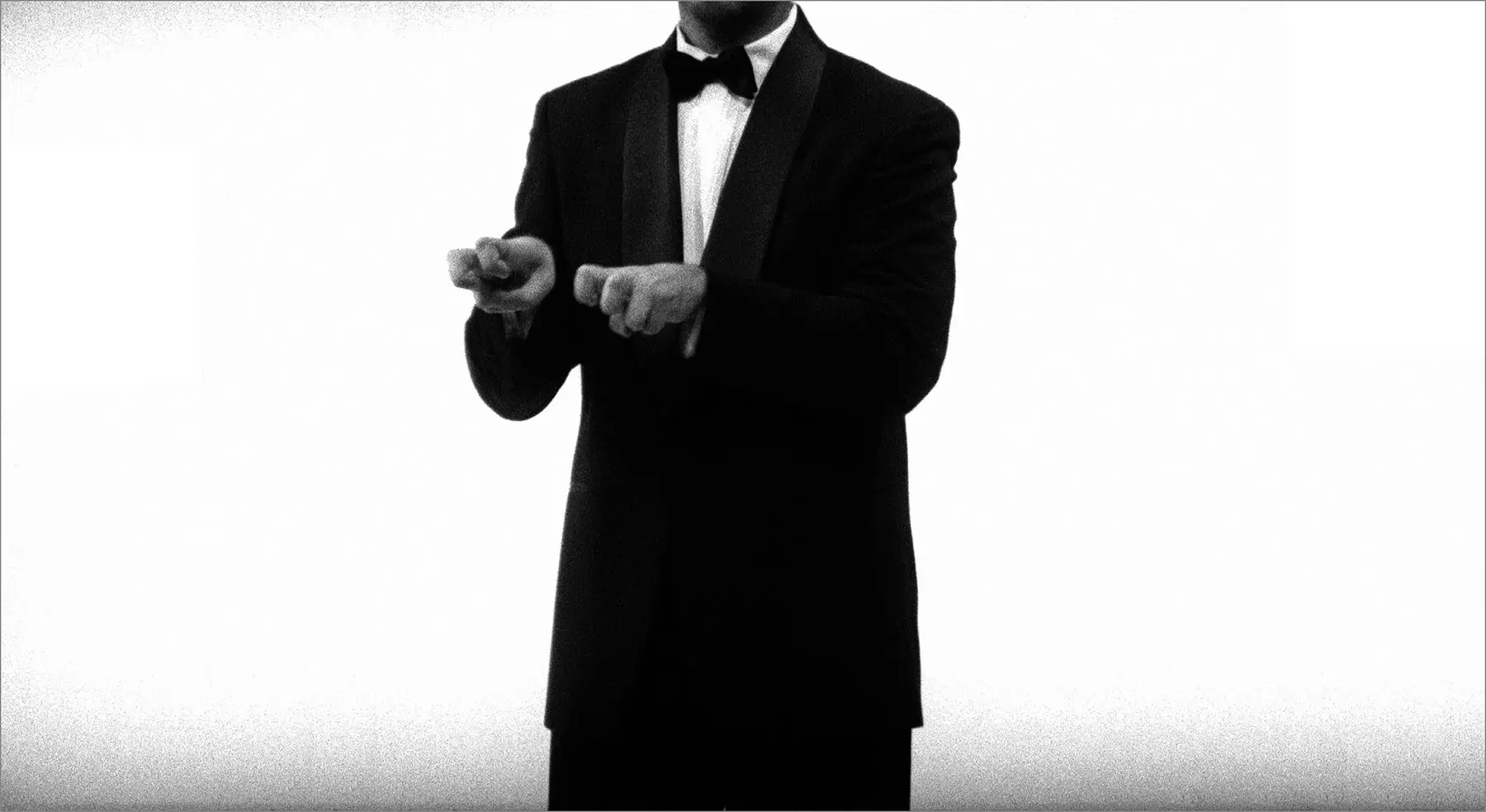
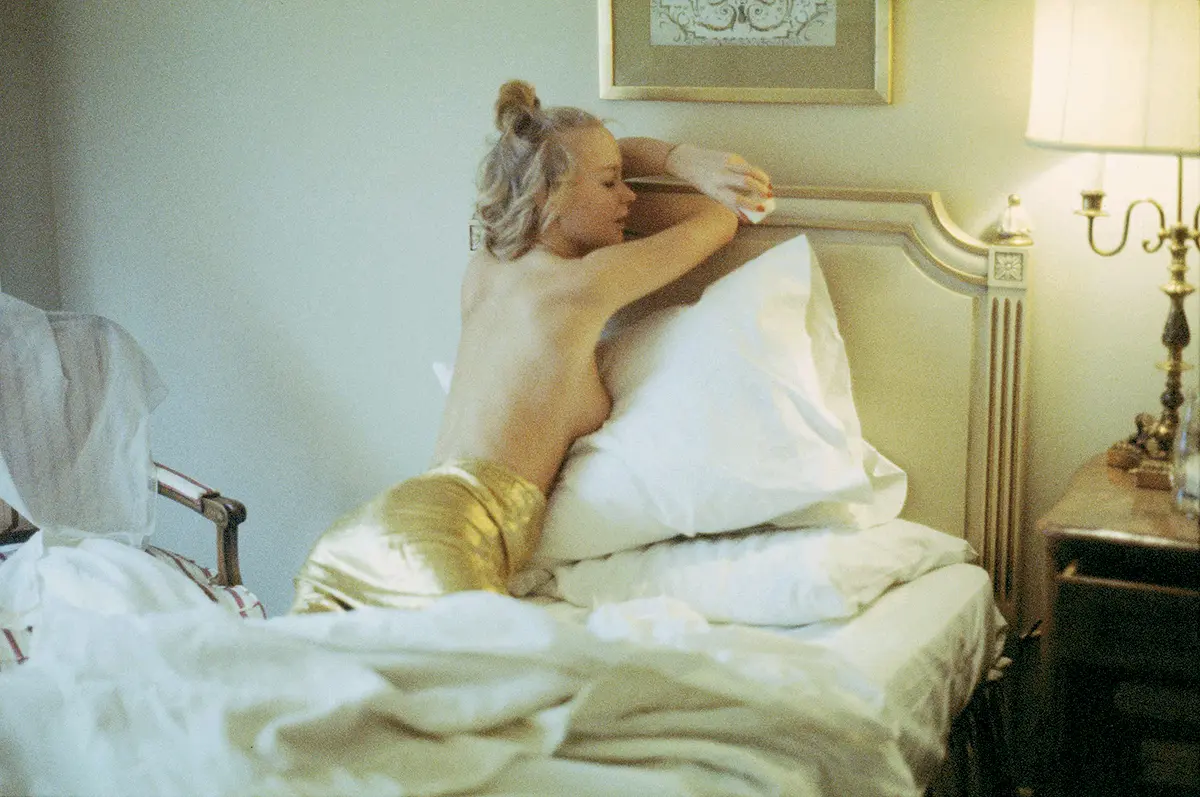
Wolfson’s piece depicts a man from his shoulders to his thighs, dressed in a tuxedo and conveying in sign language Charlie Chaplin’s speech in The Great Dictator. Chaplin’s monologue is a watershed because the film was the only “talkie” by the silent movie master. Simply executed but very high in concept, Wolfson’s 16mm film achieved a poetic subtlety via the conceptual tension between the silent movie genre and sign language and through the projector’s light flickering through the grainy celluloid and the noise emitted from the turning of its reels. Similar in effect as Billy Sullivan’s slide installation of images titled 1969–2005 (2005) that was mounted in one room. Although Sullivan was a friend of Nan Goldin and his work predated her Ballad of Sexual Dependency, there is an aesthetic affinity between the two artists. Sullivan’s slides were projected onto three walls, with the center images showing a nude woman frolicking on a bed in an upscale bedroom, like a kind of soft-porn photo shoot. Flanking her on the side walls were images of men who were possibly friends, acquaintances, and members of Sullivan’s extended social family, some living and others dead. Engulfing the stage on which this cast of characters appeared was a somber yet elegiac audio track. Similar to Roland Barthes’s Camera Lucida in which the literary critic ruminates on his mother’s death without ever showing an image of her in his book, there was a deep sense of pathos in Sullivan’s installation; and the feelings of loss encoded through a spiritual yet corporeal eroticism elevated the installation’s sublimity of mourning and melancholy to redemptive, existential, humanist heights. In short, it was devastatingly moving.
Other works were memorable as well, but not so much for their emotiveness as for their cerebral dimension, such as some fine photographic work.
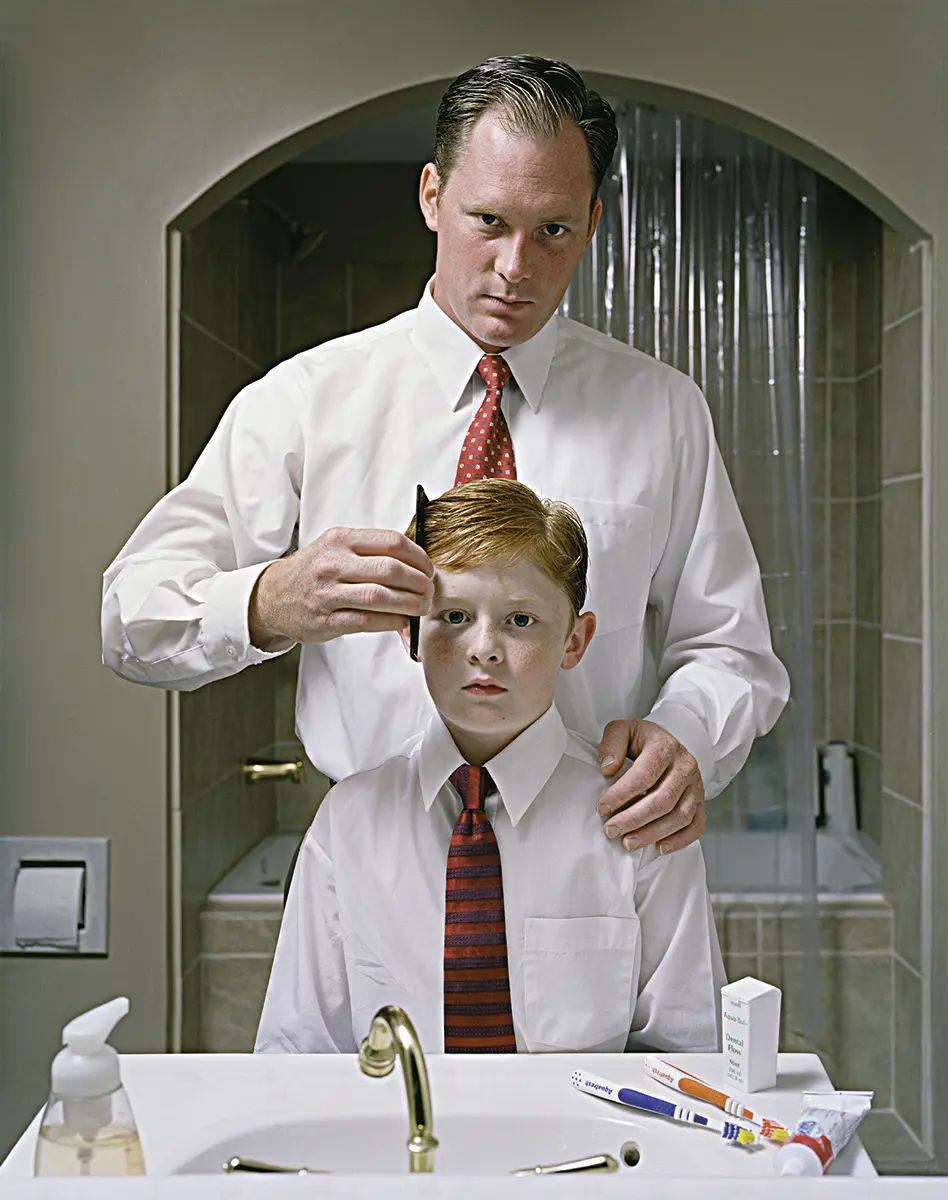
Some of these included pictures by Anne Collier and Angela Strassheim. Collier’s photography combines a stripped-down compositional technique with literary conceptualism. In Spill (2005), for example, record album covers are vertically stacked on a black floor and against a white wall. The only album cover visible faces the viewer and states: “you only tell me you love me when you are drunk.” The slippage between the ersatz record title and its faux-emotive message is compounded by the rest of the albums behind it: is this a bonafide collection of albums in which one end is bracketed by a particular genre, or is this an archive of the confessional? Here, ambiguity is germane, as is the nonchalance of its presentation. This coupling is also integral to the photographic portraiture of Angela Strassheim. Strassheim’s portrayals are vestiges of her previous work in forensic photography, and her attention to minutia is so exact that the images are almost transparent. Untitled/Father and Son (2004) from her Left Behind series is caught somewhere between Tina Barney’s images of upper-middle-class family life and Philip-Lorca di Corcia’s theatrical tableaux. Strassheim’s pictures are too “real” to be staged, yet there is a sincere artifice that reflexively makes us ponder the “unreality” of the “real.”
The painting was also well represented in this year’s biennial, including some fine works by Marilyn Minter and Peter Doig. Minter’s close-up of a woman’s feet wearing stiletto heels, executed in a slightly blurred, quasi-hyperrealist style and made with a projector, laid to rest the naïve view that painters who use image-producing devices are somehow homogenous in style or inferior to those who work freehand.
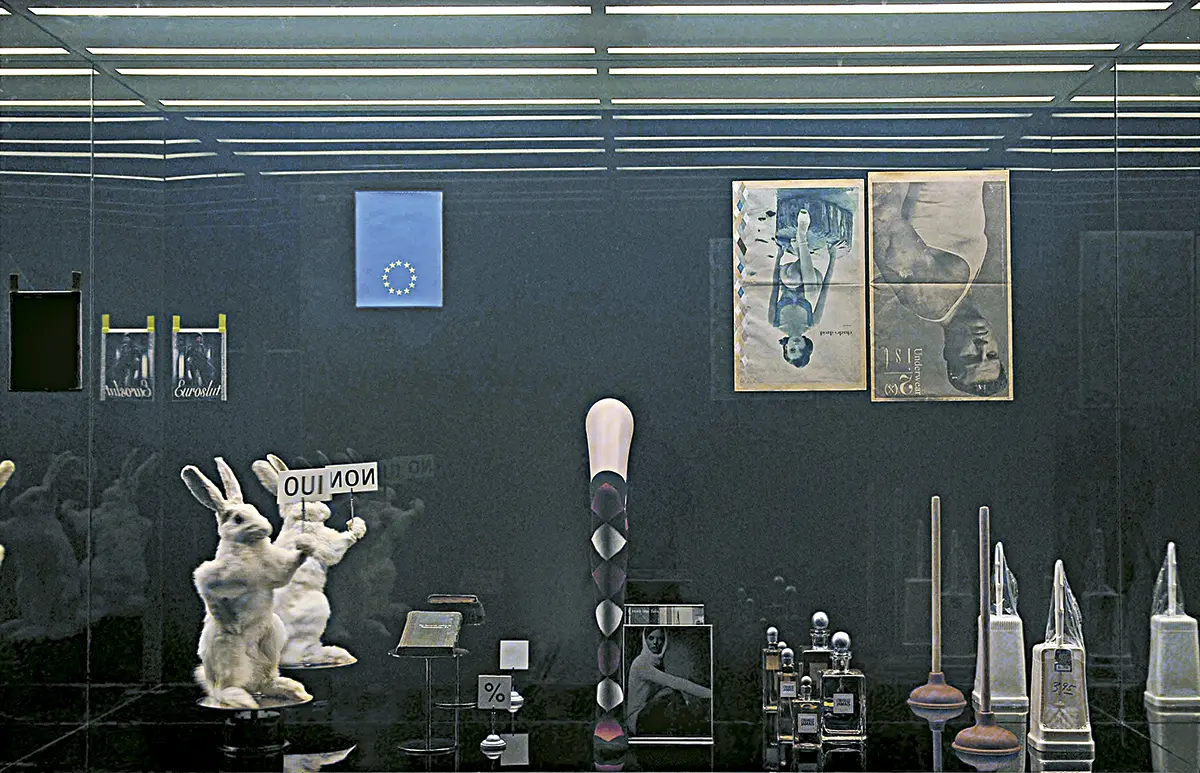
In the area of three-dimensional work, there were some good room-sized installations and individual works such as those from Gedi Sibony, Josephine Meckseper, and Nari Ward. Ward showed a work titled Glory (2004), a sculpture constituted from what appeared to be a light-emitting chamber like those found in tanning salons. Yet if one was to actually use it to tan one’s body, one would be darkened with the stars and stripes found on the U.S. flag. Ward’s piece was one of the stronger works in the exhibition that formally and conceptually conveyed the biennial’s thrust. Implying a process for burning politically charged motifs into one’s skin, this work produced an array of subtexts and metaphors of the biennial’s title. Like Ward’s signature use of detritus and found material in his sculptures and installations, Sibony’s presentation consisted of delicately made objects of flotsam and jetsam that were seemingly haphazardly constructed. Slightly demure, understated, and minimalist, they were more Richard Tuttle and Robert Morris than Carl Andre or Donald Judd. In this instance, however, it was difficult to discern how these sculptures meshed with the biennial’s curatorial purview. Josephine Meckseper’s contribution, on the other hand, refreshingly updated Karl Marx’s theory of the fetish and Sylvie Fleury’s haute couture critique by way of Jeff Koon’s post-Pop consumerism. In The Complete History of Postconceptual Art (2005), Meckseper constructed a window display that one might find in a boutique on Madison Avenue or, better yet, some bizarre ethnographic enclosure of low-culture specimens such as a toilet plunger, a stuffed rabbit, and stockings. Alongside these anthropological objects presented as ideologically neutral was imagery related to political oppositional culture. The conflation of banal and mundane signifiers with more politically charged ones within a backdrop of consumerism and the media was a deft spin on the 1980s and 90s political conceptualism.
Adam McEwen also employed the use of the media as an artistic strategy in his simulacrum of New York Times obituary columns of art, rock music, and movie personalities. As presented in McEwen’s Untitled (Jeff) (2004), Jeff Koons, who has until recently slipped off the art-world radar (though his works always perform very well at auction), has never looked as fresh as in the announcement of his death. It was this slightly dark side to Day for Night that made it a rather successful biennial.
RAÚL ZAMUDIO
New York-based independent curator and critic and host of the talk show Art After Dark.