
In the career of the Mexican artist Yoshua Okón, one can find what appears to be a group of “funny” works: images of police officers dancing awkwardly, improvisers acting in various melodramas in a furniture factory, an interminable video in which only the sponsors appear. In his exhibition at Madrid’s Galeria Espacio Mínimo, this tone continues. One sees young people, absorbed in the music from their headphones, rhythmically shaking their heads or the recreation of a shootout in which the actors say “bang” as they simulate firing their weapons, for instance. In every case, these are works that are balanced on the line that runs between reality and representation; these are works of art in the “homemade” genre, far from the high production values and the purisms that are common in most contemporary art. This obviously deliberate character possesses a special gravity, manifested in the themes to which Okón alludes. His work is funny only on its surface; most of the time it touches on the political and the pathetic without pretension but with great certitude and a good dose of acidity.
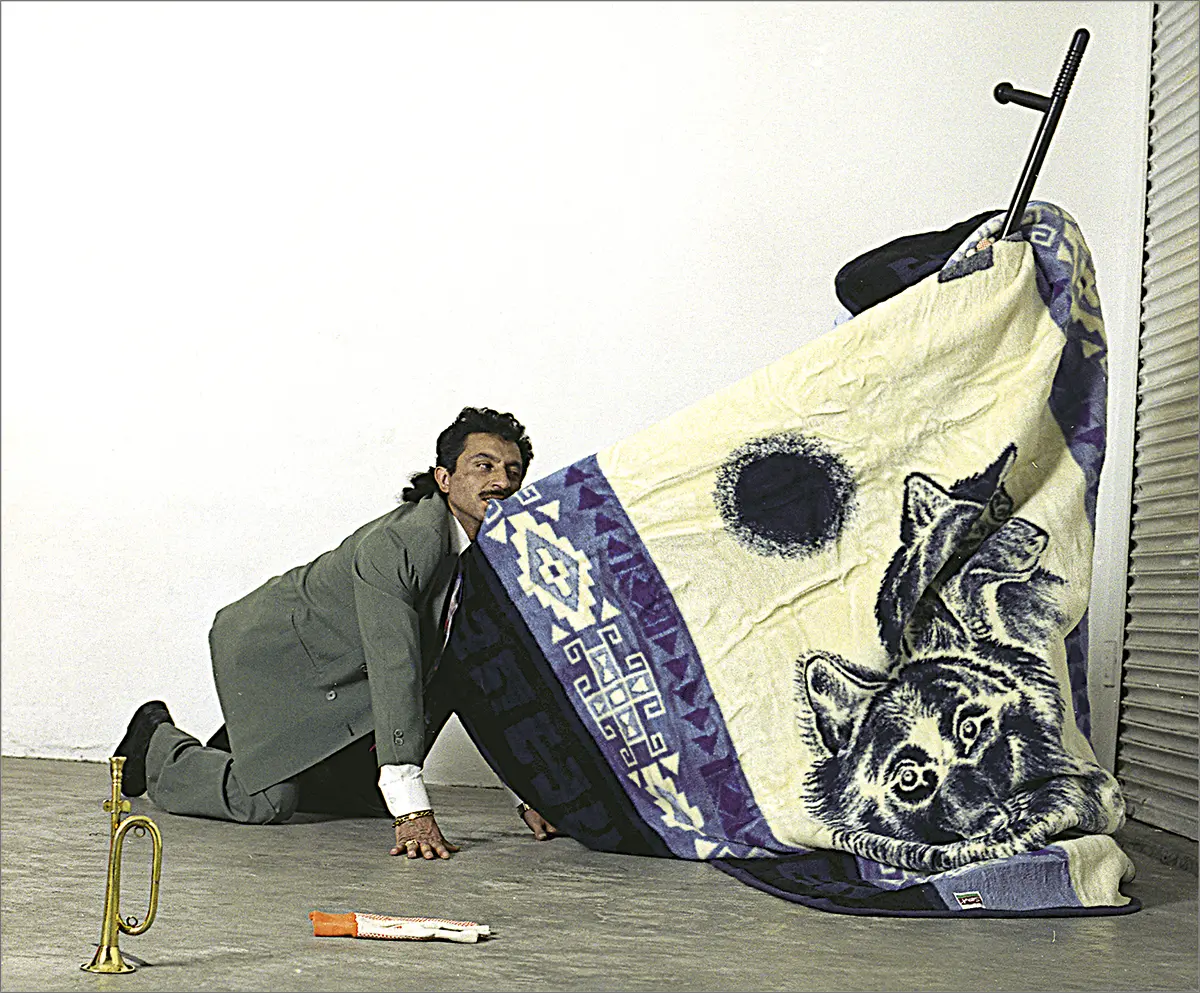
The current exhibition comprises four very forceful works related to one another only by how Okón handles their topics. There is a series of photographs from the performance titled Coyotería, in which the artist reinterprets Joseph Beuys’s famous performance I Like America and America Likes Me, where the German artist enclosed himself inside a New York gallery with a live coyote. In Okón’s work, the animal has been replaced by a Mexican coyote, a person who will speed up bureaucratic processes or help people across the border for a fee. The felt cloth, shaman staff, and newspapers used by Beuys have in turn been replaced by a synthetic blanket decorated with the image of a coyote or wolf, a police baton, and a pile of Tele-Guías, the Mexican version of TV Guide. The parallelism is more than an art historical joke or a facile simile about the proliferation of coyotes in Mexico. Okón’s photographs are particularly strong, inasmuch as they sharply capture extremely idiosyncratic issues that range from the coyote’s appearance—the outfit, haircut, and jewelry—to the reference to Tele-Guía as a substitute for Beuys’s newspaper. The whole display is relentless, not only in its comment about corruption in Mexico or the country’s cultural level but also about the art system and its reach in that context.
Adjacent to this work is the video installation Shoot. In a Los Angeles junkyard, Okón found a dented, bullet-riddled police car. It seems the vehicle had been in a shootout after a bank robbery, which was broadcast by the local TV stations in real-time. On the basis of this anecdote, Okón directed a group of videographers with their cameras to play the role of the bank robbers. He also hired a group of undocumented immigrants from different Latin American countries to play the role of the police. The awkward and improvised action by the cameras and actors nevertheless comes close to the feeling of helplessness one must feel in an actual situation, but it is reversed in this case since the undocumented immigrants who play the role of the police are far from being stars of any Hollywood-style shootout.
The show’s remaining two works are more discreet, but they also incorporate multiple references. US is a project for a monument to be erected in the United States: two huge solid-gold letters forming the word "US" stand both for the pronoun and the country’s acronym.
Finally, in Jedbangers, a screen placed atop a speaker pyramid transmitting white noise displays sequential images of headphone-wearing youths rhythmically shaking and nodding their heads. Their eyes are always closed, and they do not appear violent or menacing as they float against a dark background. On the contrary, absorbed in their music, they seem to be executing some kind of ritual exercise. The work is a reflection on the levels of introspection and individualism among today’s youth.
As a whole, Yoshua Okón’s work alludes to everyday situations that, when separated from their context, appear strange, awkward, and even pitiful. These works unsettle to the same measure that they reveal a small part of ourselves.
ISSA MARÍA BENÍTEZ DUEÑAS