
In the late 1960s, Latin American artists interested in conceptual art were a minority. More than thirty years later, however, their immense contributions and the persistence of their ideas are plain to see. It could be said that conceptual artists from other regions such as the U.S. and Europe were interested in questioning art, its traditional status, and its official institutions, while in Latin America, conceptual art was an ideal solution for political, social, and cultural contestation. The balance in Latin America seemed to work around this formula: the more dictatorship, the more conceptual art. In this equation, the Latin American countries with the strongest dictatorships were Argentina and Brazil.
Miami Art Central (MAC) is the first museum in the United States to present significant exhibitions of work by Victor Grippo (1936–2002, Argentina) and Ana María Maiolino (born 1942, Italy). Although Grippo and Maiolino do not represent the spillage of the political or the social into conceptual art in the same direct manner as others of their generation, they are deeply connected to it. Grippo’s work is subversively social and cultural; Maiolino explores the limits of a subjective language.
One can say that Grippo is as special as Fontana, although he has at times been excluded from such important shows as Inverted Utopias at the Houston Museum of Fine Art in 2004. This large exhibition at MAC, however, offers a chance to know his work in depth.
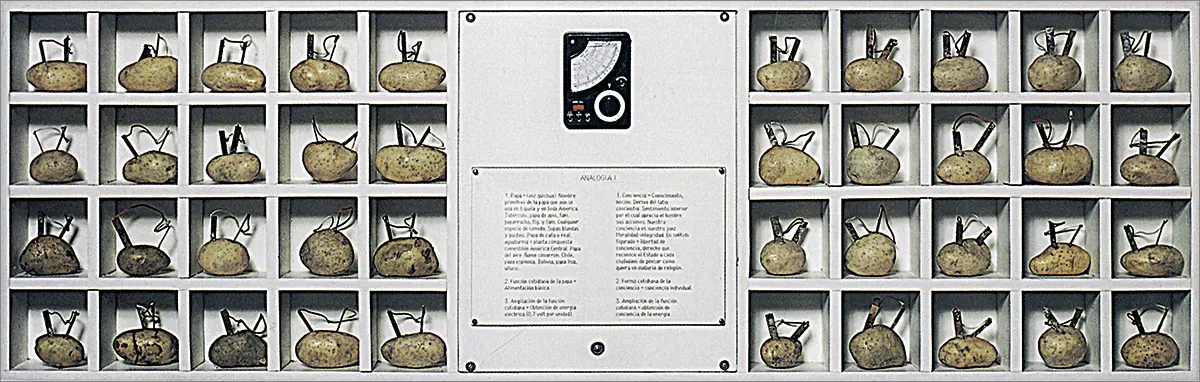
By 1971, Victor Grippo had already conceived his magnum opus, Analogía I, which demonstrated the energy contained in forty potatoes, each in a separate compartment, as captured by electrodes and a voltmeter. It was “a disconcerting work in the elements used and its conceptual problematic,” according to Nelly Perazzo, who has studied Grippo’s work for several decades. Perhaps what could be seen as disconcerting, represented through the scientific and the organic, is Grippo’s highlighting of the unity that exists between the divine and the natural, as though in a declaration of mystical union.
Analogía IV, from 1972, is the MAC show’s centerpiece, an expression of wise perfection. In its simplicity, this work confronts and integrates many concepts: the natural and the industrial, the sublime and the sordid. The final result is a surprising connection of beauty with what could be understood as the terror of existence. Another of Grippo’s most interesting sculptures is, undoubtedly, Vida, Muerte y Resurrección (1980). Inside shapes built with lead sheets, black-bean seeds emerge, germinating. But the exhibition’s museography didn’t allow for showing the work in progress, as it was originally conceived.
The exhibition of Ana María Maiolino’s work also allows an in-depth look at her practice. Maiolino’s entry into the Brazilian scene with paintings and graphic works as a member of the New Figuration movement marks her initial artistic period. In the early 1970s, Maiolino took a bold leap, conceptualizing her work and also giving shape to the geographic continent she inhabited.
Space and matter give way to a series (Buracos Negros, 1972–1974) of ripped volumes or planes, which Maiolino cuts, breaks, and moves from the center of the plane to leave only the large hole and uses the empty space as volume as if wanting to demonstrate what Helio Oiticica called “the organic visual.” Referring to this series of works, Paulo Herkenhoff said, “It transforms surfaces within spatial vertigo.”
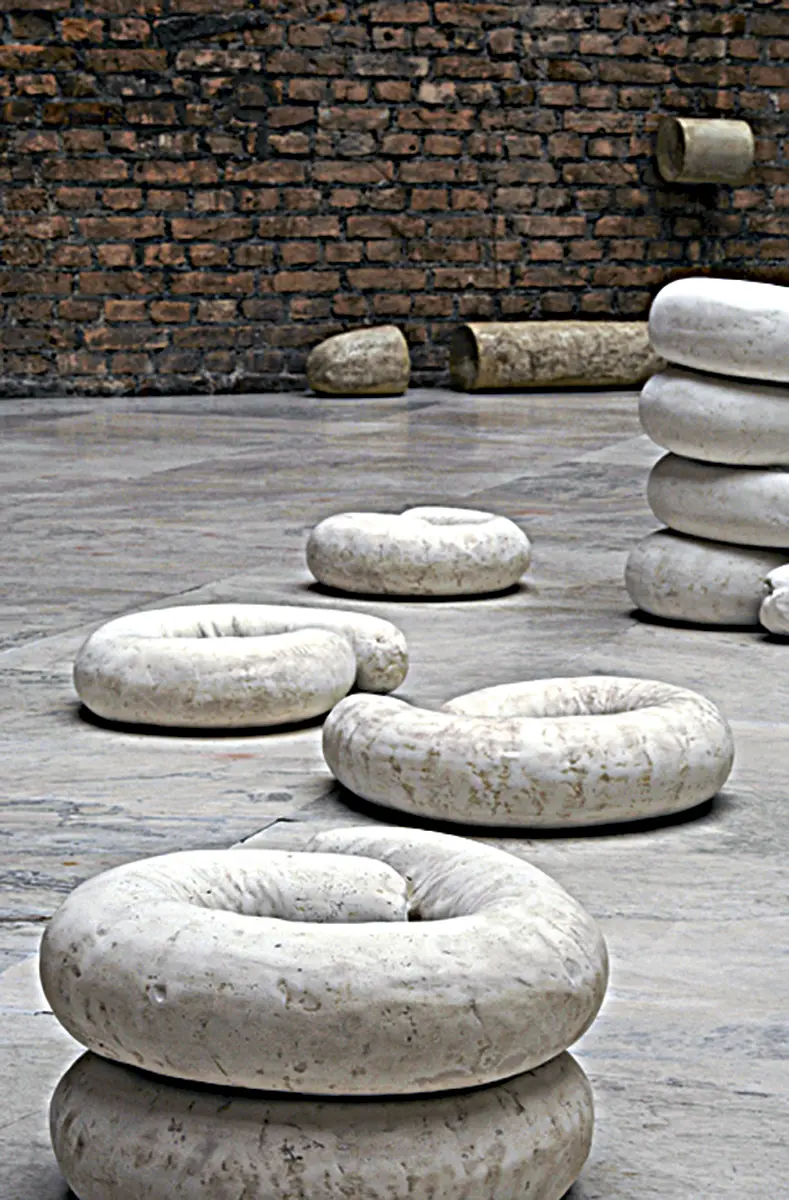
Maiolino’s preference for matter in dialog with empty space is consolidated with the series A sombra do outro from 1993–1999. Large jumbled volumes in white clay simultaneously expand through the floors and the walls of the gallery, “like a poetic act that acts on the world,” as Lucio Fontana once said. In order to understand the work of Brazilian artists from the Neo-Concretists to later generations, one needs to be familiar with Fontana’s oeuvre. These ideas, based on his Spatial Concept, are what also gives vitality and an enigmatic quality to Maiolino’s work.
Also shown among the videos is her great installation Entrevidas of 1981, where the public walks over a paved area covered by hundreds of eggs. With control, the viewers walk around the eggs with the same care needed to walk a tightrope or a minefield.
EUGENIO ESPINOZA