
The drawings in Ana Patricia Palacios’s Absurdos paralelos I exhibition reassert a tendency that was evident in her previous work. Palacios had been exploring an absurdist path that displays the incongruities in which seemingly quotidian characters fall, and it becomes more prominent in this series.
Palacios starts from personal experience. The issue is no longer the idea of doubles understood as twins. Rather, duality describes how two characters that appear to imply the other actually reveal clashing or complementary aspects; for these subjects, the search for individuality involves confronting contradictory states with which one necessarily coexists. Palacios intuitively chose references to the art of the clown in order to emphasize burlesque situations.
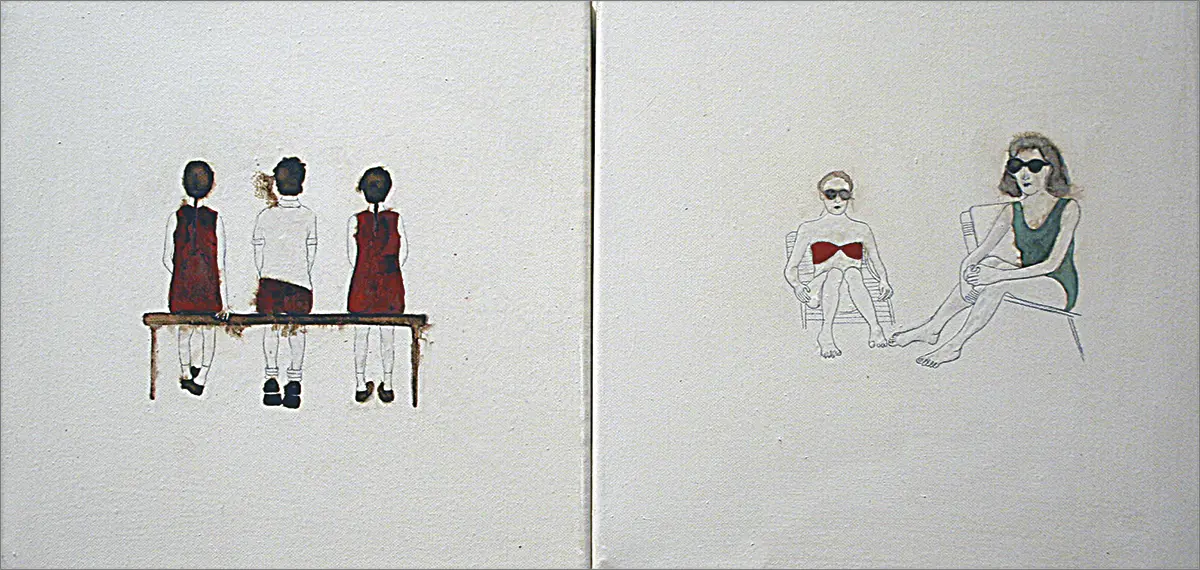
This complex and ambiguous relationship between duality and individuality drives Palacios to work in series that allows for the emergence of new characters. For example, in La pareja (2006), a commonplace situation shows two characters that appear empty inside using simple corporal language. The viewer is left with the tasks of imagining and evoking where he or she is situated as an individual. In this assumption of what is irrelevant, it places the viewer squarely in front of the complexity that lies within simple things.
In La espera (2006), the figure’s eyes are covered, awaiting something but unable to move forward, as if incapacitated. The images are evocative and reflect imaginary situations within the flow of every day, and the viewer, knowing what takes place, feels questioned.
Another shift vis à vis Palacios’s previous work is that she seems fundamentally interested in body language and strips other elements away to arrive at a very austere style both in her handling of figures and color and her depiction of space. Formally, these works are less static; they display surprising movements and grant their characters autonomy. Drawing becomes a protagonist, used to capture moments of spontaneous form.
Palacios’s scenarios seek to go beyond what is seen; her characters seem to be questioning us with their actions. Their dual relationships suggest the possibility of other meanings, and what dominates the work is human feeling in the face of collective absurdity.
IVONNE PINI