
Adan and Eva, the extraordinary and controversial drawings presented by Antonio Fonseca in some recent international art fairs, along with his recent Bacchus have prompted many to wonder about this young artist whose work explores the limits, precipices, and freedoms of sexuality while confronting death. What critics saw in Fonseca when he was a student at the Escuela de Artes Plásticas de Puerto Rico in the 1990s was an excellent artist with the potential to interact at the same level as artists of the previous generation, such as Arnaldo Roche Rabell, Mari Mater O’Neill, and Jorge Zeno. This is evident today, as this chronicler and transgressor present his most recent paintings and drawings at Galería Viota, under the title of Doble Sentido, inviting us to reevaluate everything he has done after graduating from the Master of Fine Arts program at Cornell University in 1999.
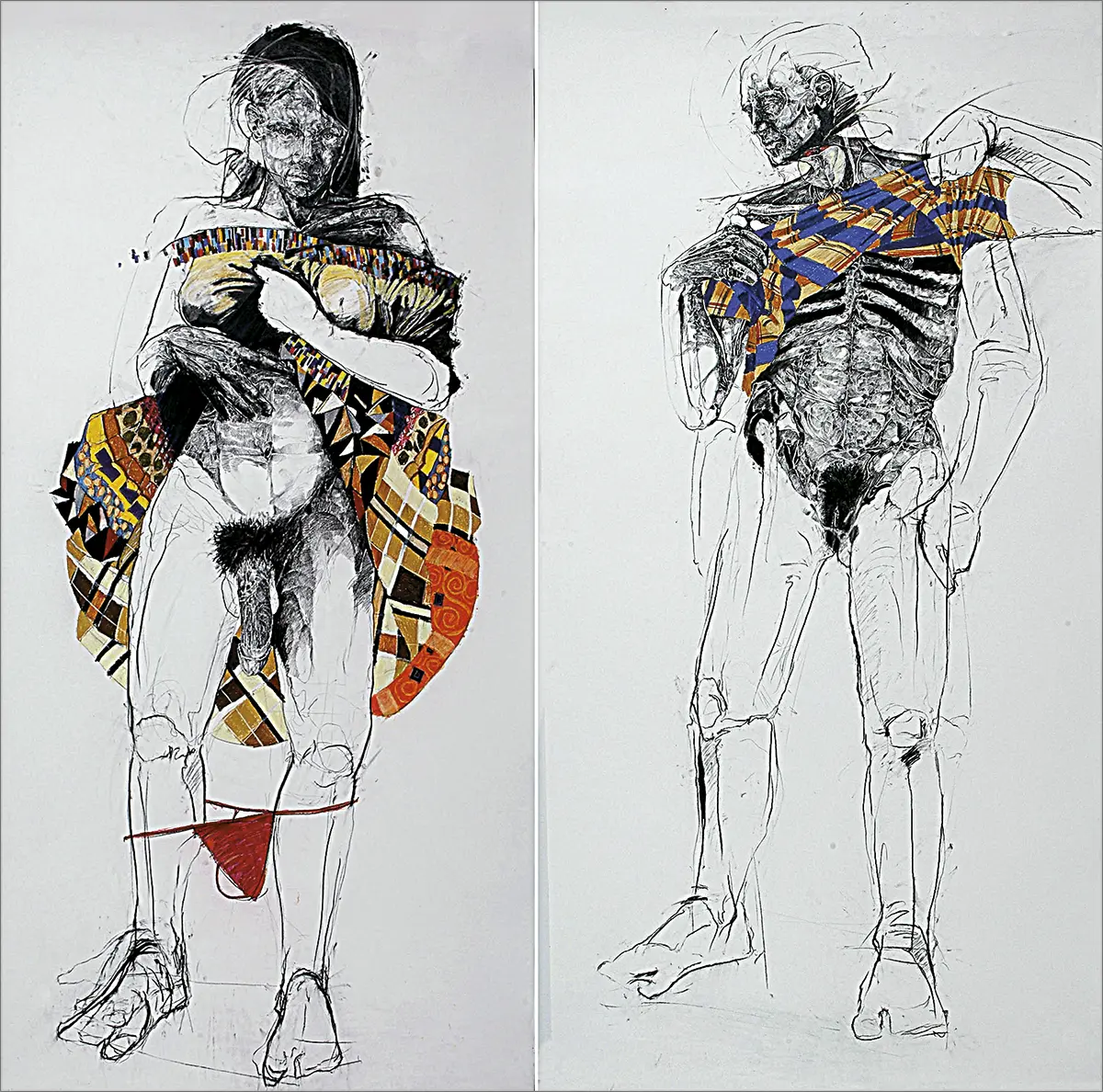
Fonseca (born in 1972, Puerto Rico) received his education from Puerto Rican masters. However, it was the painters Domingo García and Arnaldo Roche Rabell, and the printmakers Myrna Baez, Susana Herrero, and Haydee Landing, who most influenced the development of his aesthetic and ethical discourse. From them he learned the different beauties, depths, and enigmas of men and women as they translate into art; from Susana Herrero in particular he accepts and makes his own the sexual ambiguity and the bodily passion that she conveys in her work, and Roche Rabell helps his venture into the construction of his own tropical baroque. But it is with Haydee Landing—an extraordinary printmaker educated in Mexico and a creator of fascinating pantheons of phantasmagorical beings who remind us of Juan Rulfo’s characters in Pedro Páramo—that Antonio Fonseca establishes an intelligent and honest dialogue, and this is the key to understanding the first period of his artistic production. His first characters emerge in this period: “forces” that seek their space and reason for being or happiness in life. It is also during this period that the presence of human skeletons as symbols of death, life, and evolution begins in Fonseca’s work. From that point, the artist brings to life the eternal struggle between Eros and Thanatos, the constant struggle of flesh and spirit, the perpetual struggle between injustice and justice, and the pronounced borders and barriers of sex. These works are hard and difficult, but they also contain an astonishing existential lyricism, which has helped this young artist win prestigious local prizes.
In the MFA program at Cornell University, Fonseca worked under the guidance of a group of prestigious artists. After exposure to Eco and his semiotics and the proposals of postmodern thinkers such as Derrida and Foucault, and specifically Baudrillard’s theses and, of course, Freud and Jung, Fonseca’s work reached a new eloquence and required multiple readings.
For the composition of his new scenarios and chronicles, the artist assumes both the position of the protagonist and of the voyeur in topographies of ambiguous sexualities. In them, we see the labyrinthine play of his subconscious with the realities that surround him: his marriage, his minority condition in the United States (living in a New England that is at once liberal and full of rigid structures, where a Caribbean person is the Other, different, and indecipherable), and being from Puerto Rico (a colony that believes it is part of the First World but is an island of contradictions in a Caribbean sea of carnivals and globalization), and his positions regarding sex and sexuality.
In his latest drawings, mixed-media works, and paintings exhibited at Viota Gallery, Fonseca continues to leave behind hindrances and fears and decides to build scenarios with no rules where, in the words of the Puerto Rican reggaetón artist René Pérez, the Resident of 13th Street, “Se Vale To’ To’ To’” (“anythang, anythang, anythang goes”). In his forceful, provocative Toxicidad social, Fonseca creates baroque postmodern tableaux where he builds a corner of his own mythology, filled with hallucinatory combinations of references: a George W. Bush with Mickey Mouse ears crowned with a quarter; an angel announcing to Fonseca (who poses as John Lennon) the coming of the Apocalypse; a graffiti-crowned female dog. Although this and other recent paintings are outstanding, the transit from drawing to painting has not always been easy for Fonseca. Sometimes the subtlety, drama, and depth that have defined him simply do not translate to painting. Seen in its totality, however, this new work by Fonseca is cathartic and achieves its goal: to have us analyze life, as Socrates instructed twenty-five centuries ago.
MANUEL ÁLVAREZ LEZAMA