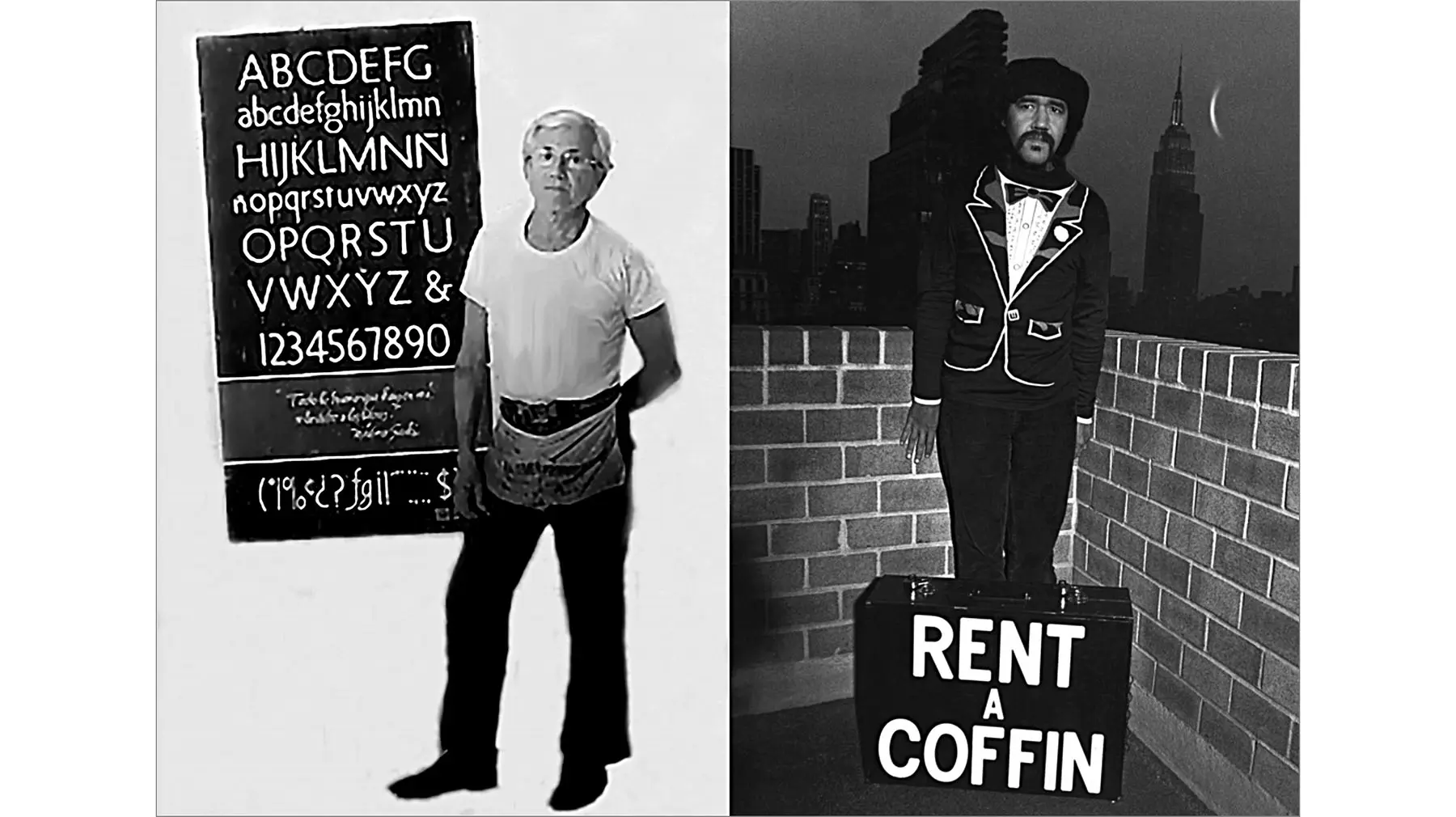
After their deaths, the links between Lorenzo Homar and the Reverend Pedro Pietri are clear. Homar (1913–2004) was not simply a master printmaker; many claims he was the most important silkscreen artist and graphic designer in the modern art history of Puerto Rico. Pietri (1944–2004) was active and known for years within the Nuyorican community as a poet, social provocateur, and organizer. Why are they brought together in this exhibition? Aside from the use of words, little seems to link the mainstream rational processes and formalist values of a poster designer with the free-form signage and irreverent street performances of an angry, edgy poet who chose the social margins. One wonders what was in the curator’s mind and, more to the point, what is newly presented and learned.
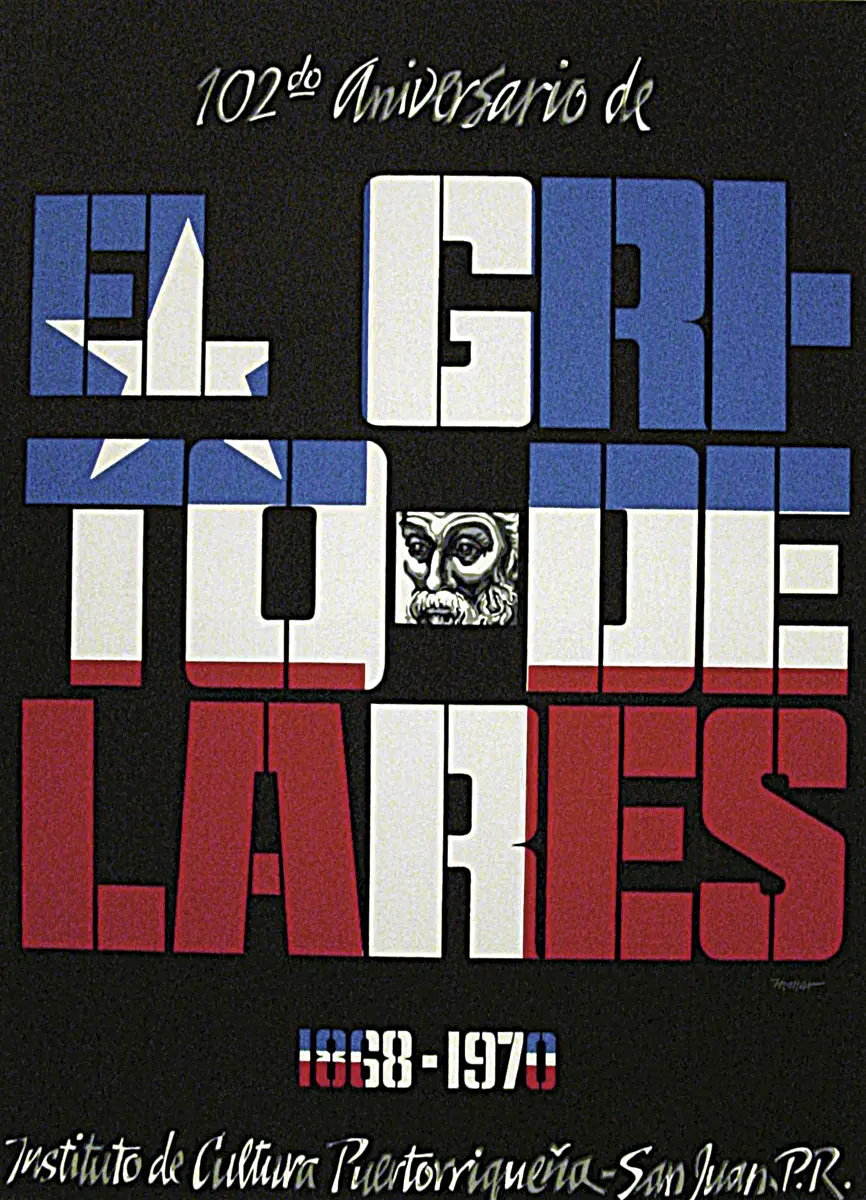
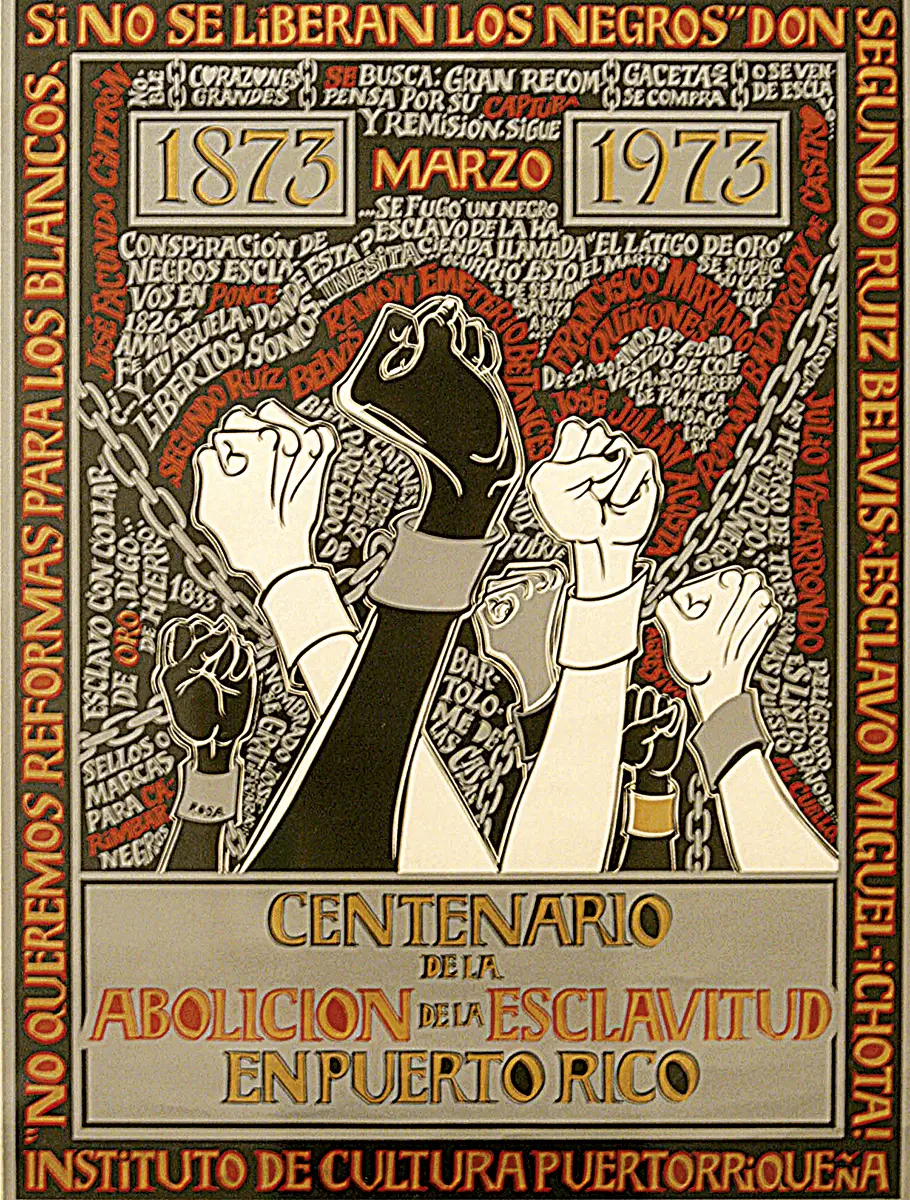
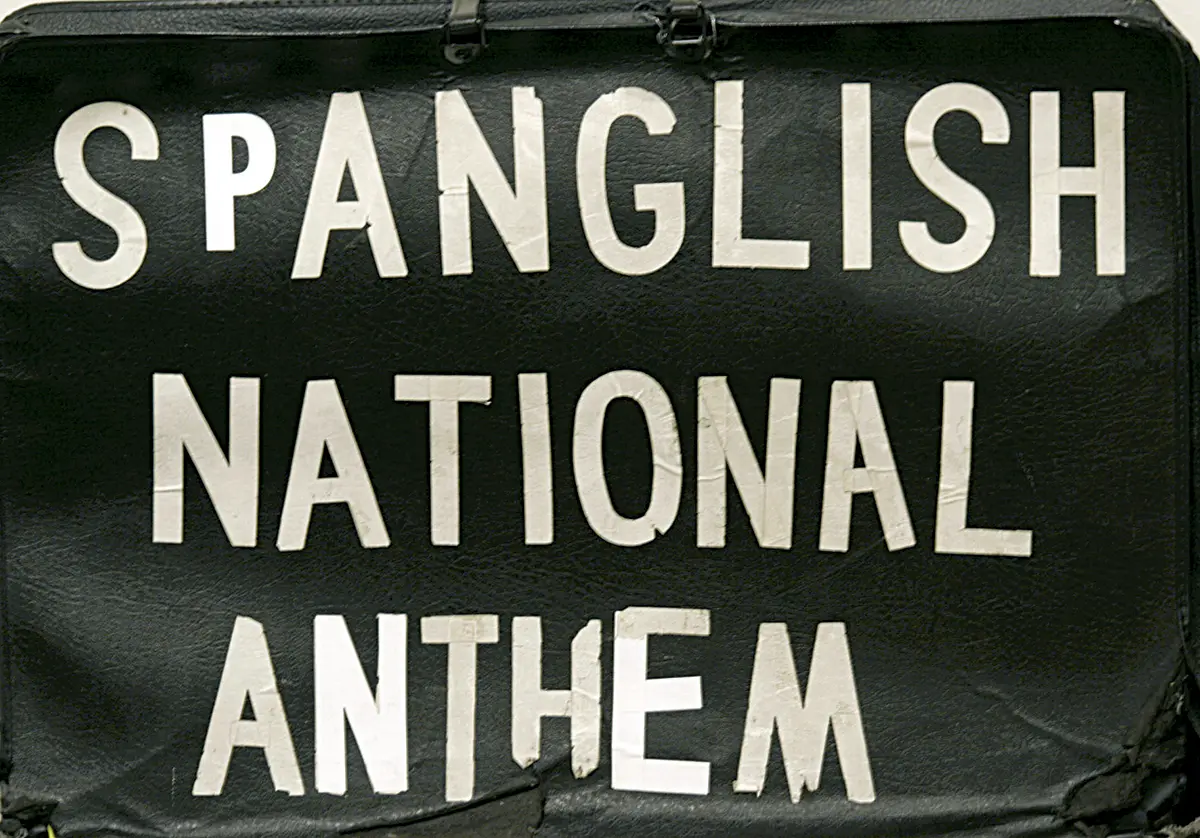
The separation between their respective bodies of work is enforced by the exhibition design. Homar’s crisp graphics enlivened by abstract and at times expressionist experiments with interwoven blocks of color neatly line the outer, rectilinear hallways. Pietri’s black-and-white, frequently ragged, hand-lettered signage and many personal artifacts from his performances and life—which include the condom-covered cross he often carried and several videotapes of his poetry performances and interviews—are concentrated in one central room.
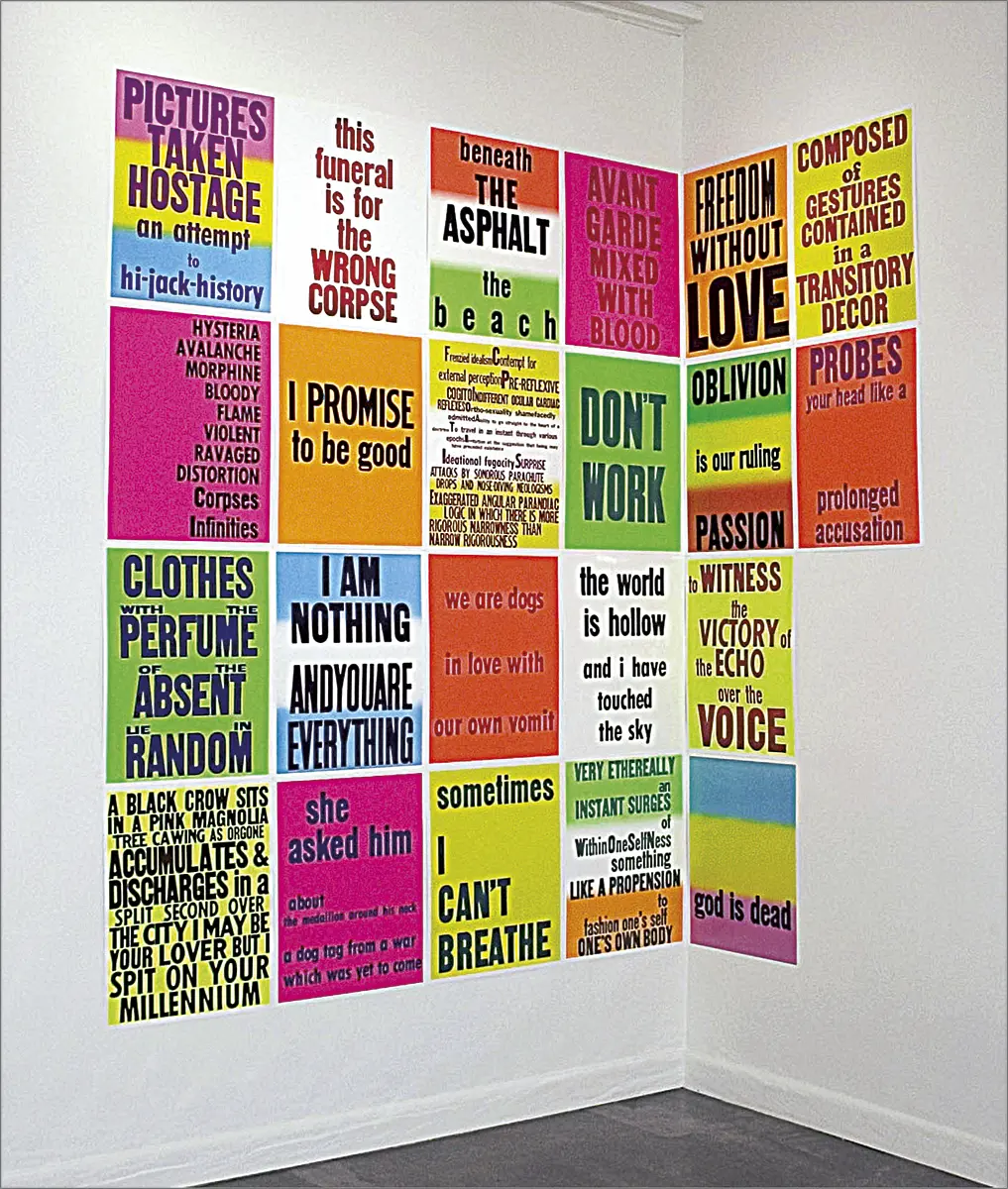
Both have separate rooms featuring the artists they influenced; this was no small accomplishment of art history by the curator Margarita Aguilar. Homar’s friends, collaborators, and disciples are those of the international modernist generation, with posters and book designs dating from the 1960s and 70s. Here, the exhibition’s emphasis on words as the connection between the artists seems quite literal. As Homar’s graphics illustrated and expressed the words of many authors, so too did the graphic work of his colleagues José Alicea and Antonio Frasconi. They also share a common allegiance to authors, images, and traditions easily located within Puerto Rican popular culture. Indeed, culture more than art is the most insistent theme, the space between the lines, found throughout the exhibition. This includes the difficult-to-discern but all-important attitudes toward culture.
For instance, the prints of saints by José Castellanos treat text and image irreverently but beautifully in a self-conscious parody, typical of a popular culture that considers its beliefs seriously yet satirically. His work makes obvious cultural attitudes and distinctions within the mainstream, not cultural contradictions. It is the exploration of this double-sided, culturally inherent attitude that unites Homar, Pietri, and their friends. Jaulabra en la Labra, the intriguing, interactive, graphics-based mixed-media installation by Antonio Martorell and his friends from 2004, tells the viewer that the relation between graphics and words is not one of static illustration but a dynamic, physically embodied, and demanding process closer to Pietri, the poet.
The Reverend’s circle of collaborators and colleagues in the art world—to momentarily, if falsely, distinguish visual art from the world of street poetry—seem of a different generation and world, that of conceptual and performance art, with emphasis on process more than a product. The performances, installations, and writings of ADÁL (Adál Maldonado) and Guillermo Gómez-Peña align with Pietri’s dedication to developing a sense of national and cultural identity. Papo Colo, the co-founder in 1982 of one of New York’s most egalitarian and avant-garde galleries, Exit Art, has a similar concern but a different direction. He argues for “zero identity,” accepting a hybrid state based on your own reality rather than those assigned to you by the world. Yet, he too has always seen people as “producers” of culture. The strongly conceptual, printed posters and projects of Daniel Joseph Martinez complete the now-altered circuit, returning to the use of graphic posters of Homar’s tradition but using the satire and parody—albeit less direct and more conceptual—found in many of Pietri’s projects that were constructed as public interventions. Homar and Pietri appear closer than at first thought.
It is true that poets and writers concern themselves with words spoken, written, and conceptualized. And graphic designers are by nature tied to social needs and often progressive cultural contexts and concentrate on words authored by writers and poets, giving them physical form in traditional and contemporary ways. Homar worked within the graphic mainstream but also altered and reconstructed it. Pietri worked in the avant-garde tradition of poet-critic as an outsider, but he helped construct a mainstream from a margin—the Nuyorican cultural movement. Both figures share concerns of culture and Puerto Rican identity and have provided strength and influence to others. These are important similarities and differences, used to construct legitimate and linear histories of art and culture. In writing missing or lesser-known histories, the exhibition is successful and necessary. But the exhibition also seems self-conscious that this very necessary process is flawed, doomed to reinforce the constructions of culture through traditional western art history as inside/outside or mainstream/margin. History is far more rugged and untidy, with differences that depend on the nature of the culture.
The term “words” can also be understood as actions, taken or intended, in cultures where ideas carry weight. Linear divisions used in traditional modern art history separate words from visual objects in the name of common-sense scientism that links objects with actions. But what if a culture is poetic? Does such a schism apply? What if culture creates its importance through song, music, dance, writing, and a general vitality whose dynamics of identity infuse all? How is one then social, political, or “real”? Is it fair to judge Pietri as marginal when his social strength founded a cultural identity? Is it fair to judge graphic designers as merely mainstream or as non-political in such a situation? The boundary lines waver.
The space between the lines appears not only as an attempt to align two creative individuals who did not seem connected but also to ask how Latin American and specifically Puerto Rican art needs to be assessed in relation to culture. It is true the Museo del Barrio is dedicated to the history of the Latin community, but that historical engagement takes place within a larger frame at a time when the very foundations of historical construction need to be re-evaluated. Perhaps that is why so many museums mounted large exhibitions in the early years of the new millennium to explore different ways to write the history of art. Their scale may have blinded them to what this small, thoughtful, innovative exhibition tells us: history emerges most distinctively from between the lines where art and culture intertwine.
RICHARD LESLIE