
Recently, Carolina Antoniadis presented her works simultaneously at Centro Cultural Recoleta and at Galería Infinito in Buenos Aires. Both exhibitions were testaments to the maturity in her work, where the decorative and sensual color and line describe sinuous labyrinths related to everyday life and family memory.
In work from the late 1980s, such as El fin de los sueños (1988), it had already become evident that Antoniadis’s investigations in space clamored for protagonists. These works are characterized by a flattened, saturated space where human figures of different scales are superimposed or slide through abstract nuclei in a vertiginous and arresting decorativeness. This decorative spirit seems to void the flatness but at the same time reconstitutes it in a graceful and consonant vitality very much of our times. Indeed, contemporary advertising and graphic art so influence that feature of Antoniadis’s art such that Elena Oliveras has accurately described her “collage mentality.”
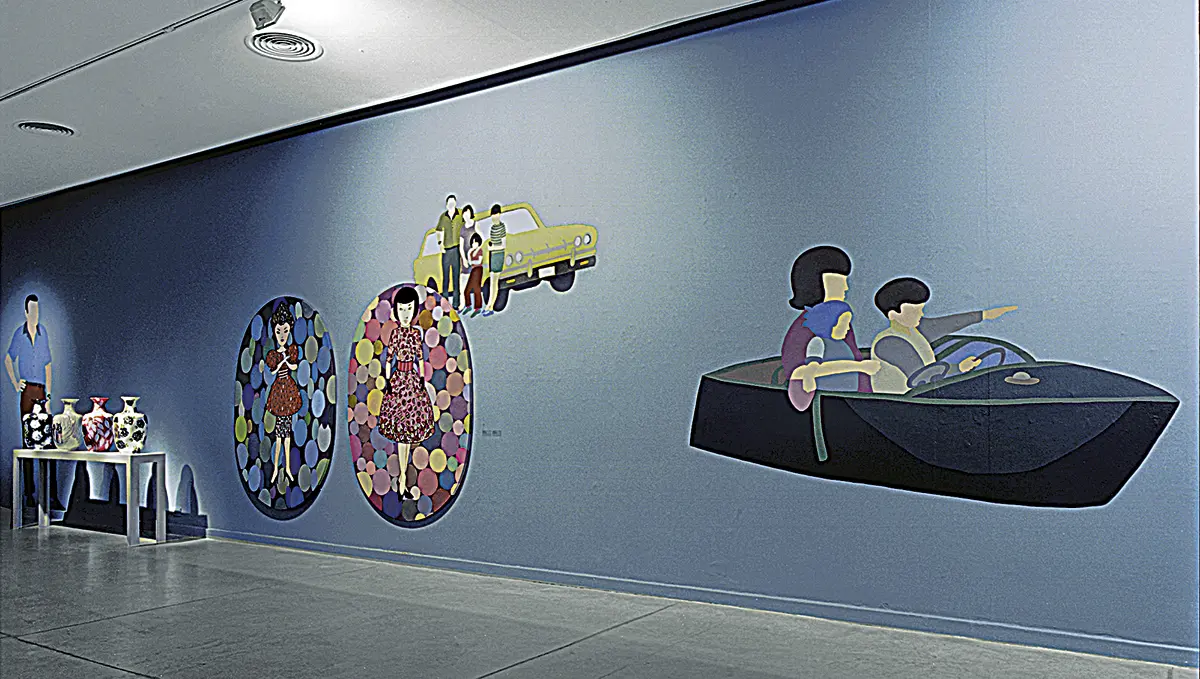
Antoniadis’s interest in college has allowed her to retain her heterogeneity and controversial spirit, assimilated to a certain cool and conceptual climate that characterizes some artists of the 1980s generation. In this way, the space in her work acquires an outsized dimension because of the overabundance of figurative and non-figurative references that clash, fragment, and push toward various interpretations. Among the non-figurative elements, some break the unity of the image and also give it cohesion, and others come from Antoniadis’s deep involvement with decorative elements. Artisanal or industrial, textured or smooth, from furniture or fashion, standardized or less conventional—these elements are distributed on her surfaces with limitless variety and exuberance.
And, as in an endless chain, various traces, motivations, and strata of her subconscious appear. Her grandmother and mother were linked to the fashion world. The latter had a decisive influence in stimulating Antoniadis’s imagination and helping her to see through the opacity of the everyday. Other familiar figures—her father and her brother—emerge in her photographs along with her grandfather Demetrio, the painter, whom she only met through his work. Beyond any idealization, her remembrances and phantasmagorias of childhood reveal early access to doors that open and walls that crumble in the perception of the everyday. There is no enclosure, only the joy of living that the artist has carefully preserved in her work, corroborating Nietzsche’s idea that art affirms.
Antoniadis was born in Rosario in 1961. From her family tradition, she acquired a positive embrace of life, of poetry, and of creation—of the manipulation of materials to make them say something beyond the apparent. Naturally, she tells us of the world of her generation with the keys that her family gave her. This is a different angle from which to understand the intricate and surprising networks of her two-dimensional work, as well as of her objects or reliefs.
George Steiner has spoken of that uniquely human experience of expressing through different verb tenses—especially through subjunctive, conditional, and future tenses—the possibility of deflecting the power and inevitability of unmediated facts. The expression of time is a determining factor in Antoniadis’s work. When she titles her paintings Pretérito perfecto or Pretérito pluscuamperfecto or Indefinido, she is speaking about her past with a sly sense of humor, as in a schoolroom parody. She also speaks about the possibility of subtly introducing in the past-turned-present the human esprit de finesse that allows us to play with tenses, genders, and our very history, and to creatively multiply our perception of reality.
NELLY PERAZZO