
David Palacios is a Cuban artist who has been living in Venezuela since 1991. Since his arrival, he has played a dynamic and uninterrupted role in the local cultural scene, first as an illustrator in important print media and later as the author and promoter of creative projects both individual and collective, in which he continuously interrogates aspects of the artistic production system. Each one of these projects—some presented in exhibition spaces, others in urban sites outside of the art context—questions the modes of production, circulation, and consumption of art to the point that, as has been written previously, Palacios’s proposals are not circumscribed to the work of art as an object but reach into the creative strategies that surround it.
Working on the periphery has been one of Palacios’s constant interests. He had already developed events of that nature back in Havana, such as EJA: Empresa de Juguetes para Adultos and Proyecto HACER -Comunidades- (1990). This effort has continued in Caracas, individually or collectively. As a member of Grupo Provisional, alongside Félix Suazo, Domingo D’Lucia, Juan José Olavarría, and Juan Carlos Rodríguez, Palacios has created various projects, such as La Fiesta del Agua in the La Bandera neighborhood (1998) and Del Prebacheo al Montacargas, presented in Valencia in 1999. But he has also exhibited with the group in important events, such as the 48th Venice Biennale and La Tarja at Sala Mendoza (both in 1999), Born in America (Museo Jacobo Borges, 2000), and Politics of difference: Iberoamerican Art of the End of the Century (Centro de Convençoes de Pernambuco, Recife, Brazil, and Museo de Bellas Artes de Buenos Aires, 2001). Palacios has also worked on individual projects that dismantle the topics that have occupied him throughout his career. In Repuestos Pirelli, a brochure from 1999, he ironically compares fragments of installations exhibited at the 4th Pirelli Young Creators Salon with hardware-store items, as if these were goods of identical value. In Art porcentual, Análisis estadístico de la instalación: Naturaleza muerta, the end (Sala Mendoza, 2000), he posits in statistical terms situations that are characteristic of a painter’s work (such as, for instance, the time it takes to do an oral portrait or the percentages of materials used by the artist). In Zona de distension, Inventario y estadísticas de una experiencia de diálogo (CELARG, 2002), he assumes the role of artist/curator to show the results of his experience in a traditional ceramics workshop in Guatire, on the periphery of Caracas, where he sought among other things to negotiate the distance between the artistic and the social.
These exhibitions have been characterized by their sobriety and professorial mode of argumentation. The artist presents himself as the analyst of each of the facets in the system of circulation, promotion, and sale of works of art, and even of the exhibitions themselves. The result is a dual paradox: the system is subjected to irony, but at the same time it is required to carry out the project.
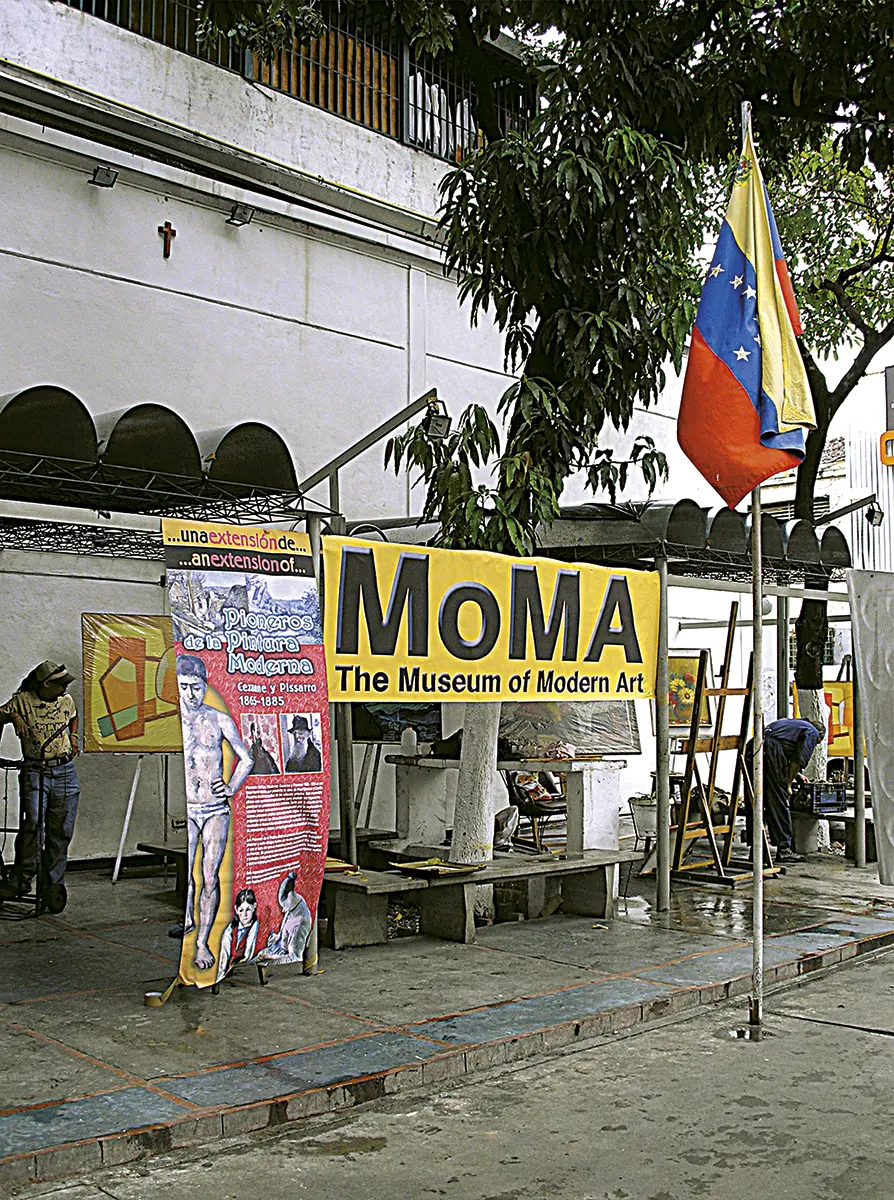
Una extensión de… at the Museo Alejandro Otero, is a clear instance of all this. This show is the record of several events carried out by Palacios in commercial locations in Caracas, Bogotá, and Lima. But it has several important particularities: each event is a parallel to another event happening on the same day in a large museum in an urban center and about a similar topic. Thus, the show Joseph Beuys: Actions, Vitrines, Environments at the Tate Modern in London, was simultaneously inaugurated at the Tate Modern Avícola Petare, an animal-feed store in Caracas. The latter inauguration included some opening remarks about Beuys’s work and a cocktail party. Similar actions were conceived for Africa Remix/L’art Contemporain at the Centre Pompidou in Paris and the Black and White hair salon in Bogotá, El Imperio Azteca at the Guggenheim Bilbao and the Artesanía Wayúu kiosk in Caracas, Pioneering Modern Painting: Cézanne and Pisarro 1865–1885 at MoMA in New York and the Plaza de los Pintores in Caracas, Ana Mendieta: Earth Body, Sculpture and Performance at the Miami Art Museum and the Evanyelin & Pisarro clothing shop in Lima. At the Museo Alejandro Otero, however, Palacios presented like ready-mades the consumer items usually sold in the stores as well as the photographic and video record of the inaugurations of these events. With this, Palacios exercises his irony on a current phenomenon in those great hegemonic art centers, the opening of subsidiaries abroad, “transforming them,” as the artist puts it, “into replicas of the center.”
Palacios applies the methodology and tools of all contemporary researchers: the Internet. He searches the web pages of the world’s most important museums and keeps a tally of their programs. He chooses the openings that seem most appealing and prepares a simultaneous one in “a social space that fits the curatorship” with all the documentation (photos, videos, etc.) that “will be later sent to the chosen institution.” Here, Palacios plays with the geographic flexibility that globalization allows and both tweaks the limits of the artistic circuit and widens the social circles to which these events are addressed. It is a way to reformulate an enduring polemic of art and society.
SUSANA BENKO