
In Eros–Thanatos, an interactive video installation, Erika Harrsch manipulates the space and modifies sensory perceptions with a variety of organic and physically resonant symbols. She develops complex work with lively, visually crisp, and questioning results that fall outside traditional parameters. The project is based on pairs of formal and conceptual opposites like that of the title, including contrasts between nature and artifice and the immaterial and the corporeal.
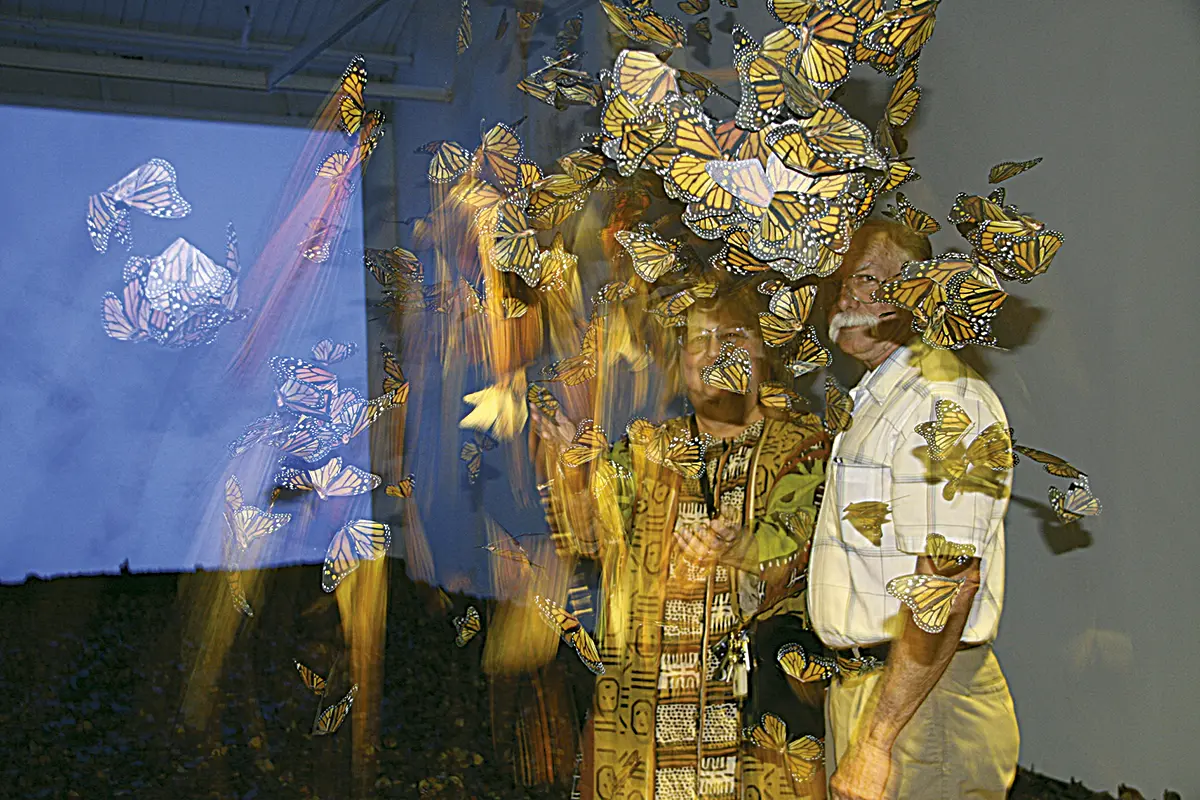
Those who went to DiverseWorks’s main gallery during FotoFest witnessed a floor installation, a video projection, and some murmur-like sounds. The seemingly simple Eros–Thanatos is highly elaborate and composed of several elements: 60,000 Monarch butterflies printed, cut, and mounted on a synthetic-grass carpet; a projection area for Objeto del Deseo—a 12-minute DVD loop projected on the gallery’s back wall; and an elaborate system of interactive sound. For this last aspect, the artist collaborated with Edmund Mooney, a sound expert who has worked, among other projects, on a sound map of New York City for the local Acoustic Ecology Society. The recordings made at the Michoacan butterfly sanctuary were edited with the addition of intimate female exhalations, in a cycle representing both animal and human life.
Harrsch devoted several months to researching butterflies and worms in a natural science museum, with the intention of bringing together the forms of the butterfly and female genitalia and making the insect a visual icon and metaphor for women. Femininity is, in its genesis, a structured and complex organization that constantly seeks genital representation, where a woman is structured as the possessor of sex that produces desire. For a woman, the search for her own desire and to be desired is essential in the constitution of her own identity and the development of her personality, which will condense her sexuality and her psyche. In classical Greek, “psyche” meant “butterfly,” as well as “soul, mind, and breath.”
The artist carried out the second stage of her project in the Monarch butterfly sanctuary in Michoacan, Mexico. Eros–Thanatos, like any good work of art, does not reveal the effort of the long days filming and recording, of looking for a clearing in the woods or on the ground, and of the constant concern of walking without hurting the sanctuary’s butterflies. Harrsch recreated this environment in the gallery, but the insects in the installation are not real butterflies, as convincing as they are. One felt the constant tension of walking on the large carpet of butterflies, afraid of hurting them.
Eros–Thanatos offers several readings, from the most naive and gratifying to densely conceptual reflections of interconnected realities posited by the artist, especially when visitors recognize female genitalia in the butterflies. Harrsch reflects on certain relationships within society: the body/object relationship, the sexualized woman who becomes an object possessed, collectible, and manipulated through a monetized value, in a society that personifies objects and turns people into objects. Eros–Thanatos expands the boundaries of perception through this audio-video installation that experiments with a non-existent space, with sounds, views, and touches that were created by the artist based on her gathered experiences. In the conjunction of organic experiences and electronic media that express life and desire, and life through death, there is the vital parallel of sublimation and of comparisons between “earth/mother/nature” and “heaven/man/culture.” The video explores love and desire embodied as a butterfly of fleeting life and ethereal lightness. To this video, the artist added ever-changing gesticulating shadows created by the movement of visitors in the gallery as they walked through the installation or bent to pick up the artificial Lepidoptera.
The butterflies were printed in Mexico; volunteers were essential for the mounting in Houston, where the work’s interactive aspects actually began. The Mex-Am Cultural Foundation, the Harris County Cultural Art Council in Houston, the Texas Commission for the Arts, the Andy Warhol Foundation, and the National Endowment for the Arts were the project’s U.S. sponsors; sponsorship in Mexico came from MADS and KBK gallery. Considering the many parties that assisted in the development of the work, Erika Harrsch’s Eros–Thanatos proved that borders do not exist when it comes to artistic creation.
GRACIELA KARTOFEL