
The passion with which Ernesto Ballesteros (born 1963, Buenos Aires) speaks of invisible worlds and the conviction with which he plays with lines and dots are the counterpart to the silent vigor of his art, an art that works on the viewer without the viewer ever realizing exactly how it is done.
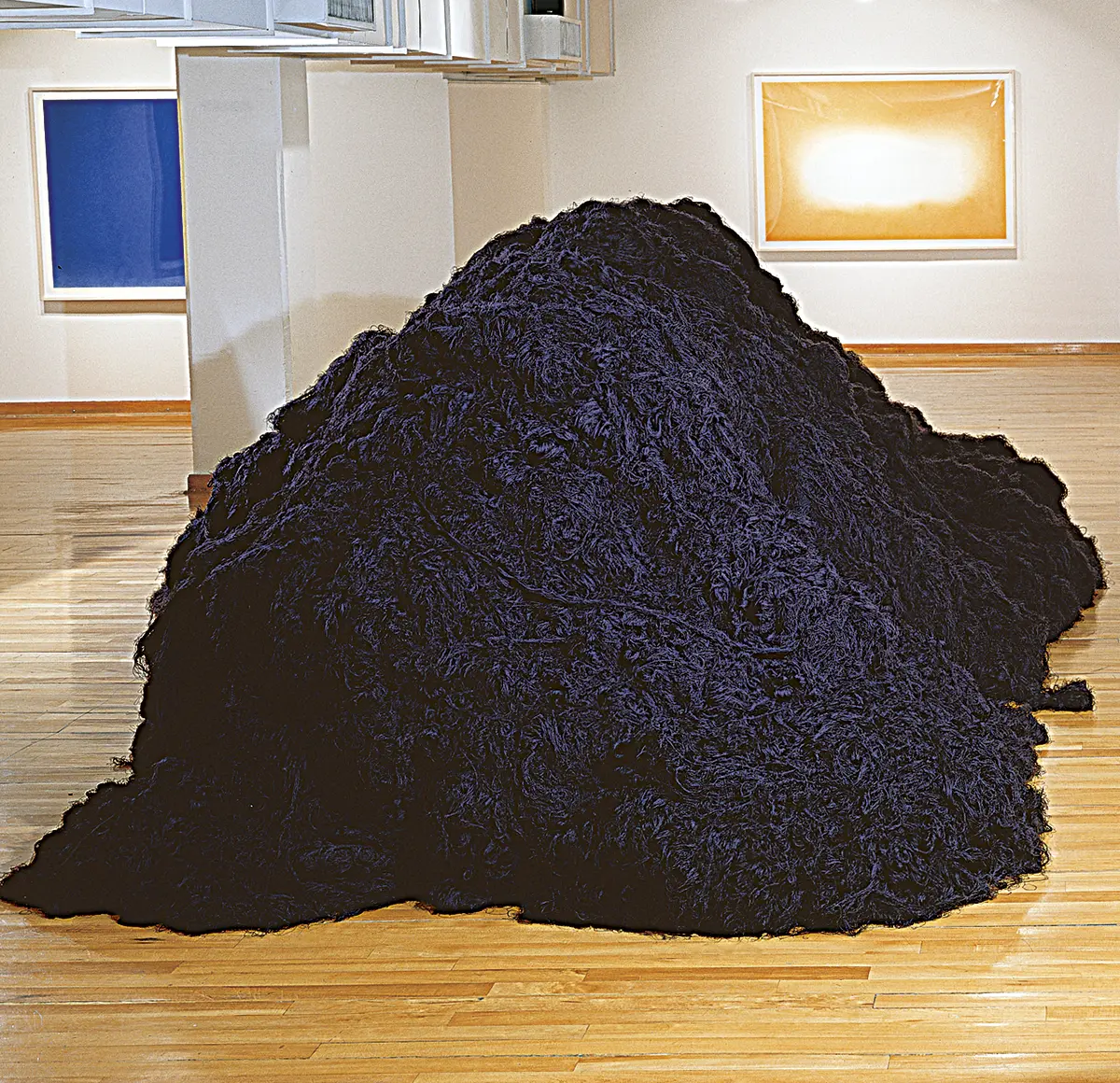
In the works exhibited at Ruth Benzacar Gallery, Ballesteros once again demonstrates the potency of draftsmanship that “can do anything,” as Marta Traba says, alluding to its relevance, intimacy, and expressiveness. The show is composed of abstract vistas, drawings with “the amount of kilometers of line applied to a landscape,” and a 40,000-kilometer installation—a length equivalent to the circumference of the Earth—made with black threads and a sound element, placed at the center of the space. The music by Nicolás Bacal and Nicolás Mastracchio, with a program of constant, minimal variations, is barely audible.
These “landscapes” are inspired by Georges Seurat (1859–1891), an original and refined student of aesthetics and scientific treatises who developed the technique of pointillism or divisionism, as he called it: small, pure-color dots placed next to each other produced “an effect of greater vibration and luminosity with that optic mixture.”
Indeed, these marvelous works in red, green, yellow, blue, purple, and black also vibrate and generate sensible representations. Without strident notes and based on the pencil’s pressure on the paper, the emerging images are like foggy horizons, splendid sunrises, and magical sunsets. Oval, square, and rectangular in shape, the framed papers reveal the artist’s painstaking planning for these almost ethereal but vibrant abstractions.
Ballesteros executed these works along with eleven other artists, in the manner of a Renaissance workshop. Is Ballesteros proposing the dissolution of the author? Is he making joyfully evident a generalized practice? The catalog, with a text by Lux Lindner, identifies the collaborators and publishes around one hundred photographs documenting the process, the works, and the Ballesteros-led group’s downtime. The interesting thing is that some of these enthusiastic draftsmen are emerging artists who have already carved a space for themselves, as is the case of Nicolás Domínguez Nacif, Isabel Peña, Juliana Iriart, and Eduardo Navarro, among others.
This is not the first show that Ballesteros has devoted mostly to drawing. Already in 2000 and 2001, he dealt with lines, dots, and intersections, arranged to follow calculations of his imagination. Ballesteros’s fascination with drawing began at the age of five when he made his first doodles. His father discovered the youngster’s interest when he found him very quiet and focused, following the daily progress of a great-uncle’s painting; later, he was sent to study art.
Ballesteros, an acute observer, started his professional life as a comic-strip artist. Although it seemed obvious that he wanted to be an artist, after high school he was undecided about this career. Interested in philosophy, biology, and genetics, he studied advertising in order to earn a living. He spent three years in art school, but he dropped out when he stopped “try[ing] to prove something in order to try to show something.”
It is at that point that Vito/Ver and Vito/Verá, two characters born of gestural drawing and action painting, appeared in his canvases and became exclusive protagonists of his comics. Later, these characters returned to the canvas, enlarged to the point of losing their specificity and becoming abstract. At the same time, they went to the streets, as spray-paint graffiti on fifty city walls.
Perhaps as a counterpoint to the emotionalism of Ballesteros’s drawings in this show, the inescapably large installation highlights the meaning of the line in accord with the artist’s interest in scientific rationality. “Mine is not a scientific attitude, but the attitude of someone who observed the philosophical implications of scientific discoveries.” After deepening his reading in astronomy, quantum physics, and cosmology, Ballesteros came to understand that the vacuum does not exist and that it is the observer who shapes the universe. “What we call a vacuum is filled with energy. The only thing that prevents us from seeing something of that vacuum is the range of our observation instruments.”
Point by point and with these ideas dancing in his head, Ballesteros creates shining works of startling beauty.
VICTORIA VERLICHAK