
City dwellers find no respite from their fears and obsessions in Bird Flu Dreams, exit’s first solo show at Magnan-Emrich Contemporary. Giant blackbirds loom over unaware visitors as they enter the gallery and face wall shadow #1, a black-and-white mural depicting the flying creatures (and their excrement). The show, on view from May 18 to June 24, includes over one hundred ink drawings on Mylar, acetate, and found prints. The two-dimensional works, ranging in size from 7 x 7 inches to 50 x 17 inches, are organized in clusters covering two walls. Bird Flu Dreams also features site-specific installations, sculptures, and paintings on found objects that fill every nook and cranny.
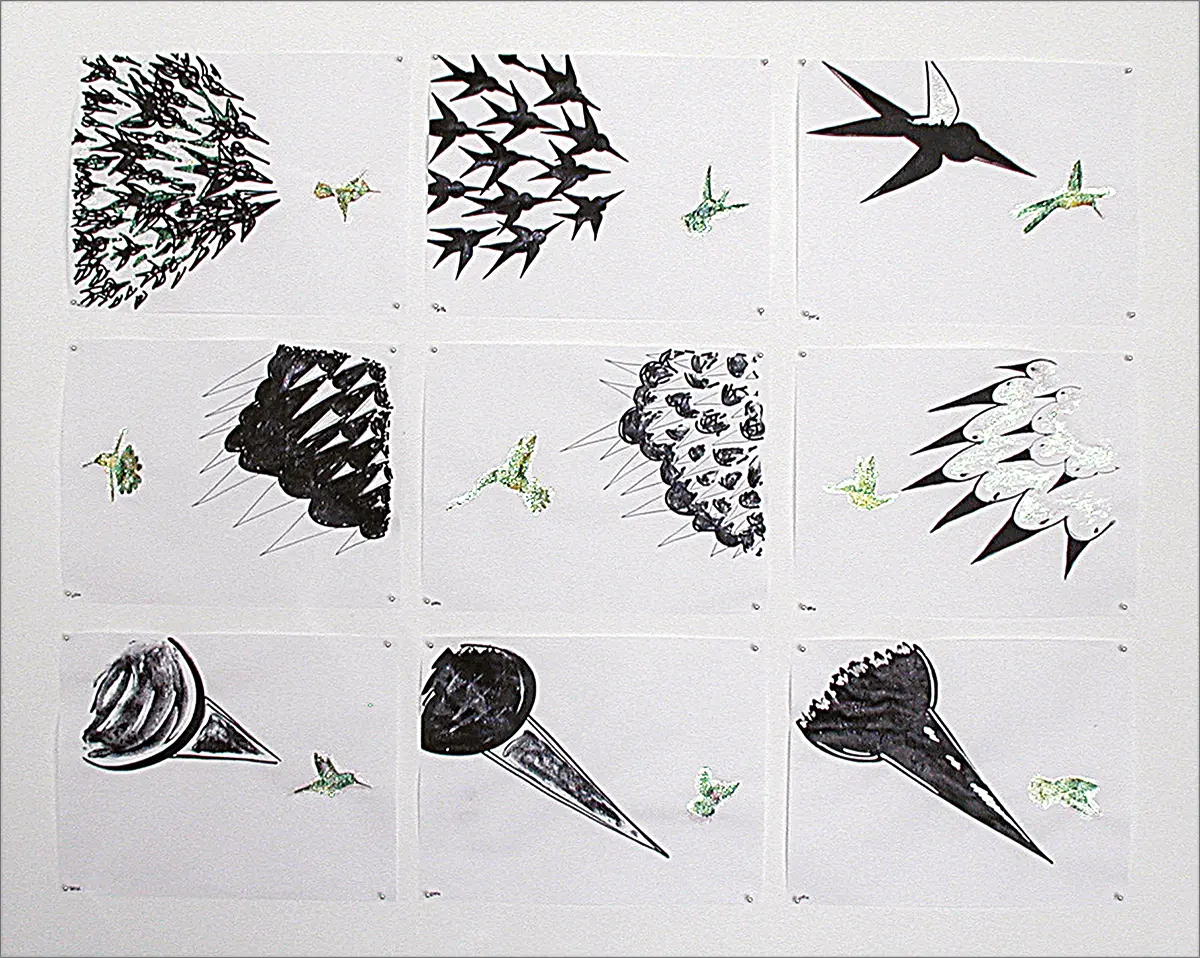
The Puerto Rican artist exit, or exit static—“always without caps,” as he says—draws inspiration from the media, pop, and skateboarding culture. Blackbirds, which have obsessed him since the start of the avian flu epidemic, are the main motif of this exhibition. His recurring visions of attacking birds find their way onto any kind of surface at hand, including diner napkins and skateboards. Evidence of this is the hundreds of drawings dated 2006. Oversimplified graphics highlight the threatening wings and beaks. Bird squadrons nose-dive toward a focal point or surround the target in each composition, giving a sense of urgency to the works.
exit’s compulsive repetition of the same simplified motif reflects the media’s communication strategies. In the technological age, the public is both overwhelmed and manipulated by short sound bites and factoids repeated endlessly, without in-depth analysis or proper contextualization. This non-information is then picked up and repeated by the audience. Thus, people become obsessed by real or perceived larger-than-life threats—the bird flu epidemic being a case in point. In exit’s work, the birds are visual bites of disarticulated information creating an oppressive overload. The number of pieces and their placement throughout the gallery further underscore the feeling of angst construed by mass media reporting.
exit’s art exists within the tradition of popular art and is accessible to a broad audience. His work fits within the gallery context but could also thrive on the walls and streets of New York and Los Angeles. exit himself comments on the process of commercializing art: “The one thing I learned from a designer girlfriend was the fashion world’s ability to hone their highfaluting catwalk products to middle-class consumer reality.” He continues, “I’m not gonna change what I’m about. I’m just going to repackage my software until everyone’s eating it with milk at midnight in their dirty AA underwear.” Perhaps this is why he designed special flu flock wallpaper and the limited-edition appliqué fashion epidemic print. He also insists on making his art affordable and maintaining low prices. He mocks high fashion’s exclusivity. In homage to prada, anna wintour & their entourage’s internment (after ‘The New Yorker’), exit places the glamour stars in a corral surrounded by a flock of aggressive birds, chickens, and a sea of corpses to highlight the divide between the fashion world and the reality outside. Other tongue-in-cheek titles include bird flu fashionista trends and I’m so tired of shoes in the news (after Andy).
exit’s work cannot be analyzed outside the context of urban youth culture. For instance, vivisection tree is a site-specific sculptural installation done in collaboration with a fellow skateboarder, beer blond wheels. In the piece, a flock of blackbirds, drawn on the wall, are about to land on piled-up, used tattoo needles donated by a fellow gallery artist, Duke Riley. Here, impending threats are not media-made but emanate from the realities of city life, such as blood-transmitted diseases and drug overdose.
Collaboration is intrinsic to the artist’s creative process as a way to de-emphasize the ego and the individual, which are revered in pop culture and art. exit often works with his ex-girlfriend ghost pearl, as seen in pieces like glitter drawings, a wall installation of nine small bird stickers covered in glitter, ...but the mermaid people survived extinction, and victorian black dress, victorian (after the sunday times’ anglomania at the met), which depicts a nineteenth-century woman with a perfumed paper cone over her mouth and nose for protection against the stench of corpses. The sculpture long skateboard, featuring the signature blackbirds, was designed and built with the skateboard-maker lou.
exit is part of the city, of the heavily populated urban centers. Targeting a broad audience, he scoffs at high fashion and rejects elitism in art. He incorporates the strategies of middle-class consumer culture, such as simple and direct graphics, while questioning them and revealing the mechanisms of mass-media-produced hysteria. exit is trying to sneak skateboard/street-produced art into the pristine walls of the gallery, and so far he is successful.
ARIADNA CAPASSO AND DIANA KORCHAK