
With an interesting direction that has yet to find resonance in the local press, Madrid’s Raquel Ponce Gallery is developing an exhibition program that is highly heterogeneous but well-aimed, handling a roster of Latin American artists whose poetics have reached an impressive level of maturity. One of the season’s last shows was devoted to the work of the outstanding Dominican artist Jorge Pineda (born 1961, Barahona), which turned out to be among the best exhibitions to be seen in the area around the Museo Nacional Centro de Arte Reina Sofía.
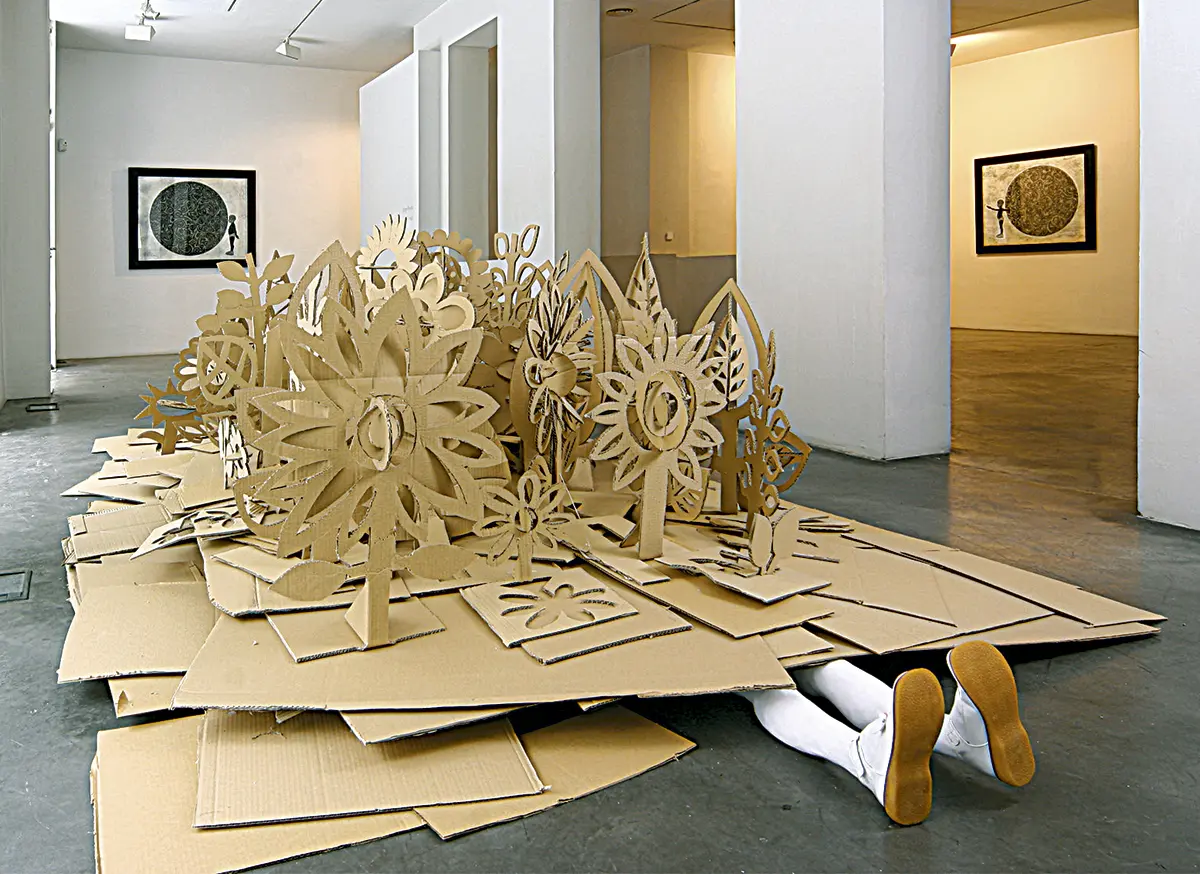
The show, with the suggestive, poetic, and disquieting title Frágil, launched a hard-nosed, direct, and shockingly beautiful reflection about childhood subjectivity and disorders resulting from the punishing, misguided, and horrific power of adults. This exhibition had the rare virtue of conjugating lyricism and pain, creating a smile of rictus. Each of the works was theatrically installed and focused on a specific drama: a timely warning about the fate of a dispossessed childhood, about culture’s potential to murder that which in principle it loves. The small characters were graphic proof of various states of violence. Pineda’s work documents and condemns violence. It is an investigation of a worldwide problem. In the poetic internalization of childhood suffering, this recent work reveals its power with a forceful tension between social contestation and artistic lucidity.
The works—beyond their facture, their painstaking and almost artisanal representation—are openly audacious in the configuration of longer-reaching metaphors. Pineda traces an anthropological map of adult mentality and its mechanisms for falsehood and perversion from the injured subjectivity of childhood, which is barely aware of the cruelty in the surrounding world. This adult mentality is perforce devoid of compassion, ignorant of clemency, and ready to calculate and to achieve satisfaction despite the cost to the children that are its tragic, furtive objects of desire. Pineda’s images of small, still-growing bodies wear leather masks and are projections of the dominant adult’s punitive desire. They are the construction of a perverted imagination that slakes a kind of thirst: to devour any gesture of candor or tenderness without prejudice. The contemporary world is hard, and Pineda points out its multi-faceted cruelty.
This questioning reflection in Pineda’s work is one of the most gratifying features of his discourse as an aesthetic creator in the world’s periphery. As a contemporary artist within a trans-territorial, exiled socio-cultural reality, Pineda is a deluxe narrator, a kind of visual poet who explores and rehearses discourses of a dramatic bent and abundant lyricism. The conflict of the exile, of the marginal subject inhabiting the frontiers of the permissible, of the Creole woman sold to the tourist as a souvenir of an exotic culture—these are a few of the many issues Pineda’s work has reflected and raised for collective discussion. If one virtue characterizes this Dominican artist’s work, it is that his work reveals a sharp mastery of the graphic metaphor. It is impossible to passively glance at his many turns behind which he hides a Lorca-like position on the face of the contemporary world’s quieted cries. Pineda shouldn’t be seen only as a describer of Dominican reality, although he nonetheless is well respected for this.
At the strictly formal level, there is a fine coherence between his two-dimensional works, which at times incorporate the wall as a conceptual element, and the installations placed in the middle of the gallery space. Pineda, like other area artists, is a maker of spaces, and, with chameleon-like skills, he makes each of his works relate in a considered manner, even when they deal with diverse morphologies. The flat figures of children both male and female—which wink to the issue of gender—refer explicitly to the childhood iconography of paper dolls that allow for an infinite shuffling of outfits and to the sexist projections of a phallocentric gaze that has historically been able to design the subjectivity of the Other. Ambiguity, veiled contradiction, the pangs of desire, and infinite tensions flow in this show by Jorge Pineda.
ANDRÉS ISAAC SANTANA