
From the street, one could read on the large window panes of the AFA gallery the phrase otro maldito dia (another damn day). It connoted the passage of time and the inevitability of fate and tedium, and the repetition of the phrase left its trace on the architecture.
Since his first return to Chile in 1998, after sixteen years away, Juan Castillo has returned to the country to recover through text and photography a history unconnected in time. A member of the group CADA from 1979 to 1983, Castillo participated in collective and individual actions that were inscribed within the urban and suburban context and that broke the limits and possibilities in ephemeral interventions on landscape and commercial advertising.1 In later visits, he sought to link the past to the realities of the present by quoting a phrase used in the 1970s and transcribing it to graffiti on the walls around the Pan American Highway.
Recently, Castillo had concurrent shows at AFA Gallery and Gabriela Mistral Gallery (GMG). Once again, the phrase Te devuelvo tu imagen (I give you back your image) was a leitmotif repeated on the sidewalks of Santiago’s Paseo La Alameda and on fifty buses. With this phrase, Castillo sought to connect the space of the street with the inside of the gallery, the meaning of which was the recreation of the private space of the home, as opposed to the outside world.
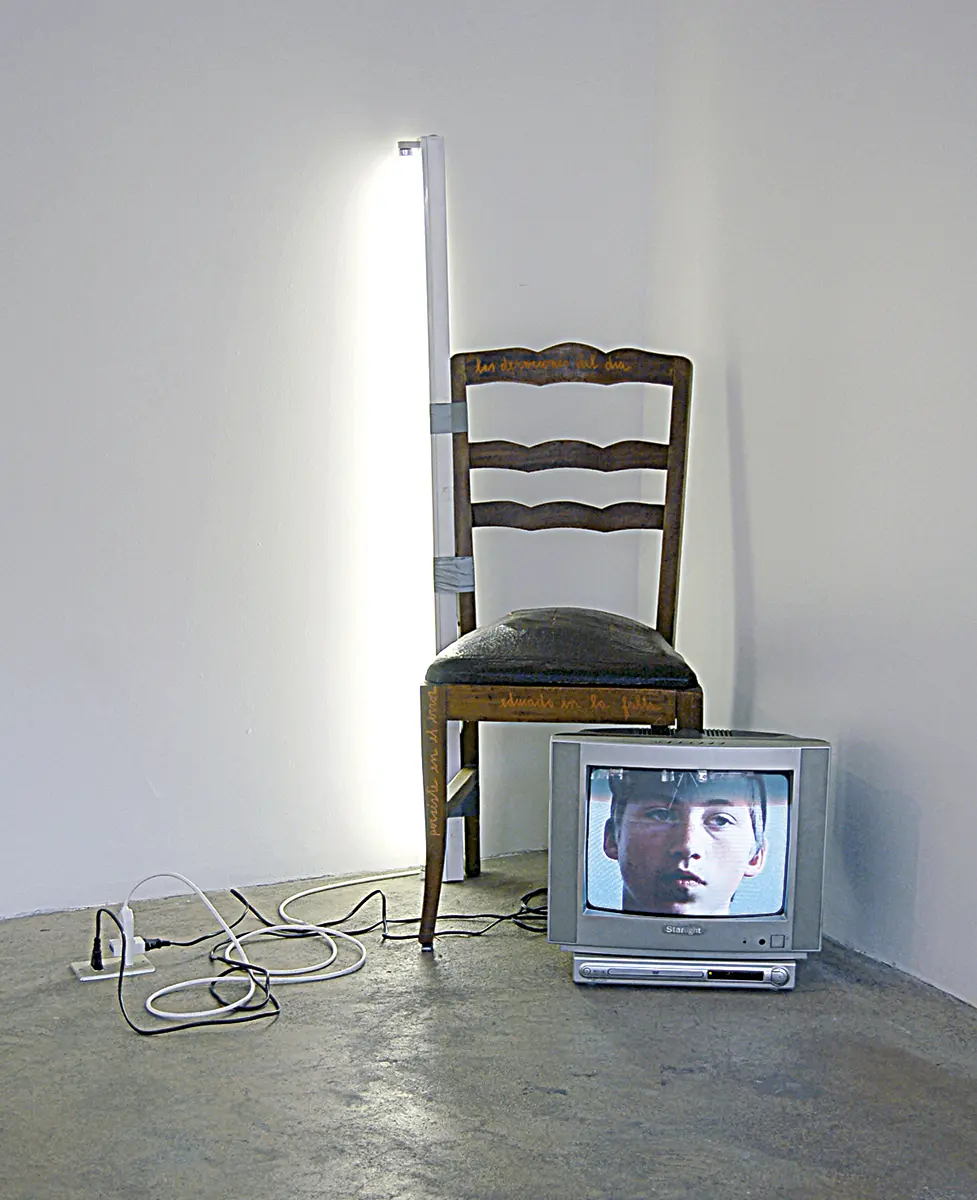
These language games in the exhibition at the GMG were an inescapable referent in the window at AFA and the phrase Otro maldito día. In GMG, the meaning of the private was altered and placed upside down, with the use of inverted chairs with monitors set into the seats, revealing the fragility of the refuge of home and the inevitable intrusion of the outside “sneaking in” through the interstices of the TV. Three videos presented parallel stories about everyday life in Chile: lunchtime in the home of a “Micrero”2 and his family, recorded conversations inside bars on Paseo La Alameda along with the interactions of pedestrians with the texts on the sidewalk, and the path of a bus from the point of view of the driver. Castillo weaves a network of floating identities into an interview with immigrant youths, shown close-up by a monitor in the place of a chair’s fourth leg. In the other three, identities point toward subjects in spaces of transit: buses, bars, and streets.
In the show at AFA, the TV screen was used to explore the “interior” of feelings and the private lives of six youths. Otro Maldito Dia was presented as an installation or total work that wove a network of intercrossing meanings between the different individual parts. Accompanying the chair/TV were seven photographs installed between two galleries and a hallway. Unlike the three portraits of the bus driver’s family, the young faces were fragmentary and out of focus. The images, printed on acetate, were installed as lightboxes but did not light up. On his prints, Castillo demarcated an area using a red crayon, like the trace of some fire. The fluorescent tubes were outside the boxes. On them, a folded kerchief showed the full black-and-white faces of the portrait subjects without manipulation but with written phrases. One more face was added to those of the six young immigrants: that of a female student, a leader in the country’s latest mass student strike. Two white school-uniform shirts hung from the ceiling, illuminated from inside by light bulbs and stained with tea. Once again, Castillo connected the past and the events of the present to incorporate events that re-contextualize a work of art configured in the journey (of the bus through the city, and from Chile to Sweden) and the immediate experience.
The displacement of the images’ supports spoke not only of the fleeting nature of time or of movement but of the portrait subject and the speaker in the video. They were all youngsters whose identities were marginal to any definition, unhinged between the adopted language in the country of their residence and the language of home and their parents’ culture. They were presented in the vacuum of not belonging in a context, which was evident in the confusion of the speaking subject and the altered language of the images. Through these young people, which included his own son, Castillo threaded his own history as a subject in transit.
NOTES
1. CADA: Colectivo de Acciones de Arte (Art Action Group), composed of artists Juan Castillo and Lotty Ronsfeld, and writers Diamela Eltit and Raúl Zurita.
2. “Micrero” refers to the driver of a Micro-bus, for urban transportation in Chile.
DERMIS PÉREZ LEÓN