
Luis Rocca Brito (born 1964, Venezuela) has always worked on the theme of landscapes. But his treatment of this theme is anything but conventional. An analysis of his production, especially this new series of paintings titled Demarcaciones, reveals a definition of the pictorial space in figurative and abstract morphologies. The artist himself conceives of space as very “active, where the possibility of alternating figurative and abstract elements coexists in such a way that the result is a field filled with transparent, divided atmospheres, offering visual qualities through color saturation as well as the constant presence of the line, of drawing, simultaneously intervening with pastes, textures, and colors.” Thus, his are landscapes where figuration, abstraction, drawing, and transparency result in the same plastic quality that has been present in a large part of Venezuela’s landscape art, as already posited by Armando Reverón in his famous sepia and white periods.
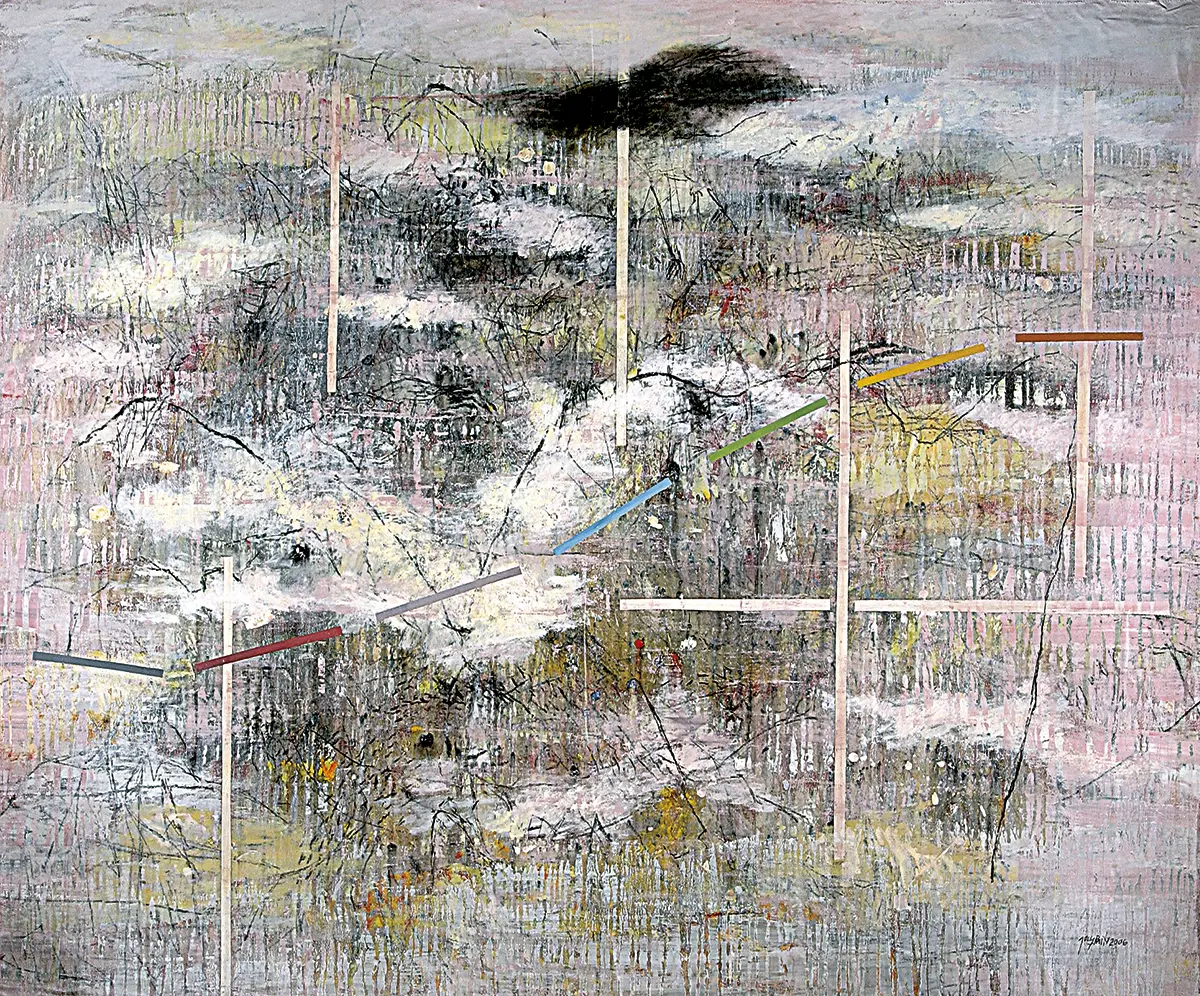
With a well-established oeuvre in the Venezuelan art world, Rocca Brito, who has been exhibiting individually since 1987 and has taken part in numerous group shows, works with the semantics of the landscape. Separating visual values from anecdotal references, he establishes associations between two virtual planes of the two-dimensional surface, background, and space, creating a foreground with transparencies supported on color bands that cross each other in different directions. It is important to understand the series’s title, Demarcaciones, as part of the issues that interest Rocca Brito. Drawing, which was essential in his academic background and has been his expressive medium for several years, is the pure concentration of painting’s visual meaning, where verbal or narrative ideas have no place. His landscapes are projected outward with poetic energy based on a schematized language of signs. This is where figurative values reside, while abstract values identify the landscape’s representational appearance. Line, color, light, and shadow, in structural approximation, engage in a process of transforming the imaginary into visible space, rather than being the result of a naturalistic perception.
Rocca Brito’s landscape is the constructive sequence of suggestions of mountains, rivers, buildings, or trees, which are discovered by the viewer as if many doors have been opened at the same time and which are construed by the mind as a whole of perceived fragments. It is a journey through recognizable cartographies in the painting’s surface, an integrated impression of a proposed creation, not an imitation. With their own dynamic, shapes diffuse in space and transform the painting’s surface into a field of visual energy in constant motion. This energy replaces the static configuration of one-point perspective with veils, transparencies, and atmospheres.
Rocca Brito displays new visual proposals in relation to his past work. He journeys to the realm of dreams while situating himself in the reality of the landscape theme. He expresses revelations, as he would put it, in “confronting emotion with the rule,” to produce a visual identity marking the continuity of his own style.
BÉLGICA RODRÍGUEZ