
Between the sublime and the banal, the vulgar and the elegant, and the innocent and the sinister—situated at the fluid point that separates the real from the virtual—Marcelo Pombo has developed a coherent oeuvre since the late 1980s. Born in 1959 and a representative of the 1990s generation, he demonstrates that decades do not always begin with the change in digits. One can say that “the 90s” began in Argentina in the late 1980s when a group of young artists initiated a project that moved away from trans-avant-garde painting. It was characterized by anti-expressionism, a new approach to conceptualism, and the recuperation of the object in a manner close to Arte Povera.
Pombo’s first solo exhibition took place in 1987, at the Centro Cultural Recoleta’s Youth Space. But it wasn’t until two years later that his work received its first recognition, at the Centro Cultural Ricardo Rojas, a part of the University of Buenos Aires. In this space, which became the fountainhead of 1990s art, Pombo presented a series of works linked to neo-Pop aesthetics and to the rhetoric of advertising.
Other launching sites for 1990s art were the Instituto de Cooperación Iberoamericana (ICI) and the Banco Patricios Foundation. In these spaces, visitors could witness a new aesthetic that, although it was initially deemed inconsequential, developed a critical line of thought about not only social conditioning but conventions of art as well.
Light Art
“Light art” is not pretty, decorative, and low-calorie art, as one might suppose and as was assumed by many critics at the time. It is not any less serious or intense than traditional art if we take into account its ability to “illuminate” content. This is achieved by an acidic tension between the provocatively non-transcendent signifier and the transcendent signified to be deciphered. Other practitioners of “light” aesthetics in the 1990s are, like Pombo, figures in the international art circuit: Jorge Macchi, Miguel Harte, Sebastián Gordín, Miguel Rothschild, Ernesto Ballesteros, and others.
Working with kitschy, mass-produced, and disposable materials do not necessarily imply conceptual lightness. Pombo chose these materials because they activate thinking in the viewer and promote a critical, ironic distance from the work. Such a distance is as active as the one practiced by the Stoics through their strategy of indifference.
End of the Party
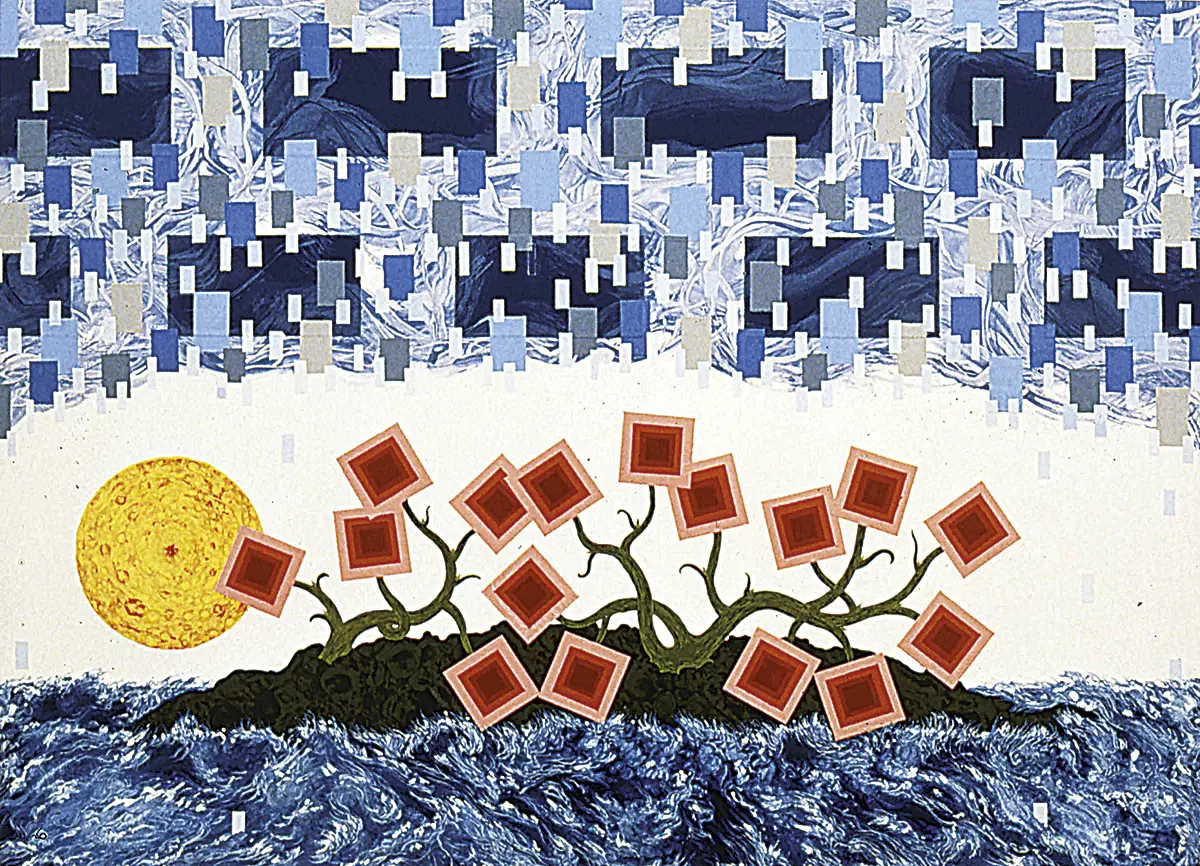
Pombo found in “poor” materials—plastic containers, medicine, and food cartons, bedsheets, stickers, garlands—things deserving to be salvaged. With them, he emphasized what can be called, in the context of neo-capitalism, the “industry of joy.” This phrase is contradictory and ironic since if there is something that, being spontaneous and natural, cannot be industrialized, it is joy.
Contemporary society, which revels in extreme consumerism, seems founded on a truism: “I consume, therefore I am.” A parody of Descartes’s most famous statement, this doubtful truth opens the door for the possibility of a manufactured joy—a virtual joy that becomes real when it is seen as a response to a natural need. Advertising and design employ the perversity of a purchasable joy and aim to persuade that consumerism can make us happy and complete. Manipulation and inertia work together to achieve such goals; this is why artists like Pombo have been inspired to shake the audience into awareness of their fall into consumerism’s “funnel law.”
Some of the artist’s early works transform the design into nightmares. In one work, where Pombo uses Sarah Kay-styled children’s bedsheets as a support, their practical function disappears and the motifs are transfigured, wrecking the enchantment of the deliciously bucolic scenes represented. But attractive design is not always eliminated. In Frutillitas y la enredadera (1992), for instance, there are still tender, infantile characters in marvelous environments, although upon closer inspection the calm scene that should accompany dreaming suddenly shifts. With careful observation, one notes that the eyes of the child protagonists are covered by branches and have been blinded, as if by Hoffmann’s terrible sandman. Something similar occurs in Oso Yogui (1993).
In those blinded eyes is the corollary to a gaze—the contemporary gaze that has progressively been emptied out of content: there is nothing to see. The blinded gaze becomes another aspect of the objectless gaze. These are images of an “essay on blindness” that Pombo begins in the early 1990s and carries over into his black and white drawings, where frames surround only emptiness.
In Pombo’s images, nothing seems to play a predictable role. Since the eyes don’t see, the nude body of the handsome youth does not cause admiration; the narcissistic Bill Body (1992) suffers a foul transformation. A similar counter-functionality is found in the idea of a party that does not entertain. A cotillion garland appears suffocated, contaminated, or transformed into something else—a tree branch. But the branch has no support. With the fragility of a paper garland, it becomes a metaphoric image for the human condition of frailty and lack of defense.
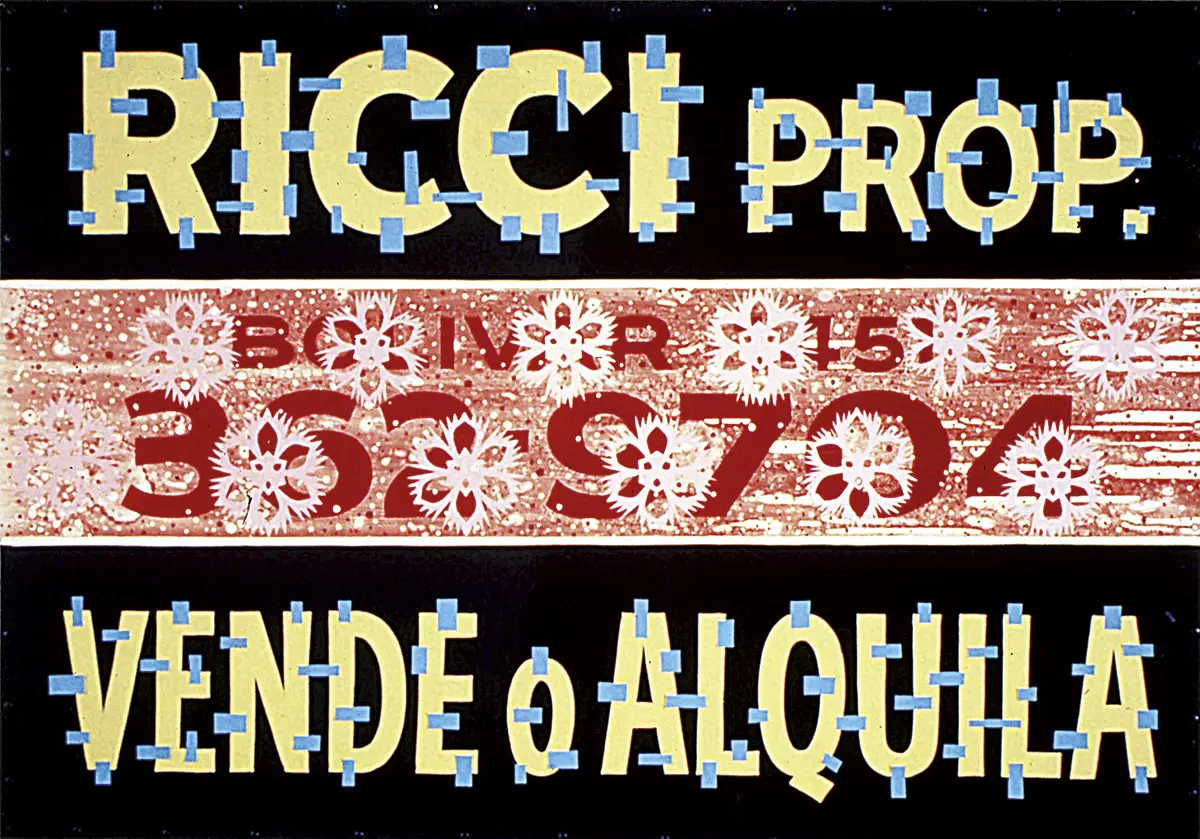
Money, and the element of luck that possessing it implies, is also a relevant topic. Perhaps one of Pombo’s most eloquent works is La ganadora (1992). Appropriating a poster announcing the results of the Prode games, Pombo hangs from it plastic sheets to which he has affixed white dots that simulate the presence of plague. With a counter-utopian vision, he seems to say that the contamination of gambling is unstoppable and so vast that the disease affects even artificial substances like plastic sheets.
Pombo’s works always seem strange or improper. What is familiar or well established (Heimliche) becomes unknown (Umheimliche). In this way, Pombo recalls Freud and leads us into the realm of the sinister, a slippery ground where everything shifts, where what is closest moves far away, and where the banal becomes sublime and the sublime banal.
Contaminations
This is a society of the “as if”—as if there was mutual respect as if institutions protected us as if we are on the path to happiness. It is not by chance that Pombo exhibits images that seem artificial, falsely seductive or luxurious, and submerged in shiny glamour. Playing with equivocation, these images do not always show what their titles indicate. Thus, they do not represent nor do they help to define. Incoherence shows the line to be followed in the formal plane. Indifferent now to its limiting function, it confuses, stops fixing contours, and what is represented vanishes into innumerable points, “threads,” or auras.
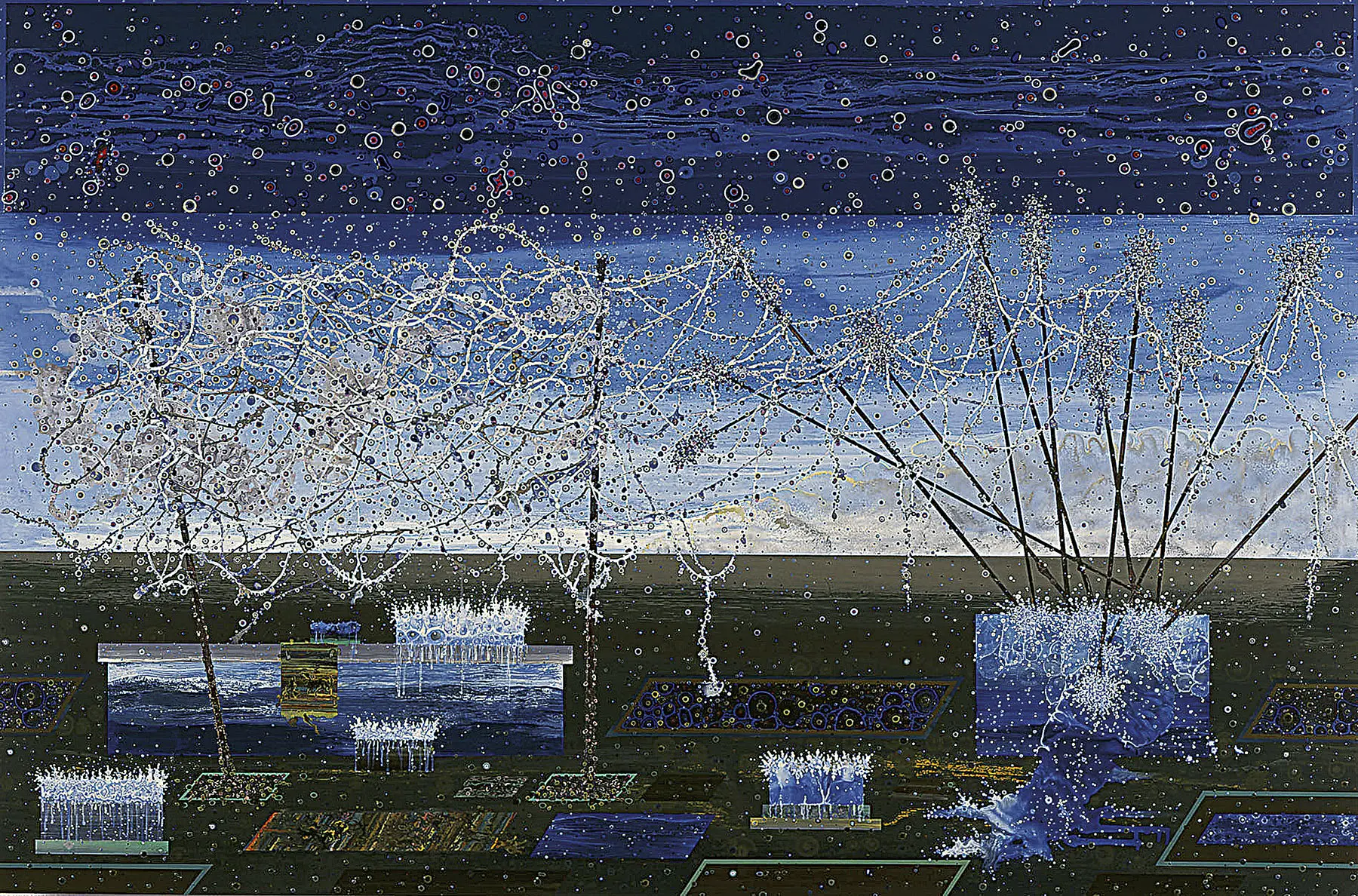
Unlike calm and familiar landscapes, Pombo’s works feature images of mountains, hills, trees, or nests broken into thousands of tiny dots inside other dots. The fine threads of rain of El aguacero (2005) are composed of a succession of very small circular marks that are perceptible on the surface by contrasting color and relief. While at a certain distance these paintings appear flat, at a closer view their density is discernable: there are thick enamel drops comparable to Pollock’s drippings.
The process of disintegrating the borders of things results in the passage from figuration to abstraction. In Pombo’s case, this does not imply a complete voiding of reference. The horizon can still be identified, although the sky is filled not with stars but with arches or empty painting frames, the sun doesn’t shine, and the firmament is filled with pseudo-planets that shine like candy wrappers.
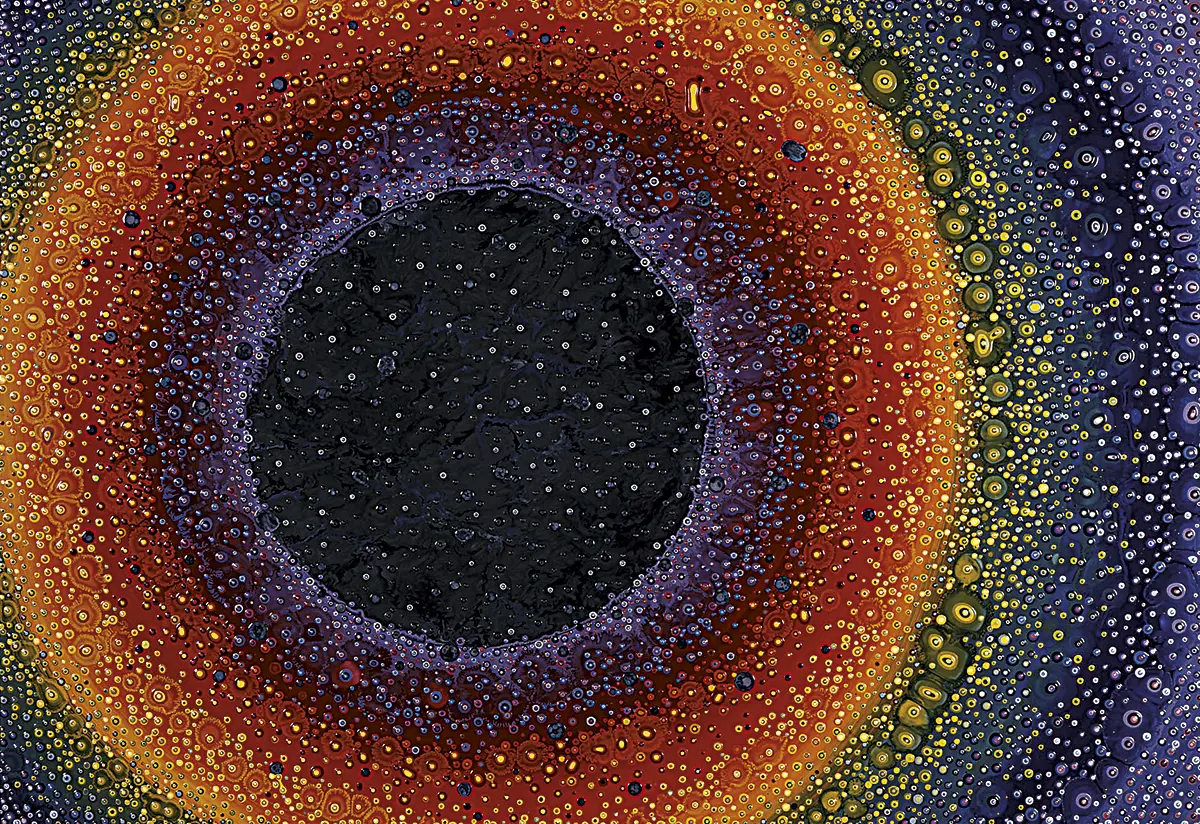
Pombo makes it difficult to see what is supposedly evident. At the same time, his work inverts the gaze, confusing the voyeur who looks and enjoys knowing that he is not being seen. The premise in Pombo’s work is that the voyeur has ceased being a capturer of objects and is seen by the work itself. In La mirada de las flores (1995), the viewer seems to be gazed upon by more than one floral eye. Perhaps this is a manifestation of contemporary paranoia about “vision machines” (after Virilio), like the video cameras that indiscriminately invade space and record all public movements to a computer. But Pombo renews the enigma of the game of mirrors in works like Las Meninas, where the viewed returns the gaze to the viewer.
Matters of Style
Although Pombo notes the particular sublimity of nature and refers to the landscape genre with the preeminence of slanted, horizontal shapes, his place among the various currents in contemporary art is unclear. He is clearly interested in geometry and composition. His paintings, which at times adopt the look of posters, combine minimalist geometry with Op Art, as seen in Acueducto (2001) and Planetas sobre el horizonte (2001).
But what label would suit him best? Surrealist? Neo-Pop? Neo-Baroque? Neo-Conceptualist? Abstract? Figurative? What label encapsulates Pombo’s polymorphous pluralism? How does one define an artist who mixes “the silly with the intelligent,” as he puts it? How does one describe the flimsy models in which he highlights the “seriousness of the frivolous,” as defended by authors like Baudelaire?
Pombo does not believe in the illusion of “being modern” or in the explicitly subversive spirit of the avant-garde. His interest in direct communication with the public leads him to evade conceptualism’s intellectual pretensions. This does not imply that his work lacks concepts. Although he is guided by the exuberance of fantasy, he is an avid realist who deeply engages issues and situations to offer a critical and poetic version of them.
Although Pombo’s work has been associated with Neo-Pop because of his use of appropriation, his work’s main feature is syncretism or eclecticism, a kind of stylistic nomadism that operates against a background of great opulence, artifice, and “sublime excess” (to use Kantian terms). This trait is emphasized in paintings like Círculo de tormenta con arco iris (2000) and Planetas en el horizonte (2001). Perhaps the best definition is “post-historic” (after Danto)—a wandering through styles and through the history of art.
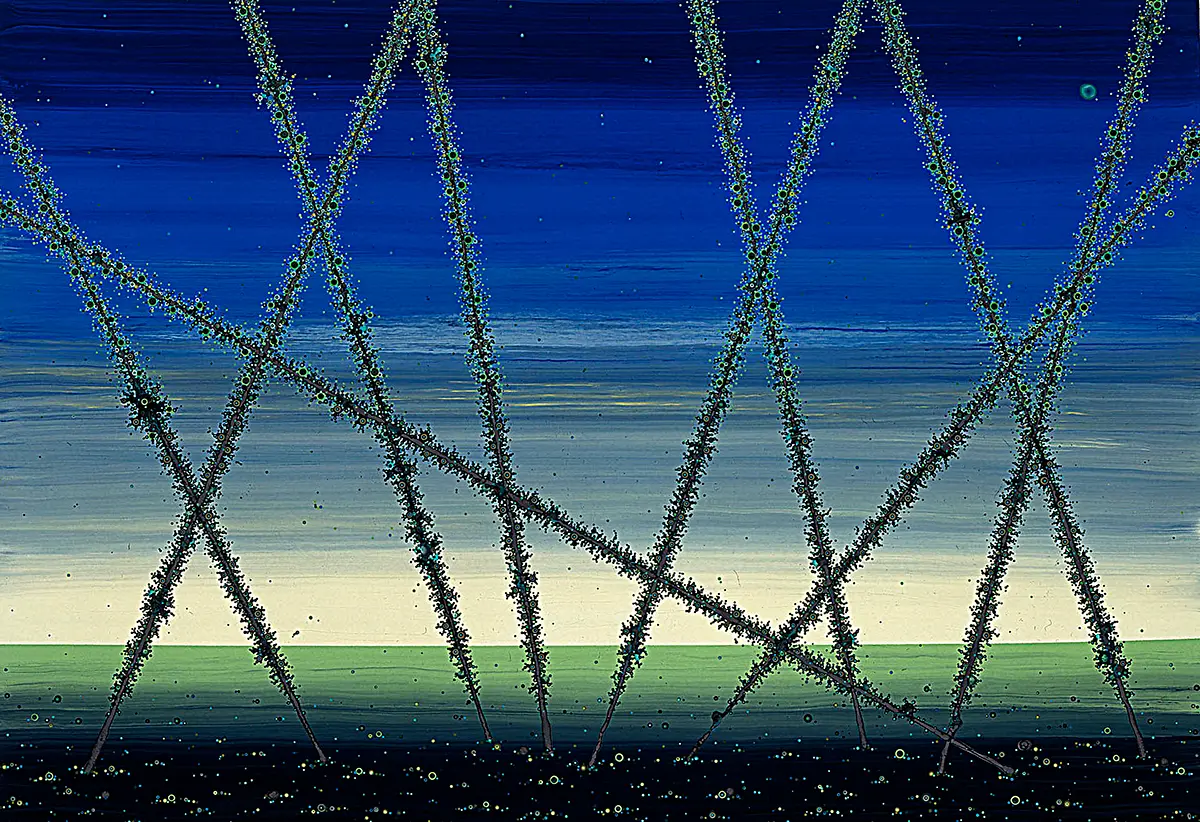
Devoid of unidirectional order, Pombo’s images bring one closer to the Neo-Baroque aesthetics and that “madness of seeing” (folie du voir) analyzed by authors like Buci-Glucksmann not only in the field of art but in the entire, virtual reality. This “madness” is characterized by fragmentation, collage-like montage, and, in general, an excess of visual stimuli, as one sees in video clips.
In the context of a synthetic aesthetic, the term “Populence” (from Pop and opulence) is highly significant. This was the title of a show presented by David Pagel at the University of Houston’s Blaffer Gallery and the Cleveland Museum of Contemporary Art. Besides Pombo, the show included Jeff Koons, Beatriz Milhazes, Jorge Pardo, Lari Pittman, David Reed, Takashi Murakami, and others.
In Pombo’s artistic genealogy, one must note an affinity with visionary artists like William Blake. In his roster of favorite artists, Tarsila do Amaral and Xul Solar are also found for their uncommon associations. Especially noticeable is Pombo’s aesthetic affinity with Solar works like Victoria (1927) or Visión en el fin del camino (1934).
Another significant influence is that of Japanese art. Pombo acknowledges: “For me, the greatest seduction comes from Japan, not only in the classic fusion of the abstract and the figurative, or the ‘trace of the gesture’ of the painter or calligrapher, or the value of emptiness, but in something even more sophisticated: ‘the trace of a moth on white paper’ that is chance, the fortuitous, but above all the aesthetic experience as a product of whoever sees more than the author (in this case, the moth).”
Material Changes
The desire to see more, or to see beyond human possibility, fuels Pombo’s miniaturist obsession. Over time, this obsession has provoked changes in his materials. While he used all kinds of “poor” objects in the earliest periods of his career, he later opts for using enamel. This leads him to the formally reductive unit of the point, which is characteristic of the paintings of his later periods.
In his selection of materials, Pombo always reaches beyond accepted hierarchies. Instead of traditional pictorial material like oil, he instead opts for an industrial one like enamel. He leans toward artisan processes like miniaturization or toward the ostensibly decorative. The decorative, with its usual therapeutic, mind-resting effect, is not something minor for him; “it seems the opposite to me,” he says. Among his works that most express the value of ornamentation are Baldosa (1996) and Círculo grande azul (1996).
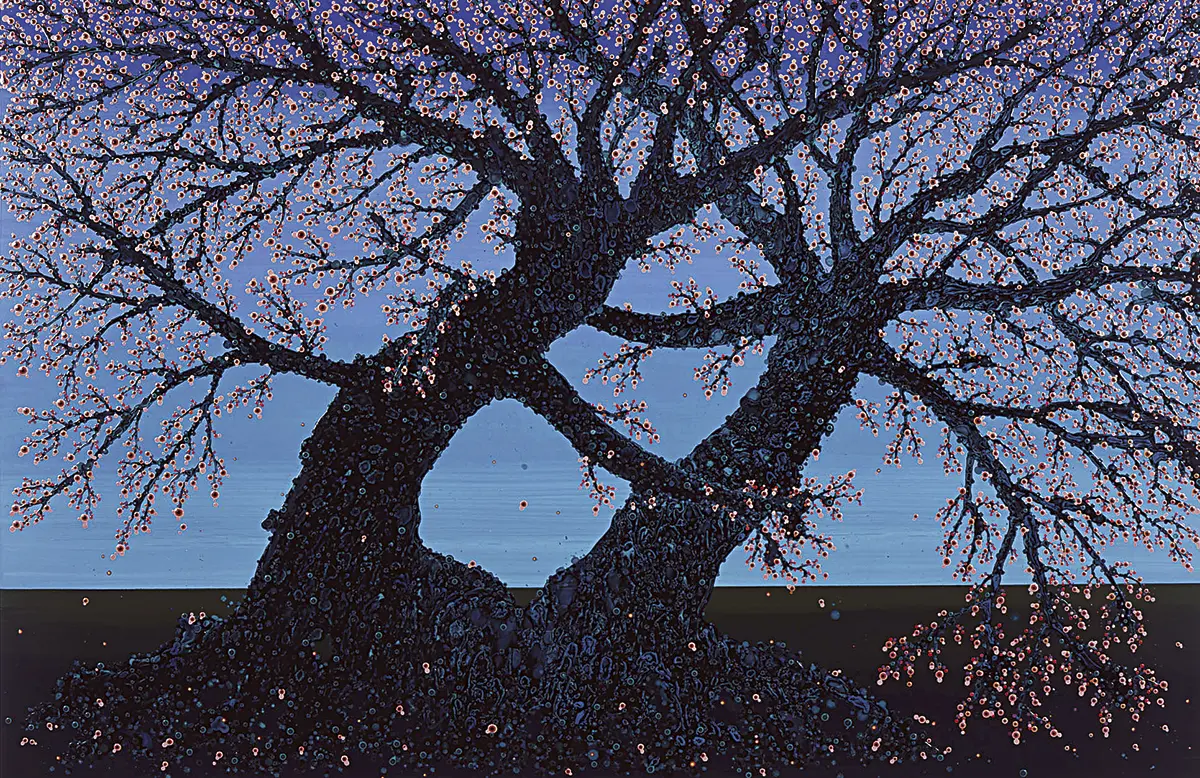
Pombo respects not only the decorative but also so-called “bad taste” or kitsch, which explains why some of his titles possess a deliberately overloaded poeticism. Fascinated by “the luxury of the poor,” he purchases trinkets from the Buenos Aires neighborhood of Once—all kinds of merchandise that are considered vulgar, with dazzling, shiny surfaces that reflect like cellophane. Included among Pombo’s affinities are chinoiserie, feather art, and rococo style. Fragonard enters the list of favorite artists with trees that at a certain distance resemble “bursts of paint,” as Pombo says.
An Aesthetics of Suspicion
When he was asked where he would prefer to live, Baudelaire responded with a gesture of cool dandyism: “Anywhere, anywhere as long as it is out of this world!” Partaking of a similar disenchantment, although enjoying at the same time a certain decadence, Pombo’s work refers to a world that is at once incoherent and opulent—a world of eclipses in attractive colors, like those in Atardecer con nube gris (2000).
Although some scenes in his works refer to the idea of the feast, they at the same time appear as models of desolation. In this way, they destabilize the viewer. Pombo’s vision is not complacent, neither in his early period nor in more recent paintings like Bodhisattva (2004). Here, the sublime spiritual being that according to Buddhism helps believers in their search for perfection is nothing but a languorous, femme fatale-like robot. Leaning on her side and looking at the viewer, she smiles lazily in a hyper-technological, nightlife environment. Nothing about this indolent figure reminds us of the meaning of the title; in Sanskrit, bodhi means “wisdom” and sattva means “enlightened being.”
Captivated by the dissonances of the present, Pombo is one of the most original voices in contemporary Latin American art. This is proved by his presence in internationally important and influential exhibitions; these include All Terrain, which also featured the artists Olafur Eliasson and Hirashi Sugimoto, at the Virginia Contemporary Art Center (2001), and “Amnesia,” a traveling show with Óscar Muñoz, Ernesto Neto and Tunga, on view at the Cincinnati Contemporary Art Center, the Biblioteca Luis Ángel Arango in Bogotá, and the Bronx Museum of the Arts.
Pombo’s work puts into play an aesthetic of suspicion. It does so with its intelligent use of irony and without the stridency of direct denunciation, and his paintings demand an attentive reconsideration of the “real.” In this way, one can discover the content of his anti-representation—the “what” of the “how.”
*All images illustrating this article are courtesy of Christopher Grimes Gallery.
ELENA OLIVERAS
Professor of Aesthetics at the Universidad de Buenos Aires (UBA) and the Universidad del Salvador. Vice President of the Argentinean Association of Art Critics.