
Many contemporary Latin American artists have an enormous ability to speak to phenomena that have become true obsessions of contemporary culture. The most solid conceptual-aesthetic discourses in current Latin American art are penetrating reflections not only about the current topics of debate but also warnings that reach into art itself: its mechanisms of articulation and its supposed responsibilities in the midst of a culture that is anchored in simulacra and superficialities. In that sense, Latin American photography, which has probed the vulnerability of its borders and its irrefutable potential for exploring the obverse of an infinitely graded cultural reality, is a form that most accurately portrays a poetic comprehension of a highly surreal, incorrigibly paradoxical present.
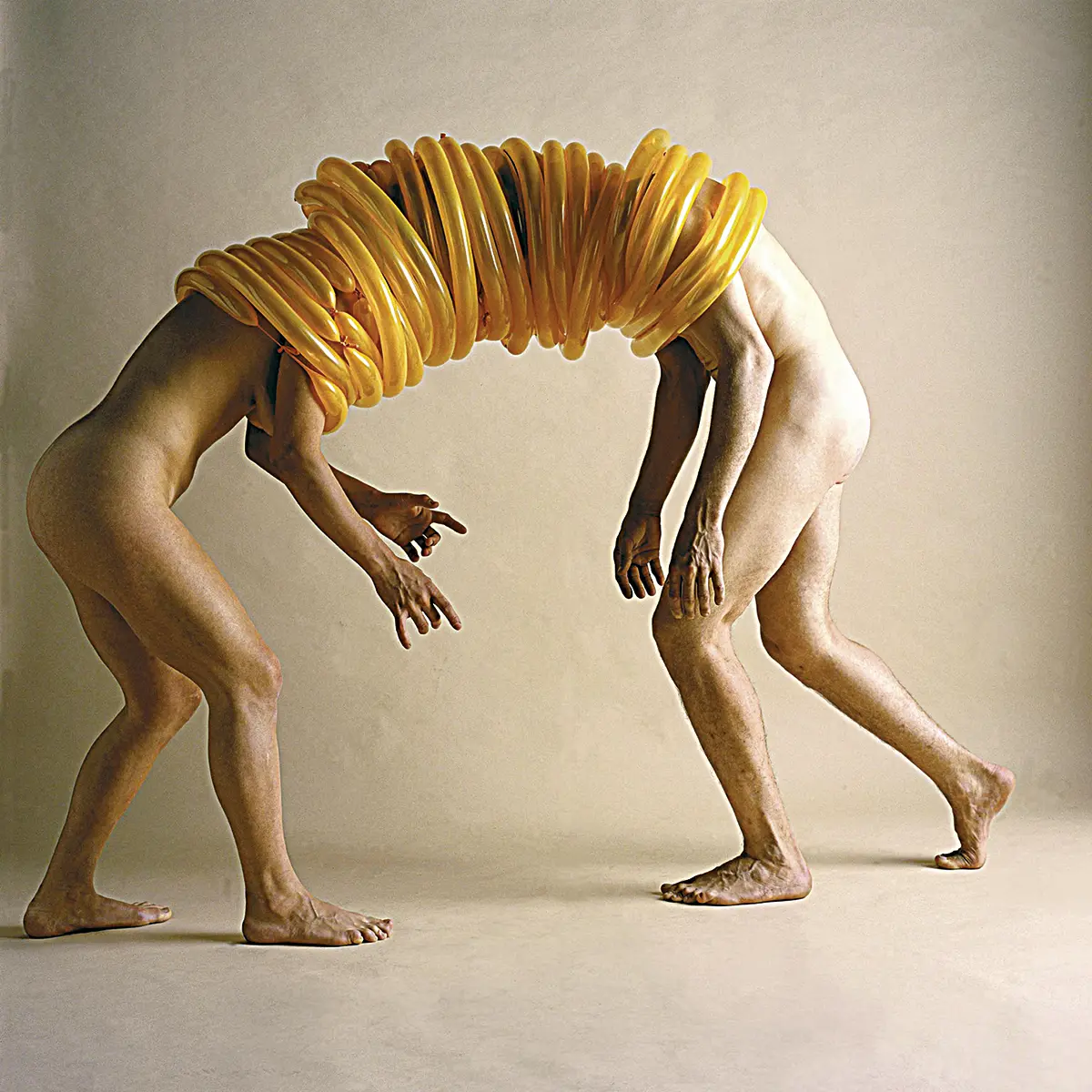
The photographic work and chameleonic installations of Mónica Van Asperen (born 1962, Buenos Aires) have been exhibited on several occasions at the Fernando Pradilla Gallery in Madrid. They are emblems of an aesthetic that, with formal delights and convincing compositional artifice, establishes deep metaphors for the schizoid state of contemporary culture. Her work surprises by sharply raising issues about the body and its representation in constructed and constrained circumstances—warnings about the body’s unsuspected limits and how it responds to the hegemonic demands of culture, making it a veritable simulacrum of virtues or a new hygienic-aesthetic paradigm of proficiency. In this way, the photographs and the installation objects focus on the conflict of opposites, a still-unresolved issue in the West’s artistic narrative. Presence, absence, matter, vacuum, air, liberation, heaviness, and lightness: these are some ideas that can be gleaned from looking at her photographs. In Van Asperen’s work, the body—the first proof of our identity and our “being in the world of tangible things”—is invaded with an astute poetry that reveals a lack of communication with the Other, which turns it into the fetish of a thousand display windows, into malleable matter on which behaviors are structured and imprinted from the centers of power and control.
Another feature that is common to many female Latin American photographers is that they themselves, in the majority of cases, are the central figures in their photographs. The artist and her body in performance becomes the focus of photographic discourse, producing an image that is anchored on the first-person singular subject but transcends it to become the amplified voice of many. From their sexual, gendered, racial, existential, and cultural reality, these artists weave self-referential universes linked to their contexts through a number of connections, some of which are suspected by the critics of the moment.
This is one of the reasons why the attack often launched against works in which visual beauty exploits a highly significant formal and compositional hedonism is gratuitous and not convincing. Photographers like Cecilia Paredes, Priscila Monge, Marta María Pérez, Milagro de la Torre, Cirenaica Moreira, Patricia Martín, and many others appeal to a clean and hedonistic use of photography. This approach does not lessen the reach and eloquence of their voices in the rich breadth of artistic practices that touch on anthropological, religious, ecological, social, and cultural issues as well as the issues explored in gender studies and the pertinent articulation of a voice all of its own. Van Asperen’s work benefits from this virtue: that of being in its own right a beautiful and complex reading of human reality, working from her own body or the bodies of others to speak to the gendered being in its eternal dilemmas of situation, encounter, and loss.
A formal aspect of these photographs, one that marks Van Asperen’s work, is the use of elements such as balloons arranged in whimsical ways along with succinct body positions, which make her compositions luxurious to the eye and refer to the artist’s own past. Her bodies/sculptures frankly seduce with their tactile and erogenous qualities and are bold re-readings of the cold neo-baroque world of the fashion model and the accelerated, exasperating universe of the catwalk. But Van Asperen’s chromatic skill and spectacular light achieve a pictorial aura with clinical undertones, and the images can be read as the new model of bodily virtue associated with the laboratory and the correction of appearances. Van Asperen’s bodies wait calmly for critics to reveal the keys of enigmatic and uneasy being.
ANDRÉS ISAAC SANTANA