Since being founded in 2000, the Zurich-based Daros-Latinamerica has organized important one-person and thematic exhibitions with works from its collection. Exhibited in its museum at the cultural complex Löwenbräu-Areal in Zurich or in international sites with which it has collaborated, Daros-Latinamerica’s program has explored key topics in Latin American art. Similarly, the catalogs published for these exhibitions are an important contribution in the academic and cultural realms.
Curated by Hans-Michael Herzog, Seduções: Valeska Soares, Cildo Meireles, Ernesto Neto is an important exhibition highlighting trends in contemporary Brazilian art. Each work is presented in its own gallery, underscoring its autonomy and allowing visitors to establish associations between them.
Curatorially, Seduções refers to two of the traditions that have most influenced contemporary artistic production in Brazil: the historical Baroque and its incorporation into contemporary culture, and Neo-Concretism. Although the path followed by each artist in the exhibition is based on minimalism and conceptual art, reconfigured as a different proposal from a specifically Brazilian point of view, and transformed into an individual formal language, the two key traditions are a communicating thread between the works. This strategy allows Herzog to foreground the affinities between the works and each artist’s contribution to contemporary art.
Desire, seduction, and pleasure form a kind of matrix holding the exhibition together, which highlights the importance of these notions in contemporary Brazilian art and in the two traditions that nourish it. In this art, subjective and cultural corporeality, the dynamic and paradoxical relationships between the sensual and the intellectual, and the materiality of forms generate and configure an experience of the works that are frank, poetic, and palpable.
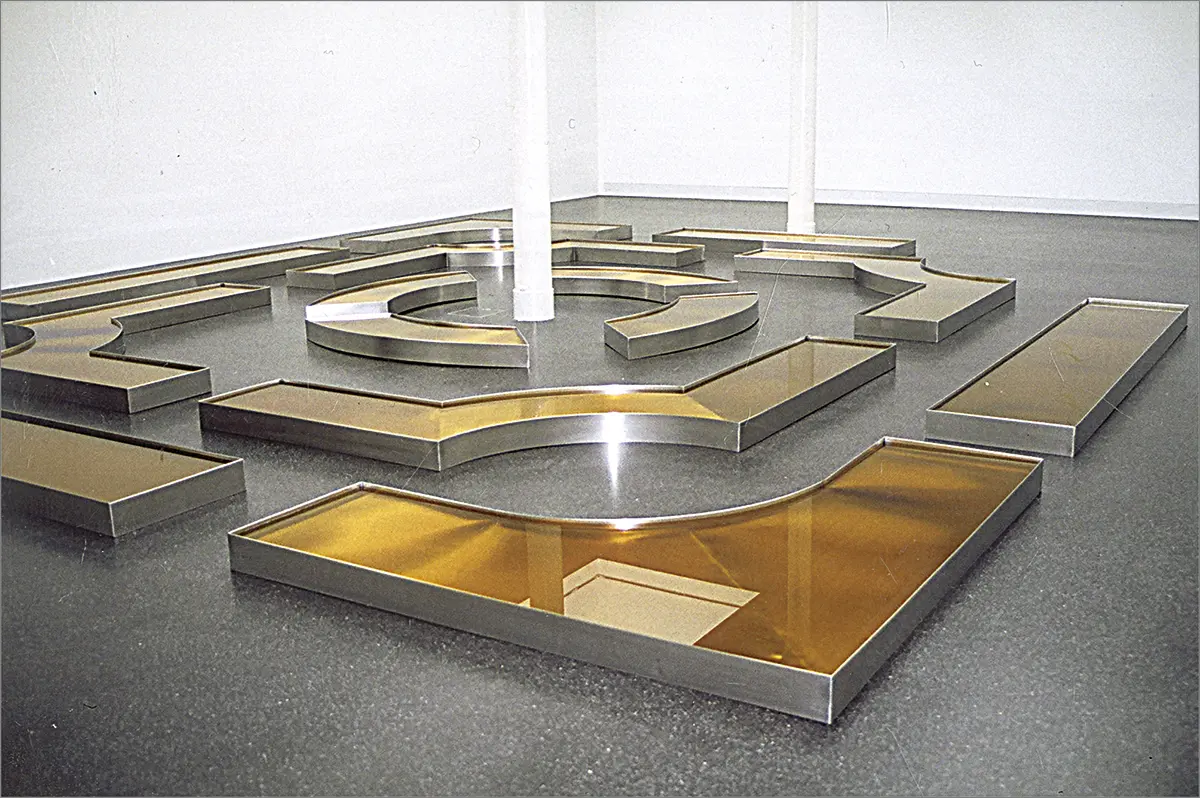
Valeska Soares (born 1957, Belo Horizonte) is represented by Vanishing Point (1998), a key work that illustrates how the artist fuses the traditions of the historical Baroque and its contemporary echoes. Vanishing Point explores the topic of the garden to reflect on the inextricable connection between nature and culture. It comprises fifteen stainless-steel receptacles filled with an aromatic amber-colored liquid. Varied in shape, the receptacles collectively form the pattern of a Baroque garden, alluding to topiary labyrinths in several landscape-architecture traditions.
Economically executed and situated within a cool minimalist tradition, Vanishing Point generates a contrast between its formal austerity and the aromatic exuberance that fills the gallery. Visual order and olfactory frenzy produce a contradictory experience. Heavy and ethereal, the work envelops the visitor, magnifies the sensorial, and transgresses the habitual Enlightenment bifurcation between sense and reason, body and intellect, a short-circuiting of the bodily and the rational that mimics the excess of the Baroque experience. It also brings to mind Lygia Clark’s participatory experiences and both Louise Bourgeois’s and Bruce Nauman’s installations, which explore the dynamism and the contradictions of the body and of language. And as Herzog points out, the work has a vanitas quality—a common Baroque theme—as the aroma brings to the forefront the transitory character of the garden and by extension the ephemeral nature and the mortality of all living things.
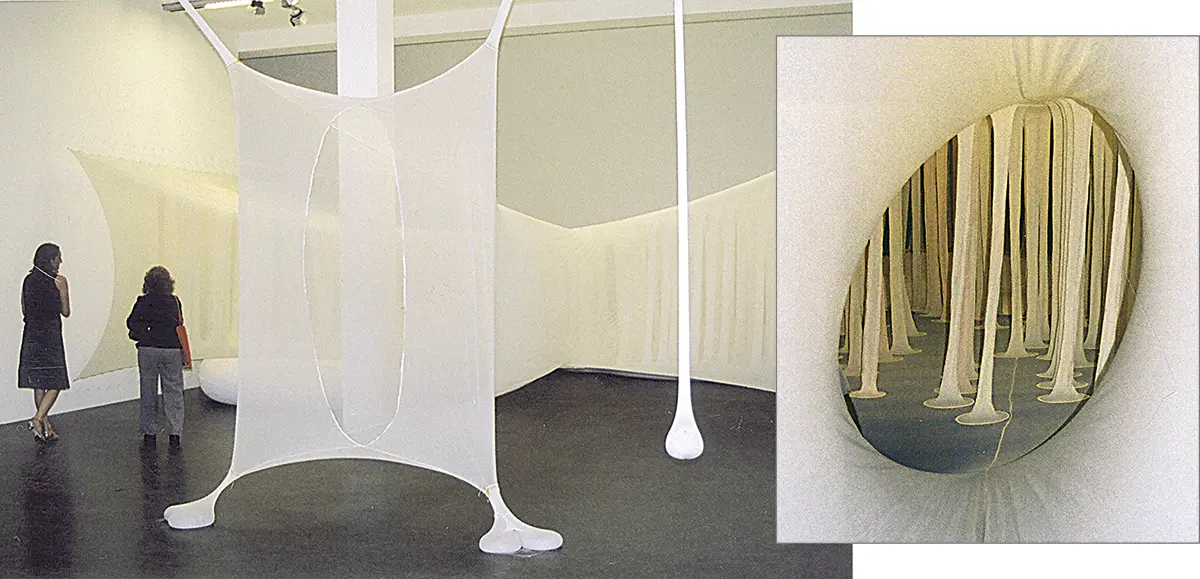
Ernesto Neto (born 1964, Rio de Janeiro) participates in Seduções with an important large-scale installation, Globiobabel nudeliome landmoonaia (2000). This work is characteristic of his exploration of and challenge to the body/mind divide. The artist defines it as a “penetrable sculpture,” and visitors enter and incorporate themselves into it, blurring traditional borders between a work of art and the public. The work is informed by Neo-Concretism, a movement that sought, among other goals, to create an art that was interactive and organic with its public, an art in which body and perception were conceived as means for learning. Today, Neto’s work can be described in terms of “relational aesthetics”—a term and concept coined by the researcher and curator Nicholas Bourriaud—as it involves the public in a dynamic fashion, a process that generates socio-spatial and inter-subjective relationships. Literally, one enters, touches, sits on, and lays down on Neto’s sculptures and installations, becoming a part of their skin and surface.
Neto’s biomorphic sculptures and installations create an integral, safe, and primordial space, thus evoking the maternal uterus. Once one is inside the uterine cavity of Globiobabel nudeliome landmoonaia, surrounded by suspended columns of nylon stockings that resemble vascular shapes, it seems one is in a pre-linguistic environment where perception is preeminent. In philosophical terms, it reverts to Maurice Merleau-Ponty’s phenomenological thinking, which was known early in Brazil and had significant influence in the artistic scene, to the point of being cited by Ferreira Gullar in his Neo-Concrete Manifest (1959).
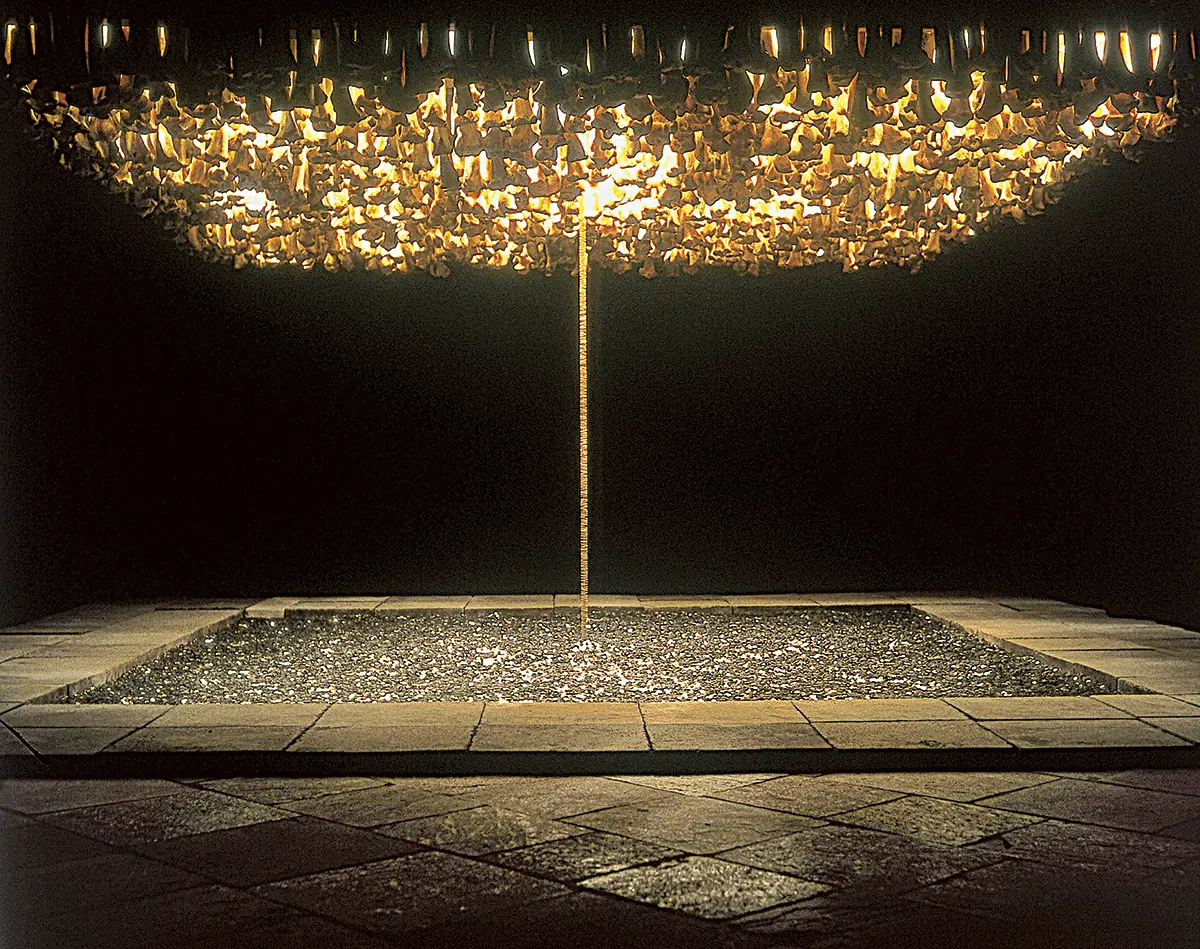
The primacy of perception and the linguistic-corporeal experience is politicized in Cildo Meireles’s Missão/Missões (How to Build Cathedrals) from 1987. Articulated by materials loaded with symbolic meaning, the installation deals with Brazilian history, in particular a period known as os sete povos das Missões in reference to the seven towns founded by the Jesuit order in the south of the country and to the quasi-utopian project of Indian evangelization between 1610 and 1767, the latter being the year of the Jesuits’ expulsion from the Americas.
Cildo Meireles has emphasized the directness of his installation. “My idea was to create it in the most direct manner, and I went straight to the point. An equation connecting spiritual power (religion), material power (governments), and tragedy (the indigenous peoples); the idea was also to work with objects that were at the same time material and symbolic.” Severe and economical with only five components, the installation’s scale is excessive (3.5 x 3.5 x 2.5 meters) and its material accumulation is ultra-Baroque: 600,000 coins, 800 communion wafers, 2,000 cow bones, 80 stone slabs, and many meters of black cloth.
Already a classic in the history of contemporary art, Missão/Missões (How to Build Cathedrals) underscores the pertinence and resonance of the Latin American Baroque in contemporary art. In this work, allegory operates as a summarized and fragmented way of representing history. The work is experienced dynamically, history is perceived virtually, one feels oneself entering it, and its formal materialization presents it as open, movable, and accumulating readings.
Seduções: Valeska Soares, Cildo Meireles, Ernesto Neto is a rigorous exhibition, illustrative of curation that introduces new audiences to Latin American art and contributes to the international contemporary art field.
VÍCTOR ZAMUDIO TAYLOR