
Alex Hank’s recent exhibition, The Melancholic Mr. A, consisted of individual works that feigned installation as well as sculptures that resembled electronic signage culled from an imaginary red-light district. The works in the front gallery that cohered as a site-specific piece revolved around a mass “burial” of icons. Less memento mori and more iconoclasm, recognizable logos, and images from a broad spectrum of commercial and low culture were littered about the floor with random precision. This effect was not unlike a palimpsest of sorts; a semiotic frenzy was achieved as signifiers clashed against each other producing advertisement inertia.
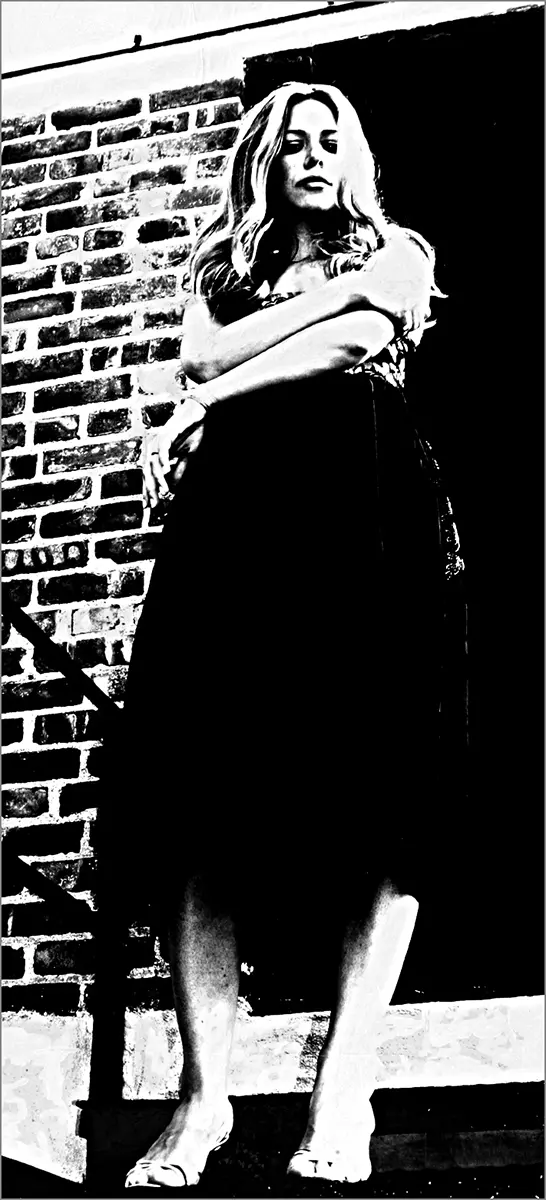
Unlike Warhol’s use of commercial citations make it difficult to tell apathy from empathy and critique from infatuation, Hank’s vertiginous and implosive bric-a-brac of logos was fatalistic. The ostensible singularity of this reading was enhanced by a series of mixed-media works of black-clad individuals presumably attending the last rites of an alternative universe of low culture gone amok. However, what added another layer of narrative patina to this piece were the individual titles of the quasi-gothic Greek chorus that viewed the interment from above. The looming figures and the titles of the works in which they were found were based on wars, including The East Cape War (2006), The Snake War (2006), The Thousand Day War (2006), The Cold War (2006), and so forth. History, in this instance, took a rather glib turn; for in this convergence of history and it's other, that is, where fact and fiction are blurred, was the subtext that these momentous conflicts that affected the development of “civilization” were also the producers of the cultural putrefaction found below. A riff on Adorno’s “museum as mausoleum” toward gallery-as-gallows, the exhibition milieu was transmogrified by an artist who acted as both morticians as well as an aesthetician with the greatest aplomb.
Similar in trajectory was the cacophony of signage in the gallery’s Project Room that also mined an array of sources both low and high, and that was ciphered through a strange admixture of sociology, anthropology, psychology, and critical theory. Featured in the smaller space were nine light-boxes that simulated signs found around the world, although their self-reflexivity was ripe with irony and double meanings that projected a myriad of narratives. Working with a finely honed sense of the contradictory were signs that advertised THE CAST (2006) and THE STAFF (2006), for example. Were these oblique yet poetic references to the larger-than-life figures in the other rooms, to the employees of the gallery, or maybe to the role of the artist in a serviced-based economy symptomatic of twenty-first-century managerial capitalism? Statements such as these were too open-ended to be written off as only self-reflexive endeavors, however.
Other wry, more cerebral send-ups of vernacular signage included ones that advertised NO HAY (2006) and Placebo (2006). Obviously the former is a Spanish phrase that could easily be read like English and in the negative as well. This rather straightforward statement was tautological to the point of self-negation; yet, its auto-cancellation was more along the Frankfurt School’s “negative dialectics” than nihilism. Placebo similarly deconstructed the notion of self-deferral via critical theory. A placebo is a substance with no medicinal value but is given to a patient to reinforce his expectation to get well. In Hank’s framework of ersatz advertising, Placebo operates within Marx’s notion of the commodity fetish. That is, the placebo is not so much fake medicine as it is the commodity object that we need for existential healing and humanistic gratification—in short, for mind/body integration and subjective completion. Overall, Alex Hank’s exhibition was an ambitious one that evinced an artistic maturity in the making. Although the strongest pieces were the light-boxes that were more conceptual in orientation and seemed more formally and thematically developed, it will be interesting to see what this relatively young artist will do next.
RAÚL ZAMUDIO