Between May 20th and June 17th, Ruth Benzacar Gallery presented the first thematic individual exhibition of works by the Brazilian sculptor Artur Lescher titled Minimal Landscapes. For this exhibition, the artist, who was born in 1962 in São Paulo and has recently received the prestigious Kajima Sculpture Competition Special Award in Japan took maximum advantage of the gallery’s topology. The horizontal arrangement of the space in which Lescher installed his unique neo-minimalist objects and site-specific sculptures echoed the tautological potency of the landscape format and Lescher redefined the gallery space with effective contrasts and interplays of concentrations, tensions, and distensions.
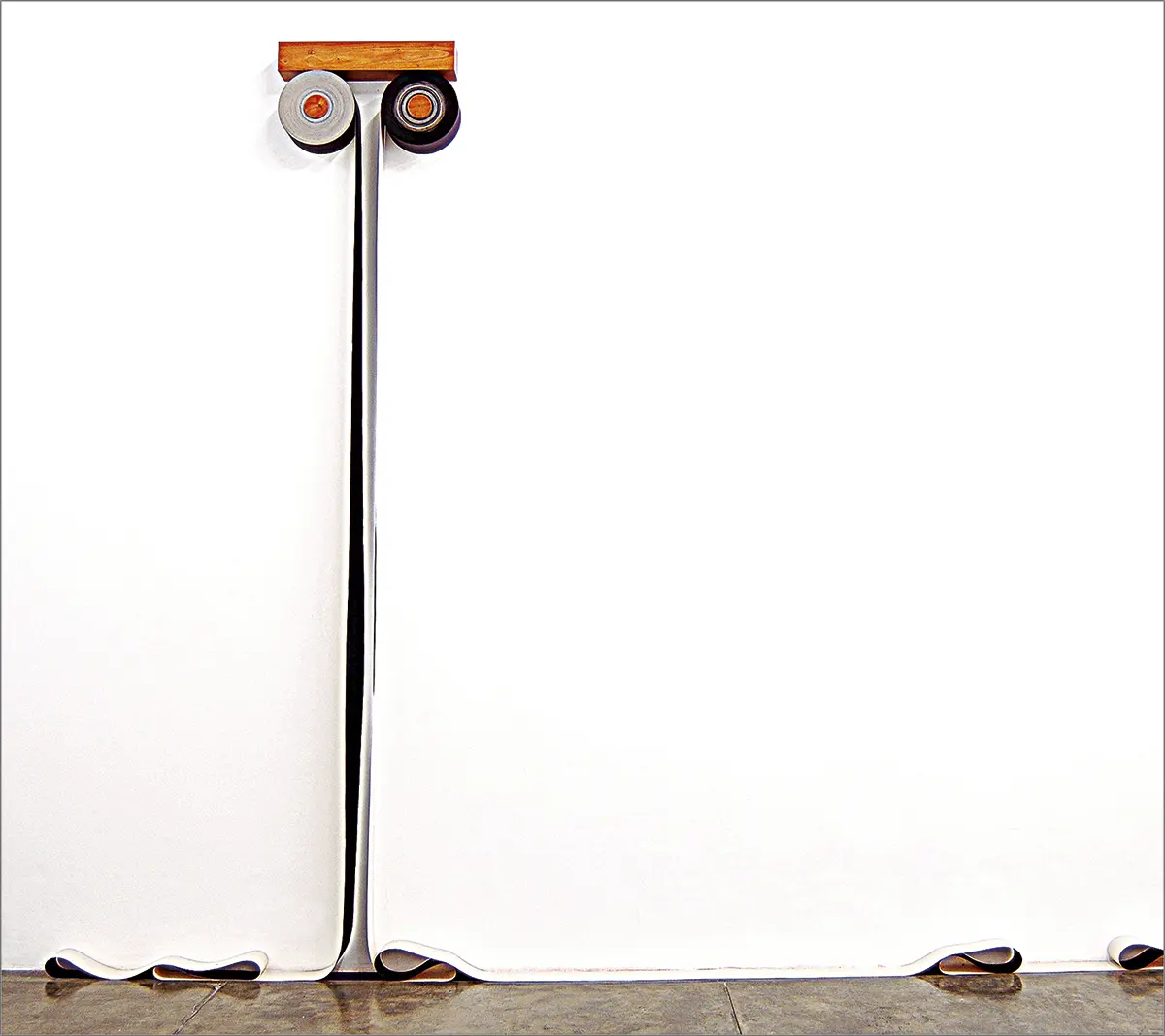
This new opus, executed in a variety of materials such as porcelain, wood, stainless steel, glass, felt, fine ropes, and silk laces, emphasized the diverse and complex possibilities contained within the spatial poetry that the Brazilian artist has been developing. Lescher’s intention is to make a 3-D visual order concrete; in this hybrid syntagm of works, the metonymical links between them produces conceptual twists that remove the works from the immediacy of sensorial certainties. Lescher promotes a critical model that confronts the supposed iconographic coherence in the visual arts field: the theory of representation, the theory of language, and the theory of the natural orders.
With the “fall of the image of the world” led by Cartesian philosophy and its notion of evidence, meanings stumble, dissolve, and disappear in discontinuities that cannot help but impact contemporary art. In this sense, it is important to underscore the artist’s own words: “This show debates the notion of landscape, almost in an indexical manner, since the works exhibited allude distantly to rivers, beaches, lagoons, lightning, and rain, with the selection of these items intended as a clear overview of my current efforts.” At the same time, talking about the clusters of installations in this show, Lescher adds: “The works establish dynamic relations with space, as a whole, as a total body of work, but, simultaneously, they retain their own autonomy, producing the tensions and distensions necessary for their existence, such as the various kinds of encounters that I want to establish between materials, forms, and constructions, which has been occurring since my site-specific work, exhibited in the most recent edition of the Mercosur Biennial (in Porto Alegre).”
A substantial body of work was displayed in the main gallery at Ruth Benzacar, including: Aguja negra—a tribute to or an erudite quotation of Lucio Fontana’s Tagli—which was lightly suspended over the wall, caressing it in an almost ethereal way; the Cometas, with their tensors; Armadilha para Baby; Lagoas; and Río de la Plata. These works triggered the questioning and mise en abyme of the “evident” systems of spatial representation by separating them from tradition, since they no longer communicate a shared set of knowledge or the cultural processes that previously transformed images into sums of crystallized meanings or anecdotes.
For Lescher, what matters is a critique of the discourse of sculpture via the creation of new cartography in which signs are dislocated. In this way, the beach, the river, and the desert are thematic indicators that connect the viewer to “naked landscapes,” and this radical dispossession is what distinguishes and disconnects them from any predictable allusiveness. The difference is not as natural as it is aesthetic, of signification.
The fact that the works are post-minimalist does not make them mute. In them, one finds a unique whisper of spatial language, which functions with allegorical sequences of traces of the world before human hands intervened.
Lescher’s sculpture describes a process of action regarding both the materials and alterable structures and the messages he codifies. He creates works that are imbued with design and the trust that characterizes the utilitarian. However, he transforms this diffuse objectivity into objects that are entirely useless and impossible to fully comprehend, like his Armadilha para Baby. This work is a large weaving of immaculately white porcelain cylinders inserted into long, dark wood frames. This floor piece can be rolled up like a carpet but exists simply to be contemplated, and one can only walk around its borders and adjacent spaces. Playing with the cylindrical and the quadrangular sections, Lescher created an appealing sculpture with purely tactile qualities.
CLAUDIA LAUDANNO