The audacious art of Augusto Zanela (Buenos Aires, 1967) works by challenging our perception; it plays with illusion and with viewer participation, offering a framework for reflection. In Praxis’ lower level he presented a small retrospective of photographic registers of virtual realities, and in the upper level an installation in tribute to Duchamp. His works include traps for the eye that question the means of representation and of discernment both of the artistic object and of reality.
An artist and architect, teacher, and researcher, Zanela puts together installation using the classical concept of the anamorphosis, an ingenious process of optical construction of perspective. One of the most famous examples of anamorphosis can be seen in the lower part of Hans Holbein’s 1533 painting The Ambassadors, at the London National Gallery. There we see an oval shape that in truth is a human skull deformed when seen frontally, but true to form when seen up close and from the right.
To create the 16 photographs included in this exhibition, Zanela invents situations that only offer a regular image from a certain vantage. This is the exact point from which the artist documents them. There is nothing left to chance in these images, dated between 1997 and 2004, in which Zanela first intervenes the space with ribbons, wood, chalk, and twine, organizing geometric shapes or objects like Pieza de madera, 2003, made with recycled wood, or Rombo. Fundación Proa, 1998. Reality filters through that “rhombus” that dialogues with the checkerboard floor in the terrace of the Proa Foundation, including in the landscape a few ugly 1970s buildings, but also the legendary Old Bridge, a fixture of the La Boca neighborhood. The Proa Foundation and its spaces intervened with simple materials (self-adhesive tape) also offer sharp results in Dos rectángulos, Fundación Proa, 2004.
Zanela’s installations are often lightning-fast. He works for one or two days, a week at most, in the place where the process of optical construction develops to create the perspective for the photograph. Seen on-site and from a normal point of view, distortions multiply in these interventions, which disappear in the photographs taken by the artist.
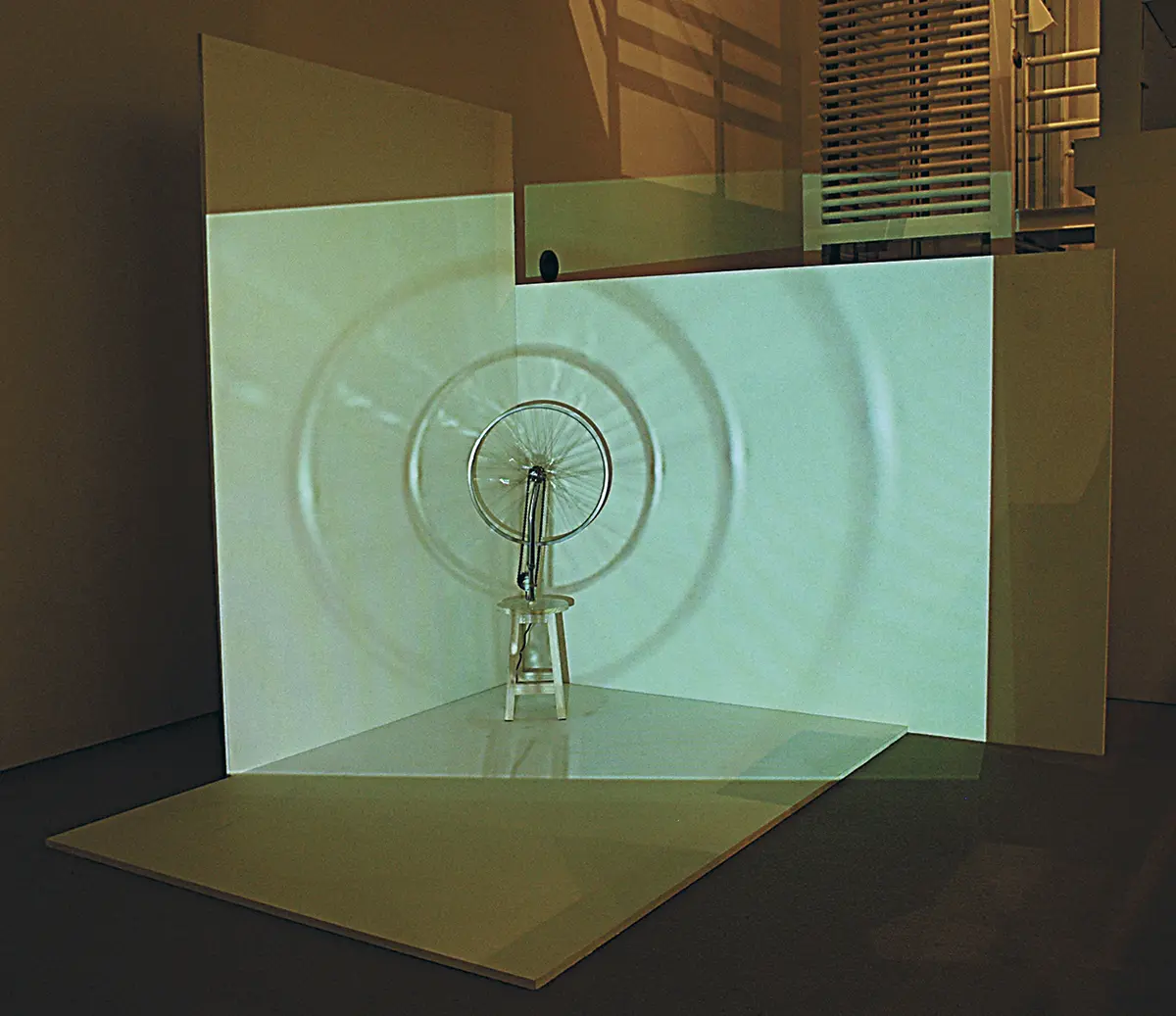
The show continues on the gallery’s first floor with another perceptual-illusion game. MD-Remix, 2006, is a video-installation in which Zanela connects Marcel Duchamp’s first ready-made, Bicycle Wheel, and one of his roto-relief drawings a series of disks with concentric circles that generate, when turning sustainedly, a hypnotic image. In this way, Zanela adds two Duchamp works that were not conceived to be shown together. "The title of the installation, MD Remix, emerged as the application of the contemporary concept of the ‘mix,’ which comes from the field of sound experimentation, and which I bring to the field of the image,” the artist explains. In this tribute to Duchamp, ironically no sound is heard.
The video-installation consists of the placement in a corner of the gallery of a bicycle wheel in continuous motion (although Duchamp’s famous bicycle is always fixed on its base,) here also mounted on a kitchen stool, next to a closed-circuit video camera that captures the object and projects it onto a simplified roto-relief drawing on the wall. This capture and transmission in real-time produces an effect of feedback for the mixed images, presenting the viewer with the image on the plane, its projection in space, and its infinite repetition on a screen placed at the front of the gallery, from which pedestrians in the street can also see one of the working spaces.
“Zanela creates a work that can at first be entertaining and, as its game moves forward, become one of the latest versions of our paranoia,” notes Gonzalo Aguilar in the show’s presentation. In that sense, the installation reconfirms the potential for the feedback of images and meanings that can be achieved by closed-circuit video in a society more and more under surveillance by a multiplicity of omnipresent cameras, in elevators, and at building entrances, as well as in the street, where they are used to register traffic violations, and in public squares or key city corners, to control the population.
Through Zanela’s unconventional and subtle photographs and his video installation, viewers will be reminded of the fact that there is no such thing as a direct perception of reality, and that —in his work as much as in life— one needs to question all certainties, since everything depends on the position from where we see it.
VICTORIA VERLICHAK