
Beatriz Eugenia Díaz is one of the first Colombian visual artists to incorporate sound into her work. In 19992 she presented what had been her graduating thesis as an art student at the Universidad de los Andes, titled No hay absoluto, at Bogotá’s Centro Colombo Americano. It was a sound installation in which both the audio and the arrangement of elements in space was related to the number 7. "Along the way in the path of artistic creation, the number 7 has always been present: as an artistic practice, as a referent for representation, as an allusion, as an interest in the concept of time, as a concept, as a magical root acting in real-time and modifying the perception of space."1 This condition joined to a minimalist aesthetic has been a constant in her work.
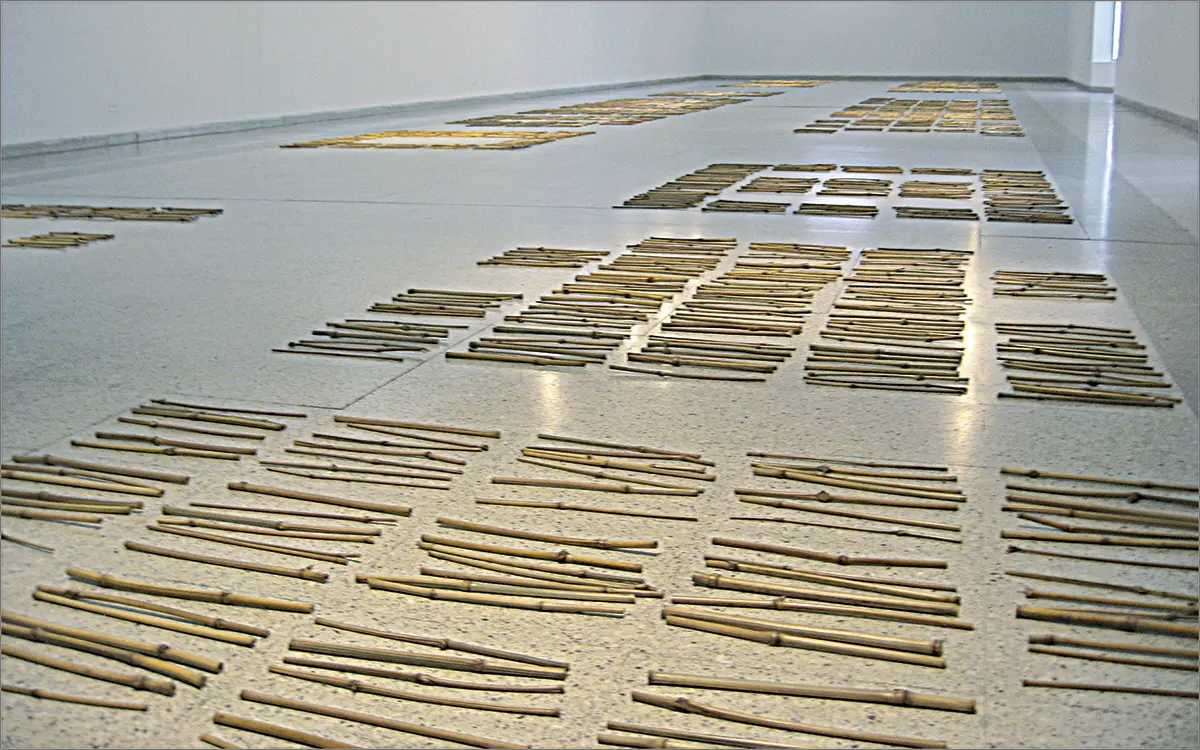
77 X 14, Beatriz Eugenia Díaz’s most recent work was installed in Gallery 3 at the Museo de la Universidad Nacional, a quadrangular space whose dimensions, coincidentally, related to the number 7. The gallery’s length is formed by seventy-seven tiles and its width by fourteen quadrangular tiles. The space’s physical characteristics, Beatriz Eugenia Díaz says, transform the number 7 into “an organizing principle for the creation of an image that is at once synthesis and opposites. Seventy-seven and fourteen are duplicated sevens. One next to the other, and one that adds to the other. The image is union and separation at the same time. Opposite, complement. Movement, stability. Diachrony, synchrony. Each visual instant in space is the memory of what was an instant of acoustic silence.”
The artist’s references regarding what supports her work are always related to a precise spatial concept, in this case, the site’s dimensions, in the same way that there is a musical, mathematical, rigorous structure related to the composition of sound, in which Beatriz Eugenia Díaz takes advantage of her musical education. The concepts on which her work originates are often inaccessible for those who have not mastered the technical language of music, yet these complex correspondences are made visible and audible, which is to say they come to us through our senses and the same exacting precision that supports the work allows perceiving an interplay of the spatial and the acoustic that can turn into an emotional, sensible experience and overtake the conceptualization at its origin.
In the most recent National Salon,2 she presented a work that is rather sui-generis in the context of her production, titled celoSie, a name comprised of 7 letters. On this occasion, Beatriz Eugenia Díaz used her voice for the first time to sing a song she had composed, structured in a complex way around the number 7. The work was conceived for a history-contaminated site, the Santa Clara la Real church in Tunja, a place of prayer for the nuns at the Clarisas convent, a placed overloaded with female memories and voices. In her first visit to the convent, Beatriz Eugenia Díaz says she found a “recliner, a book open to Chapter VII. Precisely on that open page was a musical score, and precisely there seven pneumas that were the origin of polyphonic composition.” Created on the basis of that chance encounter with the number 7, this sound work irradiated from the choir and, the way stained-glass windows do with light, it created an emotional atmosphere in contact with history, with the site’s memories, and with the present through the viewer’s experience. The same work was installed later in Bogotá’s Santa Clara church museum.
In 77 X 14, the work is inserted in a neutral, white space, one that is in a way devoid of history, or at least history was not taken into account; the definitive starting point was the space’s physical and auditory dimensions. The artist comments that in her creative trajectory she encountered “this space (...) and I thought I should inhabit it. The first thing was to hear it. It talked and I listened. I heard and listened to its silence. And I counted: 77 X 14. Filled with sevens, I wanted to inhabit this space. (...) I felt floor and ceiling. Above, empty spaces in the periphery. Sound could come from above. Below, a visual closure towards the center. The drawing could come from below. Light-gray tiles framed by somewhat darker tiles. I counted the framed tiles widthwise. I counted fourteen. I counted the tiles lengthwise. I counted seventy-seven. A reticule. Seventy-seven times fourteen.”
This unique perception of space originated the visual and sound installation 77 X 14. Arranged on the floor were small bamboo sticks delicately cut to the size of each tile and placed with great care on each one, following in each one a different order, thus creating a kind of writing or a musical score that evoked some kind of Oriental calligraphy. This drawing is related to the sound units and their respective silences, to the space’s proportions, and, consequently, with the number 7. The sound came from the ceiling, it was an audio work built on the basis of a recording that captured the noises produced by the making of the drawing, registering the knock of the bamboo sticks falling to the floor, so that the space’s “voice” is recorded, its pitch, its acoustics. This sound was then processed in a computer, following precise parameters established by the artist, in which the number 7 plays a structuring role.
The delicateness of the sound and the arrangement of the elements in space became a visual and sound experience that, recursive as it is in Beatriz Eugenia Díaz’s work connects us with the aesthetics of minimalism. The elements comprised in this installation involved our bodies and our senses, inviting us to travel through this space that for the first time let us hear its voice and its wise proportions.
NOTES
1. Beatriz Eugenia Díaz, reflections around 77x14
2. This work was part of the curatorial project of Natalia Gutiérrez's central zone, “A place in the world”, which took place in the cities of Tunja and Bogotá, 2005-2006.
MARTA RODRÍGUEZ