Trees, bandages, insects, garbage, and flags: Donna Conlon uses untraditional materials in her artistic endeavors. In her works, the process is as valuable as the product and allows her to explore the expressive possibilities of ephemeral art along with performances, assemblages, interventions, and installations. She is an artist who sculpts, discovers, recycles, and films, creating new meanings and re-contextualizing the everyday objects and waste products of a globalized society, with never-ending respect for conservation and the planet’s biological balance. Her artworks, in addition to reflecting a vibrant imagination, a sense of humor, and creativity in the use of biological or recycled matter, express a significant political charge, knowledge of science, and an urgent ecological message.
Donna Conlon’s connections to science run deep, as her university studies focused on biology; she obtained a master’s degree with a concentration in entomology in 1991. As she was closing this chapter of her life, Conlon decided she needed to explore other paths in search of self-expression, an interest that led her initially to take some courses in sculpture but later to submerge herself completely in the world of art. As early as 1993, she took part in a group show at Cornell University, and four years later she held her first solo exhibition of sculptures in stone, wood, and cement at the Department of Artistic Expressions of the University of Panamá.
With her show Permutations in 1999, Conlon really made a mark in the art world in Panama, where she had come to live five years earlier. Her “permutations” were sculptures that reproduced natural forms in materials as varied as wire, paper, latex, sawdust, and pollen. What she achieved was not a representation of the natural world with all its splendid, tropical greens but rather a group of pseudo-relics in the shape of cocoons, fruits, seeds, and nests abandoned by time, like botanical objects with the air of archeological artifacts. Conlon sought to produce more questions than answers: to trigger a heightened contemplation of nature, where she has always found new directions and paths for evolving. While she made an income as a scientific illustrator over the following years, Conlon continued to experiment with three-dimensional art using a variety of substances, creating organic forms like baskets or nests with delicate twigs or wires, Medusa-like meshes, or weavings reminiscent of Eva Hesse’s rope pieces. In 1999, Conlon crossed the line from sculpture to the creation of installation art with her piece Where to Put It All and in 2000, during a trip to Costa Rica, she carried out her first interventions directly in nature, by filling the roots of enormous trees with wire and leaves and documenting the work with photographs.
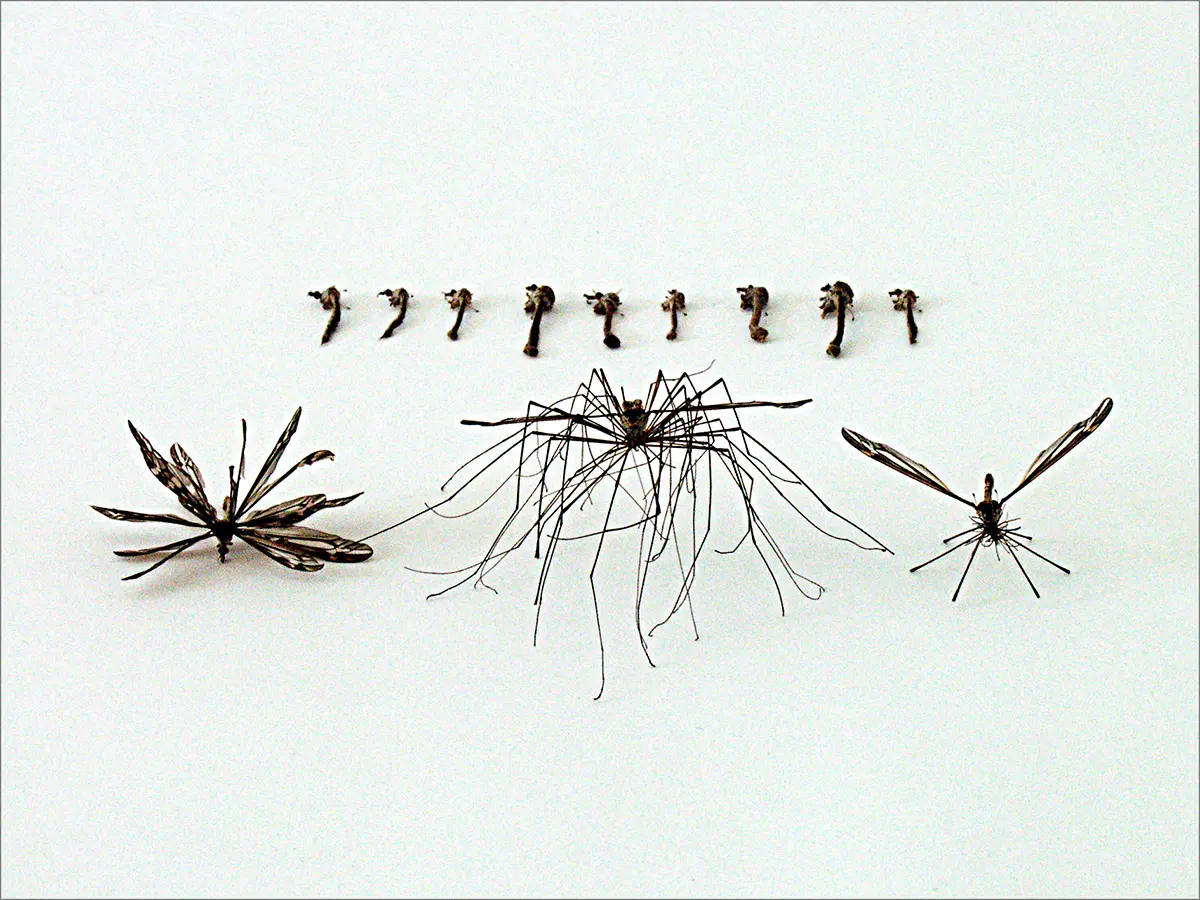
After working in sculpture on her own in Panama over a five-year period, Conlon was eager for information and intellectual exchange and signed up in 1999 for postgraduate studies in studio art in the United States. She remained in New England for about two years, with frequent trips back to Panama, and her work took off in new directions. Above all, in part as the consequence of a death in her family, she developed an interest in ephemeral art and the use of lighter materials. For example, she produced Fragility Capture (2000), a piece in which she incorporated dead mosquitoes —victims of “socially acceptable violence toward small creatures”— into a quilt of plastic sections sewn with red thread. Flying insects —in this case, crane flies— were also the focus of the Nature Improvement Project (2001), in which Conlon created three sculptural super-insects by grafting parts of other “donor” insects onto them: the wings in the first case, the legs in the second, and the antennae in the third. The result of the intervention, which referred to scientific and environmental issues such as biological manipulation and artificial selection, was an artwork both beautiful and perturbing.
To a great extent, Conlon’s works are products of her environment and the things available to her. Although the natural world still played an important role in her oeuvre, Conlon was impressed by the filth and the urban mess in Baltimore and began to incorporate garbage into her work during her student years. The process began with her collecting, among other things, almost two thousand plastic straws that she found on the daily morning walk from her home to the university. Her decision to reinsert these inanimate objects into their original socio-cultural contexts gave rise to pieces such as Cleanup II (2001), a two-channel video: one side shows a hand picking up the straws, one at a time, and the other side shows a hand replacing them in a variety of urban spaces. For the first time, Conlon was incorporating movement, sound, and her own active participation in her work, performing the action with her left hand while holding the video camera with her right.
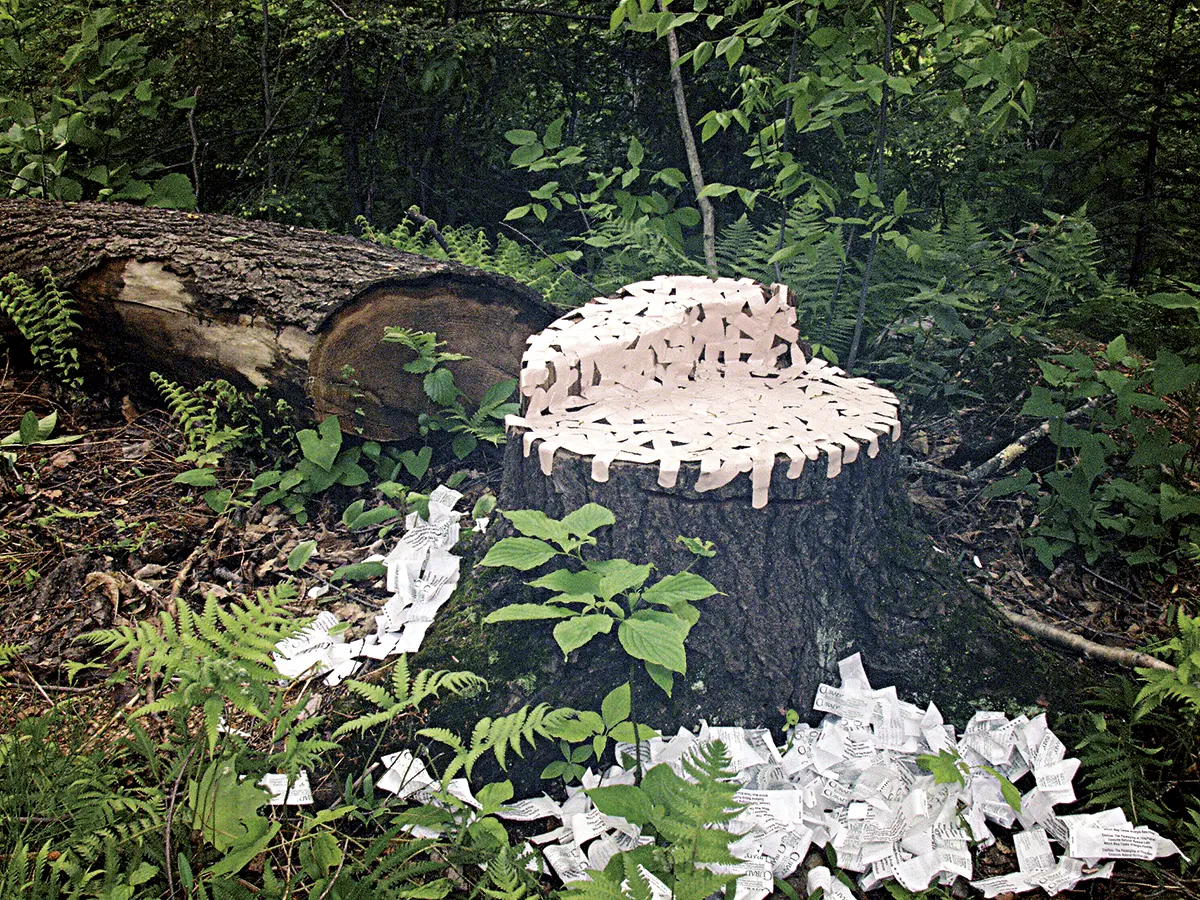
Conlon began to carry out artistic performances as acts of repair and reparation, with a view to putting things in order, to curing wounds or damages. During a residency at the Vermont Studio Center in the summer of 2001, she carried out an intervention in the woods entitled Cut Tree with Band-aids, where she applied small bandages onto the cut trunk of a tree, dropping the hundreds of empty wrappers in a pile of garbage right next to it. In a single gesture, the artist created a metaphor for a cure for man’s disservice to nature, while paradoxically bringing about a new kind of damage, thereby emphasizing the uselessness of partial solutions against pollution. The same metaphorical line of thought provided the basis for her series of four Forest Projects (2001–2002), interventions documented by a video that shows the artist’s hands “curing” mistreated plants or torn leaves with needle and thread, paper clips, glue, patches from other leaves, and even wrapping a plant with gauze in order to repair its stem. In the piece Takeover (2001), which was part of an exhibition Sculptors at Work at the Corcoran Gallery of Washington, D.C., Conlon also wrapped plants. In this case, she covered live trees in a park with twisted wires and discarded objects she had found.
The collection of objets trouvées that accumulated in Conlon’s studio were the source for the two video installations, entitled Greatest City and Single Solitary, that she presented in 2002 as part of her master’s degree thesis at the Maryland Institute College of Arts. Greatest City, with a title that ironically refers to the city of Baltimore’s slogan, addressed the excessive and pitiful consumerism that occurs in large cities through the orderly placement of hundreds of small, multicolored plastic objects —hair barrettes, soda caps, toys, hypodermic tips, and vials with color-coded caps used to distribute drugs— on the walls of a white room. The overall impression of the installation was intensified by the accompanying video that showed only Conlon’s mouth, into which she inserted the mostly empty drug vials, one by one, until space was filled to capacity, in a repulsive and unsustainable act of consumption.
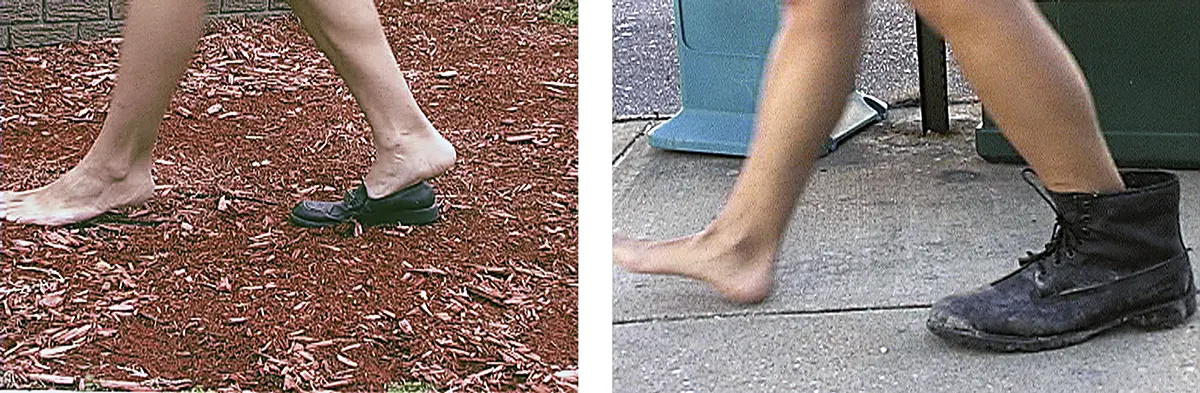
A different sense of proportion was apparent in the installation Single Solitary that Conlon created with a huge number of discarded single shoes she had found both in Panama and the United States. The piece included rows of shoes —men’s, women’s, and children’s— with dated tags like museum artifacts or police evidence, Polaroid photos of the shoes in different contexts, and a video of the artist walking in the over two hundred different shoes. Conlon filmed her feet crossing the visual plane repetitively from right to left, against a variety of backgrounds, one foot naked and the other wearing a single shoe. Every shoe has a unique personality, as did each shoe’s owner, whose absence one senses in the worn-out shape of the soles and the character of the used and discarded object. Single Solitary lends itself to varied interpretations in the same way that shoes convey multiple meanings and symbolisms, from the representation of a particular culture or personal identity to the obsession for fashion or the sexual fixation on feet.
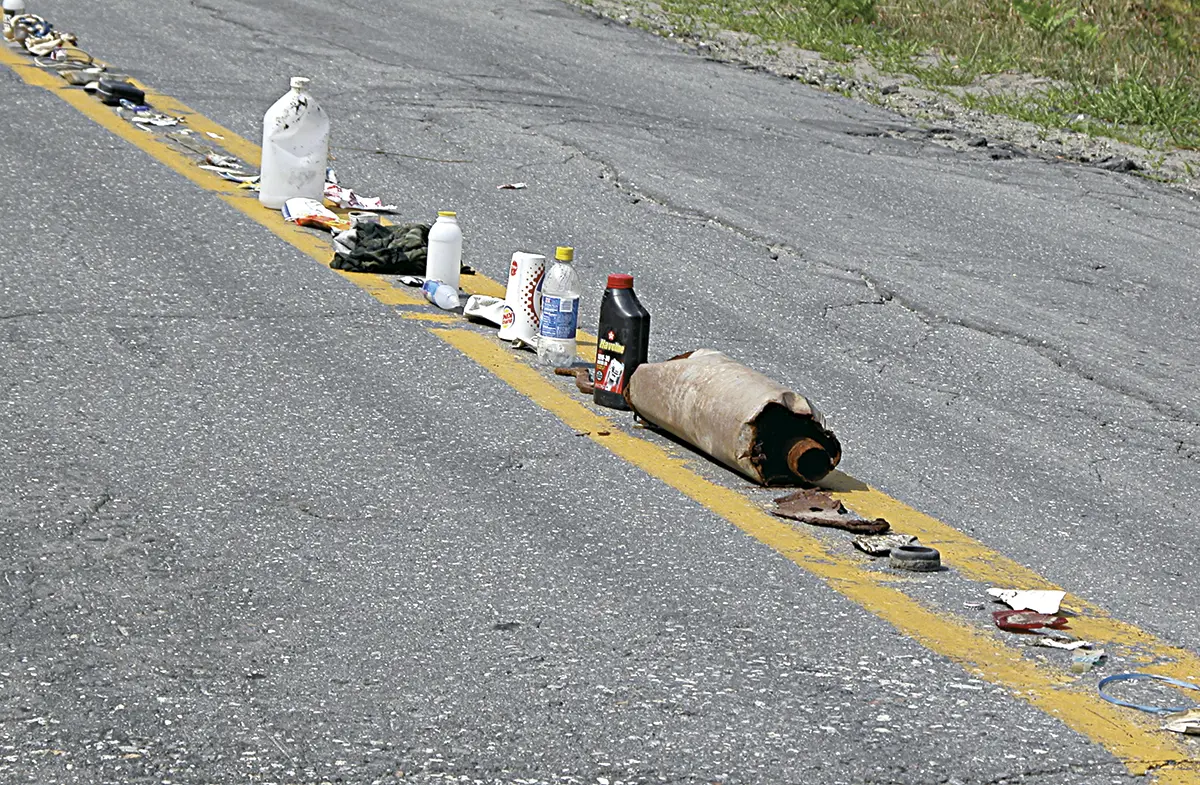
The waste created by human beings was also an essential part of the performance Country Road (2002) that Conlon documented in a video during her residence at the renowned art colony in Skowhegan, Maine. Along the two yellow lines in the middle of a road in a rural area, the artist created an axis of garbage with everything she found strewn along the sides of the road. Conlon’s repetitive movements, the placement of the garbage along the parallel lines on the road, the deep perspective, and the natural green of the forests along the sides create an emblematic image of her art. The message about conservation is forceful, especially because the neatly placed garbage disrupts the landscape in a manner that is ironically aggressive; the same garbage that mixed with the natural environment on the sides of the road was innocuous and easily ignored. If that message seemed clear, the video entitled Natural Refuge that Conlon filmed during the same period served to point out the complexities and contradictions in the ecological process. In this piece, every time the artist’s hand picks up a bit of trash, the viewer is aware that some small creature has already made it home. In an absurd act of conservation, the elimination of the garbage brings about the destruction of the animal’s new habitat.
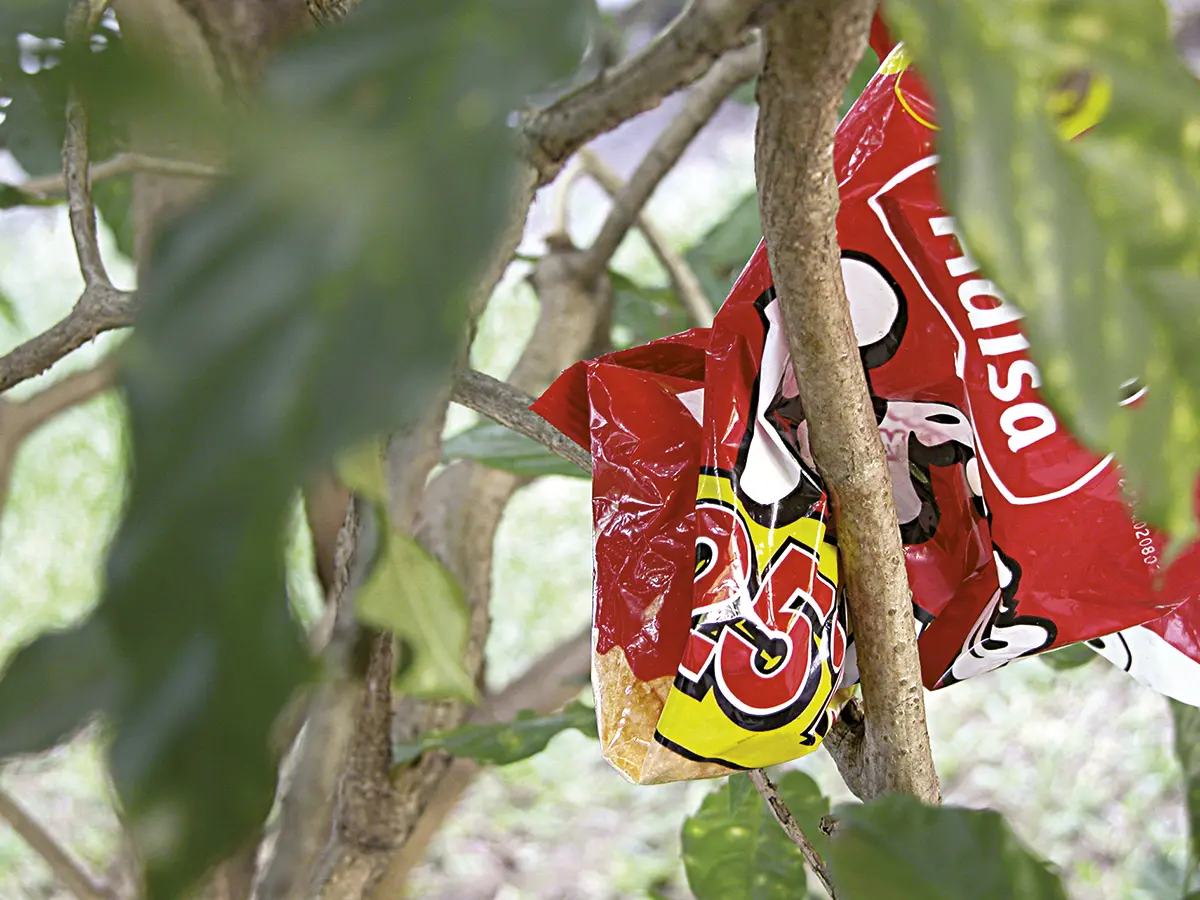
In the photo series entitled Trash Trees (2004), Conlon found and documented garbage placed in trees in Panama City. Among live branches, she discovered x-rays, broken umbrellas, juice boxes, and junk food wrappers —objects carefully placed in trees, even in some with nearby garbage cans. In her video All Fixed Up from the same year, Conlon revisited the ideas in Cleanup II and further developed the concept by filming her hand placing bits of refuse, one after the other, in strategic positions within the urban landscape. A metal cap perfectly covers an open pipe, a plastic cup fits in the space of a chain-link fence, and a straw slips easily into the ridge of an electric outlet. In a subverted order, every discarded item seems to have “its place.” As in other works, Conlon creates a visual and auditory rhythm as she puts objects into a supposed order within cities affected by so many quietly and progressively destructive daily acts.
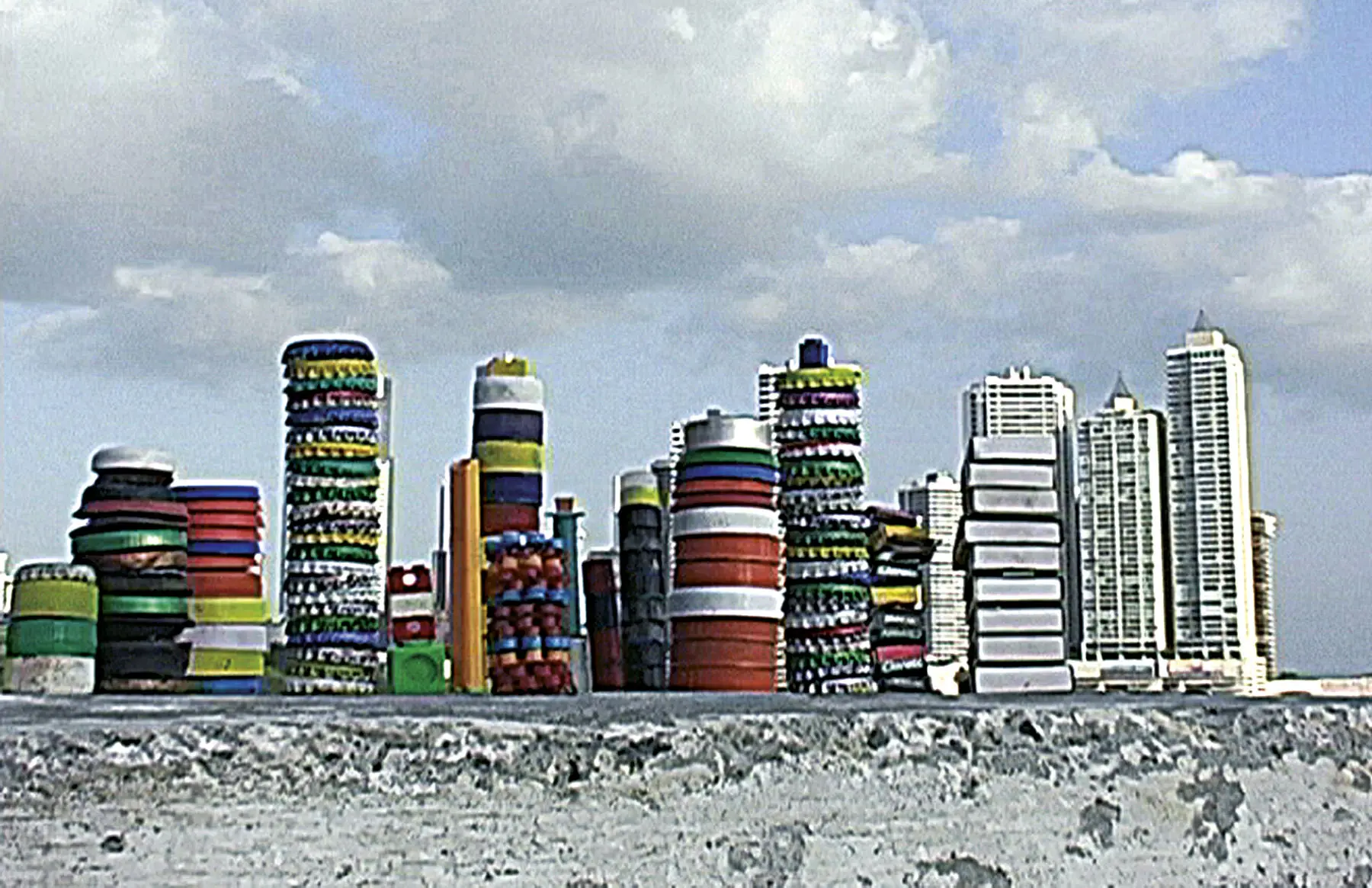
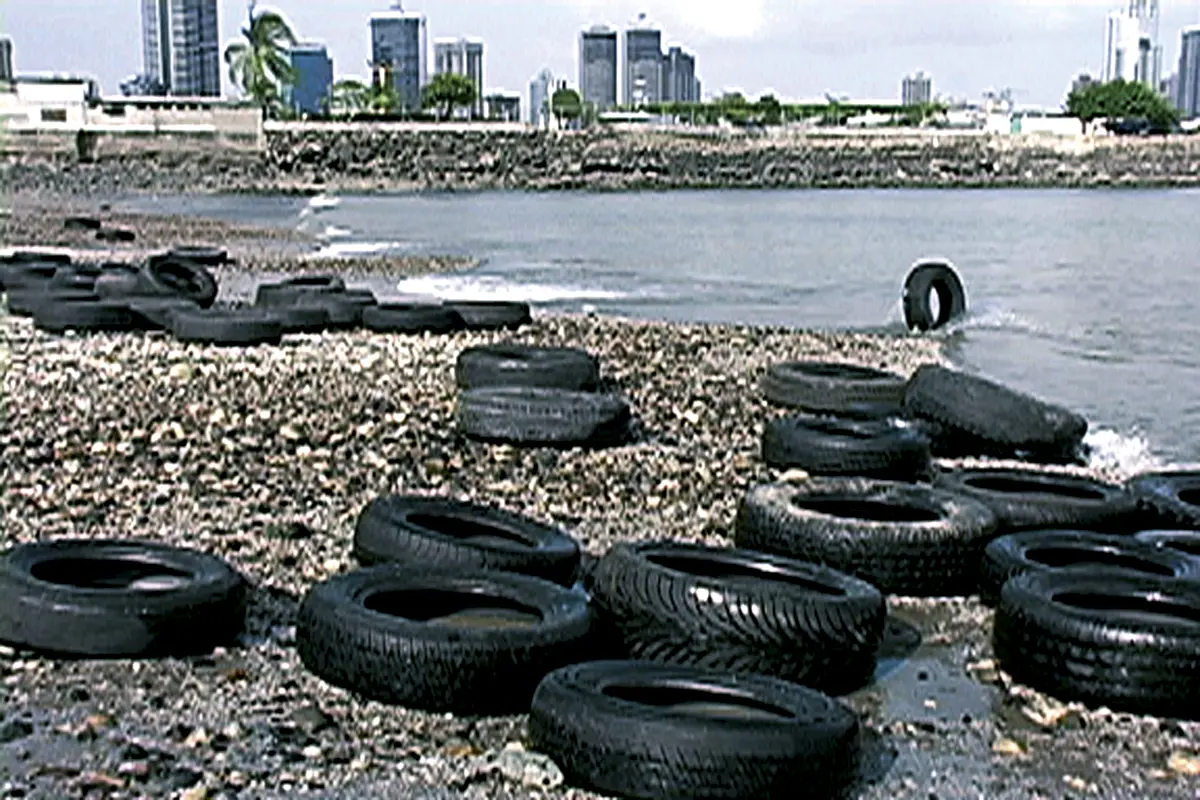
Pollution and man’s relationship to water is the theme of Low Tide (2004), a video in which hundreds of old rubber tires are rolled into the sea in the Bay of Panama, where the breaking waves bring them together. In spite of many political promises to the contrary, it is a well-known fact that the pollution in the bay continues to increase at a continuous pace, which is echoed by the tires in Low Tide. The same bay appears in the animation Urban Phantoms (2004), a video that together with All Fixed Up won Conlon the First Prize in the Fourth Central American Biennial. This video begins with a view of the skyscrapers in the Paitilla section of Panama City, seen as if on a concrete pedestal. In the foreground, several piles of refuse such as metal bottle caps and matchboxes begin piling up one by one, with corresponding sounds and in an almost mischievous rhythm. In the space between the pedestal in the foreground and the sky, the objects reproduce the skyline through the orderly accumulation of garbage. The clouds move with the wind and birds fly by as reminders that this space was once part of nature. Urban Phantoms formed part of the curator Rosa Martínez’s selection for the exhibition Always a Little Further, one of the two international shows that were the centerpieces of the 51st Venice Biennale. In its creative and playful references to problems such as urban saturation and the mismanagement of waste, Urban Phantoms speaks an international language.
Much of Conlon’s oeuvre focuses on what she calls the “artifacts of consumption”: all the paraphernalia that people dump, which never disappears from the Earth. In her concern for the environment, her actions show connections to key figures in the history of art and to other artists working today. Conlon is aware of the pioneering ideas about ecological art promoted by Joseph Beuys, who proposed a greater understanding of the interaction between nature and human culture, as well as the performances and happenings made famous by Allan Kaprow. There is also a valuable link between Conlon and the ideas of the Arte Povera movement of the sixties, particularly the anti-traditional and subversive character of her art, as well as the interest in art actions and the use of everyday material. Conlon relates to contemporary figures such as Nina Katchadourian, whose work includes repairing spider webs and mushrooms; Mel Chin, with his projects for ecological restoration; and the modern archeology practiced by Mark Dion. Like them, Conlon creates art that promotes an analysis of contemporary culture. In the process of examining humanity’s habits and discards, she seeks —as Kaprow stated— the integration between art and life.
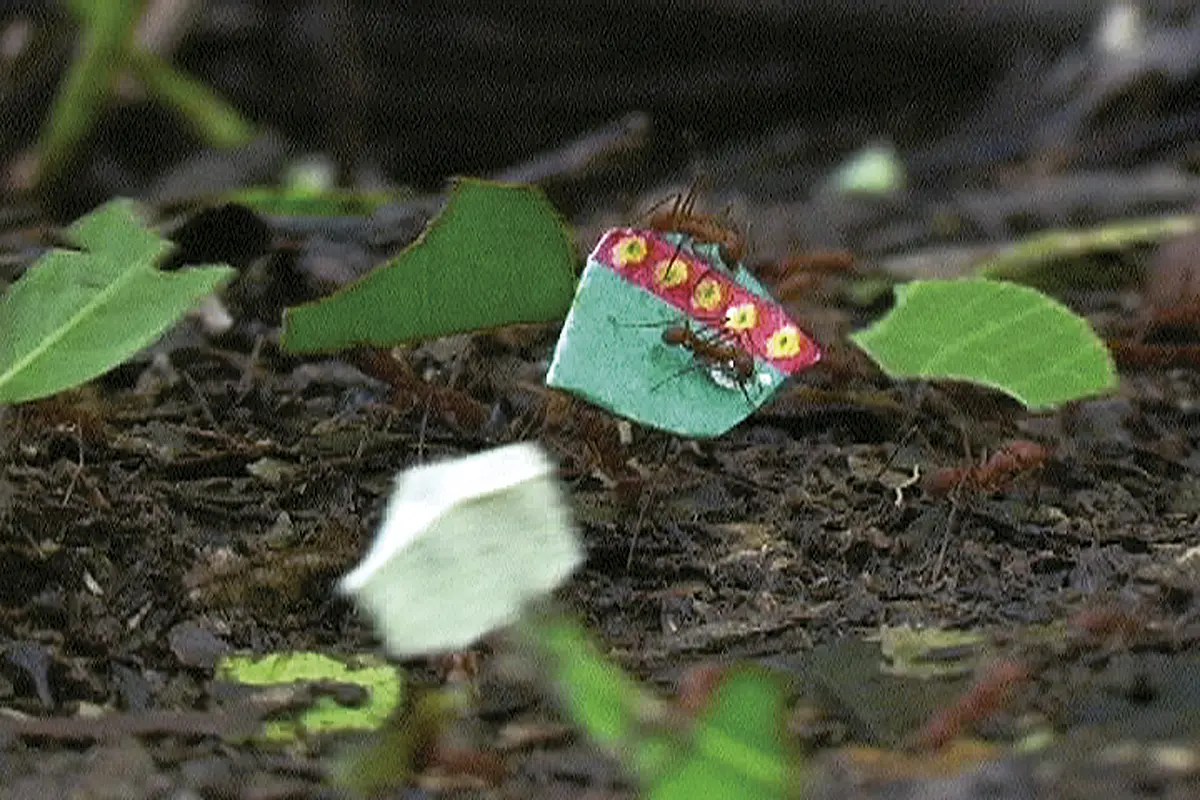
In reaction to the U.S. invasion of Iraq in 2003, Conlon took part in demonstrations and created pieces such as the videos Untied —in which her hands appear tying “all kinds of shoes, of all kinds of people in a gesture of solidarity”— and Coexistence, an unusual work within her oeuvre, with which she later represented Panama in the Pavilion of the Italo-Latin American Institute at the Venice Biennale in 2005. Coexistence shows the march of a multitude of leaf-cutter ants through the Panamanian tropical forest. These incredibly active insects move along while carrying pieces of leaves they have cut, transporting them to their nests. The amazing thing in this video is that some of the ants are carrying not just leaves but also peace signs and flags that represent the 191 countries that are members of the United Nations.1 Conlon managed, through long preparation and careful filming, to document the ants’ parade of nations, transporting political symbols in a march that is productive, silent, and peaceful. Although the video shows, quite charmingly, how many in the natural world can work together for the benefit of the community, there is also an important subtext from a scientific point of view. These ants, which can be quite destructive, live in huge colonies or “cities” with classes both dominant and enslaved, within a social structure in which only the females carry out the work. The message in Coexistence clearly reflects a combination of science, conscience, and art.
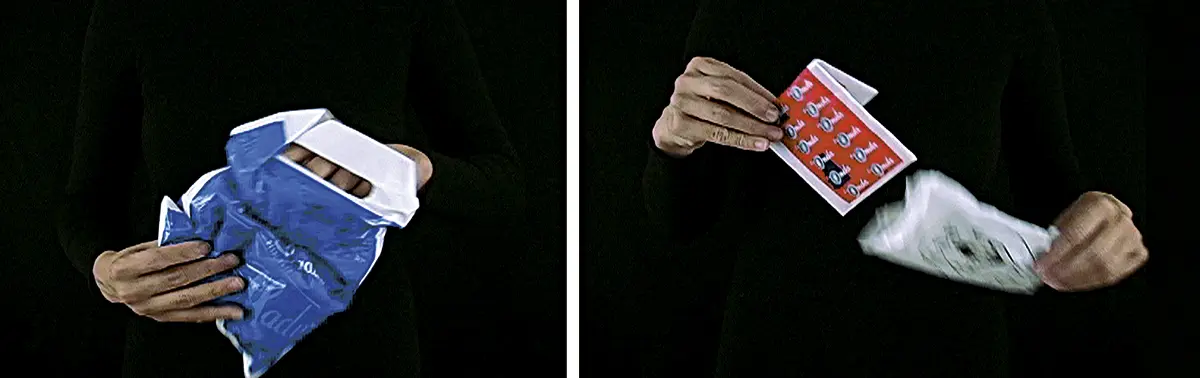
For the video Más me dan,2 which was part of the Panama Art Biennial in 2005, Conlon collected plastic bags from different sources —including stores, airports, art magazines, hospitals, and pawn shops (such as the one in the video’s title)— that speak of the globalization of excess. In the video, against a black background, one sees the artist’s hands opening bags that, like Russian dolls, reveal ever-smaller bags inside. The multiple colors and logos, the rustling sounds of the bags, and the playful pace of the piece create a seductive effect and trigger an almost childish curiosity for the next hidden item. The bodiless hands —the same ones collecting garbage in Conlon’s first videos— have become sophisticated actors that, like silent mimes, use their position or movements to express human emotions.
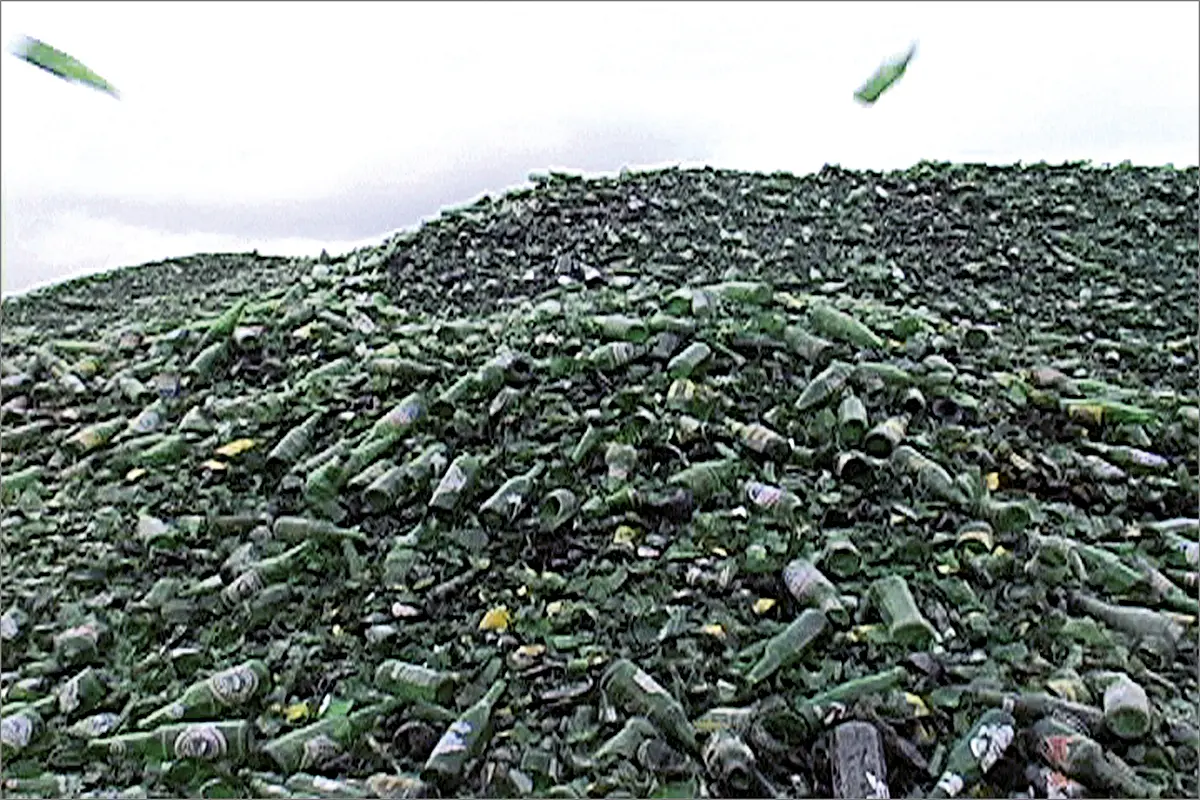
In the recent video entitled Dry Season (2006), created by Conlon in collaboration with the Panamanian artist Jonathan Harker, trash again takes center stage but in a different and strident manner, with the dramatic, almost deafening sound of bottles being thrown and broken against each other on a mountain of glass. Unlike the many pieces, Conlon has created on her own, Dry Season required a team of assistants to throw bottles from different angles as well as Harker directing the action, like an orchestra conductor, to achieve the right tempo and intensity. In this video, the sound builds in a crescendo and later diminishes before ending with one last dramatic crash of glass. The video offers, as do so many of Conlon’s artworks, a combination of artistic action with daily life, a commentary on ecological conservation but, above all, a cathartic experience that speaks of creation, destruction, and recycling.
NOTES
1. In relation to art, ants, and flags, one is reminded of the work by Yukinori Yanagi shown at the XXIII São Paulo Bienal, in which ants created paths and mixed the particles between large acrylic frames filled with colored sand that reproduced the flags of different countries.
2. Más me dan is the name of a pawn shop in Panama City, which roughly translates means “They give me more.”
MÓNICA E. KUPFER
Ph. D. in art history, art critic, and curator. Founding Director of the Panama Art Biennials.