Autorretratos: la vida es un sueño, morir es despertar, an individual exhibition of works by the Mexican painter Fernando Ramos-Prida, opened on August 12 at the Tresart Gallery in Wynwood, where it remained through September 12. This exhibition comprised twelve bas-relief works created between 1984 and 2002, which made it a kind of retrospective, even if that wasn’t the initial intention. The time span of the works gives a clear idea of how much the artist has explored the themes and how they have inhabited his thoughts and his work for almost two consecutive decades.
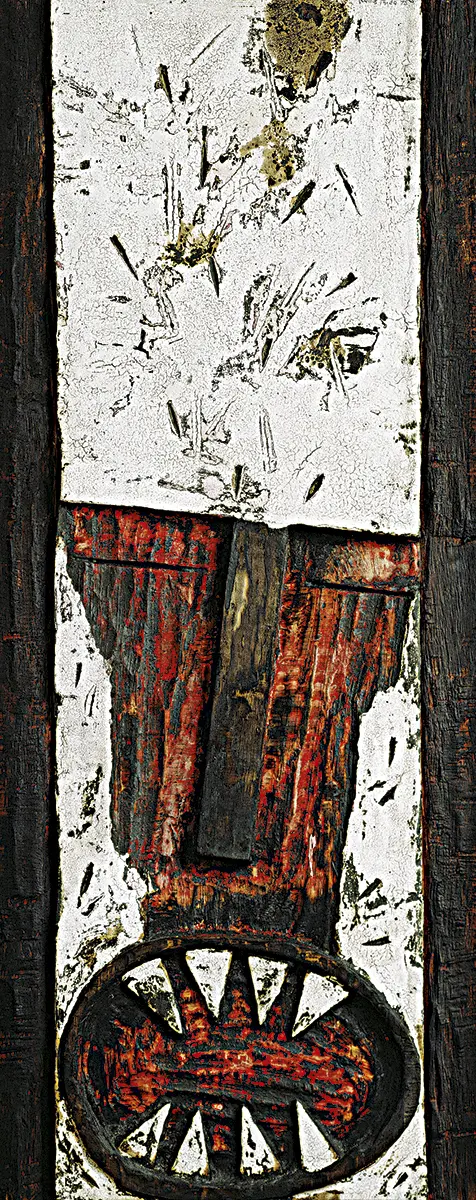
As the show’s title indicates many of these works are of an autobiographical nature, specifically self-portraits. In them, Ramos-Prida includes some recognizable elements such as eyes, teeth, and noses, but these portraits are more of his state of mind. The show’s title also confirms this, based on a well-known poem by Calderón de la Barca that traces a parallel between life and death. It is also based on the philosophical outlook of traditional Mexican culture, where death is not a definitive state but a state of transition.
Ramos-Prida digs into Mexico’s strong pre-Columbian heritage and this influence is reverted conceptually and formally in his work. Conceptually, it is reflected in the way the artist deals with death, specifically its importance as a determinant in everyday life. Formally, Ramos-Prida uses elements that are emblematic of death, like the skeleton, a symbol that was used in the pre-Columbian period and became a fundamental part of contemporary popular celebrations in Mexico. The skeleton is especially associated with the celebrations of the Day of the Dead, perhaps the most important ritual among popular festivities. This philosophy has also left its mark on the visual arts; José Gaudalupe Posada is arguably the artist who has incorporated it most intently into his work, making it famous with his satirical representation of La calavera catrina.
Ramos-Prida uses the same technique in all his works: reliefs in wood that differ considerably from traditional bas-reliefs. A prominent feature of these works is his unconventional use of sculpture techniques; the material is subjected to several procedures, from traditional sculpting to the less academic application of fire to the wood.
Ramos-Prida’s palette is rather narrow, limited to whites, light browns, and reds, and the latter is used to great effect. In general, this color selection fills the show, with the feelings of darkness that are characteristic of an existential position.
In the different works, Ramos-Prida expresses his states of mind within a feeling of transition. In Del libro de los Muertos, from 2000, the artist represents what he sees as his portrait after death, like an aerial view of himself. To create this image, he used skeletons and representations of body parts like hands and feet. He used formal elements from pre-Columbian sculpture, and the result brings to mind the friezes of temples, conceived almost as architectural elements.
Conceptually, Ramos-Prida’s work is close to that of artists like Dubuffet, who seem to set aside from their academic education and develop an interest in the kind of art known as “primitive” because it is formally structured around visually simpler principles. His attraction to this kind of works is revealed in his current production.
On the basis of minimalist work, Ramos-Prida offers his personal vision of life and death. This predisposition toward a topic that may be seen as morbid was heightened when he was diagnosed with muscular dystrophy. Anticipating changes from the illness, he was prompted to reflect on his life, which he sees as a transitional period toward a final state, death. However, his representation of death and of being dead is not pessimistic. Ramos-Prida sees life as the necessary and inevitable transition, as a preparation—perhaps, as in Calderón de la Barca’s poem, as an illusion and a dream.
IRINA LEYVA