
A well-known truism states that human psychology is complex; it can be deduced then that interpersonal relationships are even more complex. Harold López’s goal is, precisely, to analyze the many episodes he generates with the everyday dialogue between men. A twisty topic, yet the artist is successful: he appears as an observer with the ability to go beyond the public mask, we wear on a daily basis and as a creator skillful in the use of pictorial languages to emphasize the ideas he wants to express.
More than the nature of the relationships —emotional, professional, occasional— he explores those psycho-social and cultural factors that shade communication: self-esteem, frustrations, traumas, aspirations, and stigmas each interlocutor brings to the conversation. Nevertheless, the protagonists of his works coincide in one objective: to make money, and they have a common quality: they are marginals. The artist points out that in the common use of the term marginal we often forget that one of its meanings encompasses all people who live or act outside commonly accepted social norms. López questions such intolerance and prejudice in many of his canvases by having stereotypical marginals —prostitutes, blacks— share space with the “white collars,” that powerful minority that violates norms without suffering the weight of the law or of social condemnation. He also promotes a reflection about the current crisis of values, the despair, and the growing frivolity of the times. It is legitimate to note that his paintings are staged in contemporary Cuban society, although the problems they explore are equally manifest at a global scale.
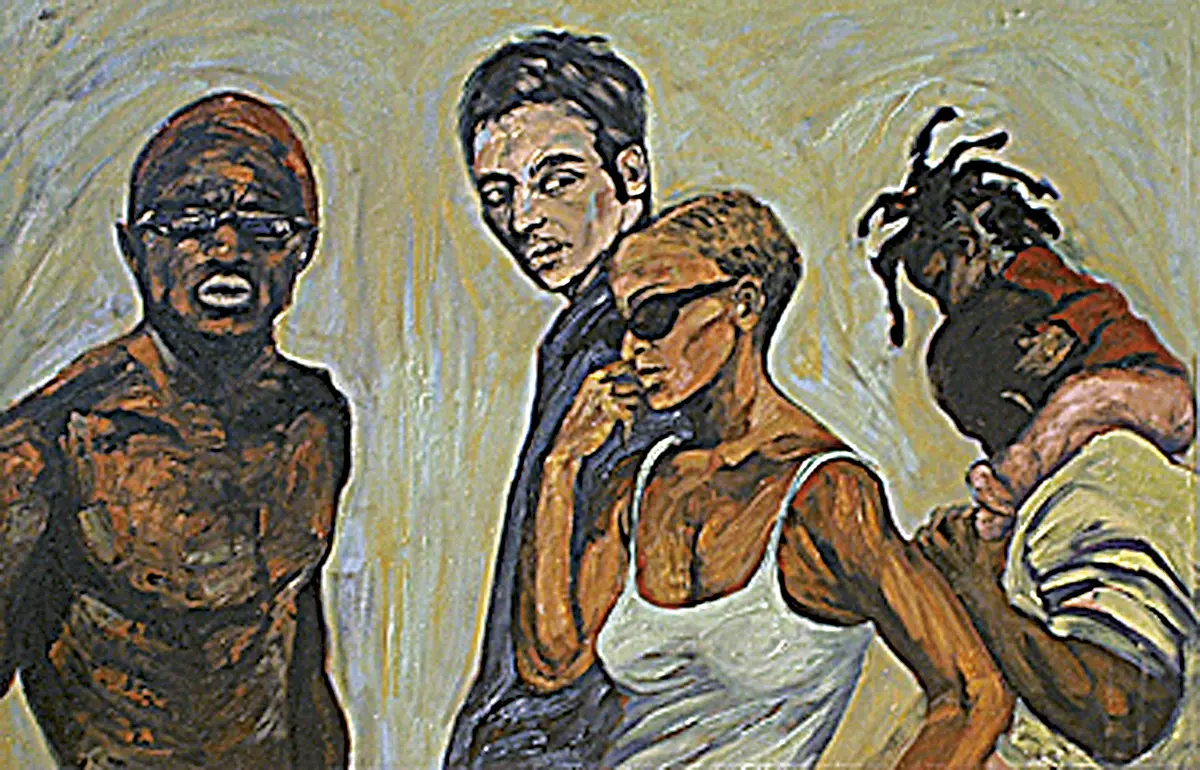
The artist abandons the representation of complete human figures to concentrate on faces. As a consequence, his paintings constitute portraits —a genre that allows for a more in-depth exploration of the subject’s psychology and to deform his or her physical features according to their spiritual deformity—. Gestures and garments highlight the attitudes on which the artist wants to pass judgment and make psychological characterization possible.
Tracing back this painter’s path, it is inevitable to speak of expressionism. His paintings accuse the influence of Munch, Ensor, Picasso... more than in the subtle distortions of his drawing, in the application of color. His brushstroke is gestural, thick, and his palette seeks a combinatory acidity as well as contrasts between cold and warm hues, while on other occasions exploiting the gradient of a single color. The simplicity of the backgrounds is intentional, he only pays attention to a few elements that denote the environments in order to intensify the contrast between figure and ground. Yet his works exhale an aggressiveness restrained in the elegance of the métier.
We must note also that the represented subject pose, many looking at us with defiance or sensuality, some rather accusatory, some expressing the anguish of living, others displaying a false complacency or great prepotency, but in the same way adopting a fallaciously spontaneous posture. López’s poetics absorbs the influence of Pop Art, with which it shares the appropriation of codes from the language of advertising —in his case from ad design and fashion spreads. Thus the light nature of his characters, but it is in the supposed acceptance of glamour where sarcasm resides and critique becomes subtler. The mixing of classical marginals and marginals masked by power in order to denounce those who, motivated by a desire to climb the social ladder or retain their status, violate the legal and moral norms, is an example of well-wrought irony. López also finds inspiration in Hemingway’s literature and the “sui generis personality” of his characters. Finally, he takes from the aesthetics of the video clips the fragmented presentation of the stories he is trying to tell.
I call attention to this telling of stories, because López’s titles and knowing, winking texts: Since 1492, El pez gordo, La familia, Polos opuestos. They point to the desire to narrate the stories lived by those who try their luck every day. Yet, López’s works capture a congealed movement that barely sketches plot, cultivating suspense and becoming highly suggestive. Their author takes distance from elitist positions and promotes communication. He is interested in having his work be accessible to the most diverse cultural levels, with the goal of prodding us to consider these beings who struggle in the present, with no more truth and no more god than money, and who comprise the beastly yet human pack among which we live.
IVONETT ARCIA ZAMORA