Exactly ten years ago, the great tribute that Horacio Coppola deserved was not organized by an Argentinean museum but by the IVAM in Valencia. Under the title of El Buenos Aires de Horacio Coppola, his major works were brought together to celebrate the ninety years of life of one of the founding fathers of Argentinean photography. Today, ten years later and coinciding with the artist’s one-hundredth birthday, it is finally, the turn of an Argentinean museum (probably the best one, the MALBA) to pay the long-awaited homage to the pioneering witness of that freshly-born country.
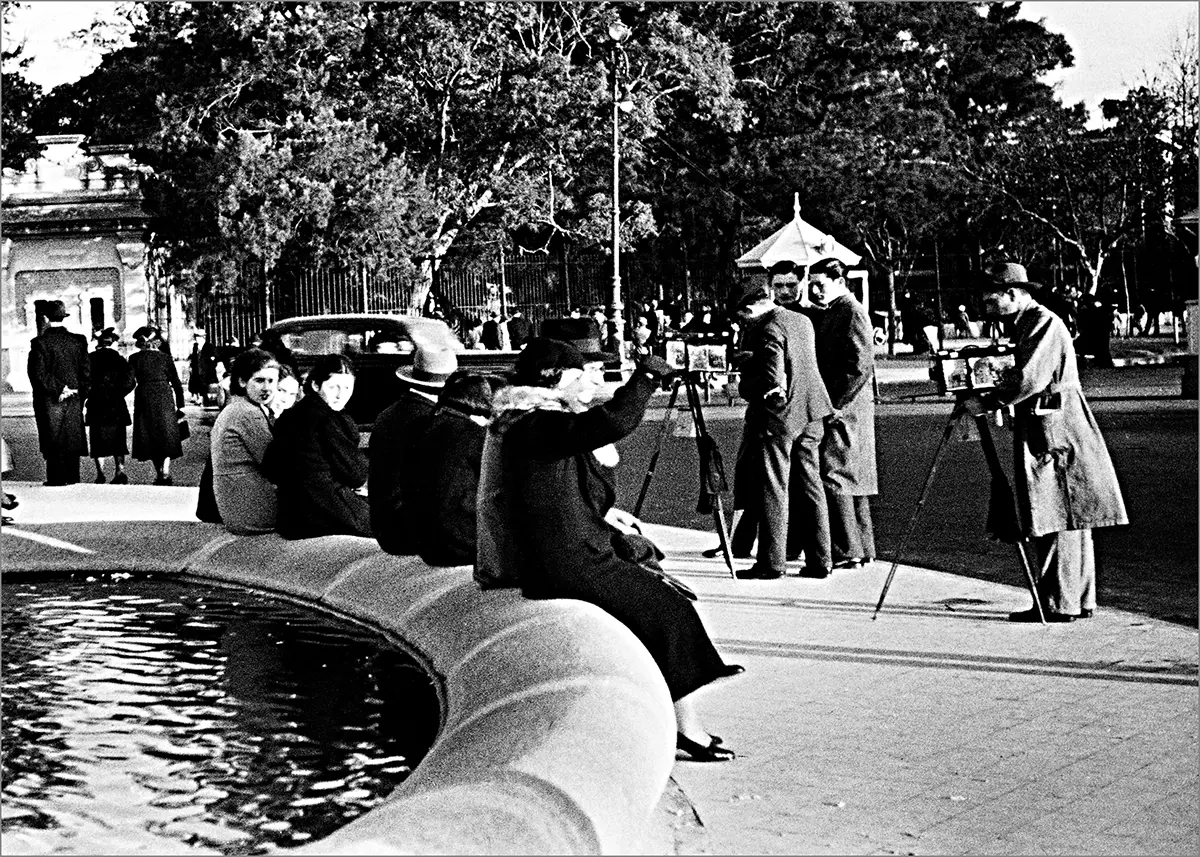
Born in 1906 in Buenos Aires, this descendant of Italian immigrants accompanied almost the entire Twentieth Century, although unlike a brilliant cohort of his like Antonio Berni (1905-1981,) who continued to experiment and to change through the last day of his life, most of Coppola’s contributions centered in his youth period, which coincided with the early modernization of the city that was documented forever in his images. Coppola’s great merit, after his education at the Bauhaus in Europe —following in the path of so many Latin American artists, restless and bedazzled by the vital pulse of the avant-garde— was to take the time to look at what was happening with his native city, that a port city that grew vertiginously throughout the 1920a, the 30s, 40s. Coppola’s great series, of course, represented in this anthology show at MALBA, is Viejo Buenos Aires, adiós (1936), an exquisite collection that conjugates a certain nostalgia for the city’s gradually lost small-town flavor and a fascination with the march of progress.
Also exhibited in this centennial-year retrospective is a true jewel filmed by Coppola is one of several excursions into cinematography. It is Así nació el obelisco, a 16 mm film now transferred to digital format and presented in a small gallery situated in the middle of the series of photographs. Coppola’s film, his look at the workers that build what was to become the city’s most recognizable symbol is an invitation to think about the construction of symbols, the historical and the affective load carried by the monuments around us. In this case, thanks to Coppola’s opportune intervention and his timely appreciation of the importance of the monster, initially resisted by the citizens, it is possible to see the future in each hit of the hammer and in the balance of the workers —perhaps ignorant of the relevance of their work— and their high beams. In the context of this anthology, MALBA also exhibits two 16-mm shorts by Coppola, filmed in Berlin and Paris: Traum (1933) and Un dique en el Sena (1934,) restored and transferred to a digital format by Fernando Martín Peña, in charge of the museum’s film section. It is important to note that the photographic exhibition had the support of and was co-produced by the gallery that represents the artist, Jorge Mara-La Ruche.
Except for Homenaje a Juan Gris, which displays that typical local gaze oriented towards Europe, all the works refer us to Buenos Aires’ street corners, façades, streets, and emblematic buildings. The contemporary gaze cannot but notice the passage of time: what back then was celebrated as modern, today has disappeared. The trolley, the mailbox, the theater marquees and the “tall” buildings are just the memories of a not-so-distant past, a splendid and resplendent past in Coppola’s photographs.
When his camera slows down to notice the wet cobblestones that will soon be replaced, and when it lets itself be fascinated by the neon lights that start to identify the street that never sleeps, Corrientes Avenue, the witness accumulates evidence enveloped in correctly classical compositions. To enjoy these views in new and impeccable silver-gelatin prints, so many decades later, when the city is another one and so different from that dream of modernity that it was for Coppola to register, is, without doubt, a privilege across generational borders, one that confronts us with that of which we are comprised.
EVA GRINSTEIN