
From October 11 through October 24, the Alcuadrado gallery presents, at the Centro Jorge Eliécer Gaitán of the National University, the series Campo Santo, by Juan Fernando Herrán. The show is comprised of some thirty large-format digital photographs that, aided by the choice of location and the exhibition arrangement, generate a melancholy, reflective space.
In recent years, Herrán’s work in photography has been characterized by its unveiling of situations that would otherwise remain hidden or unreachable. There is a common strategy to the encounter of poppies, military planes, or crosses, and it involves walking to places that are difficult to access. This, which at first sight seems only circumstantial, works as preparation, almost a meditation that allows the artist to approach the encounter with a real dimension of space in the photograph. On this occasion, the encounter is the result of a collective and silent expression situated in the middle of nowhere. It is a kind of peak literally covered in crosses.
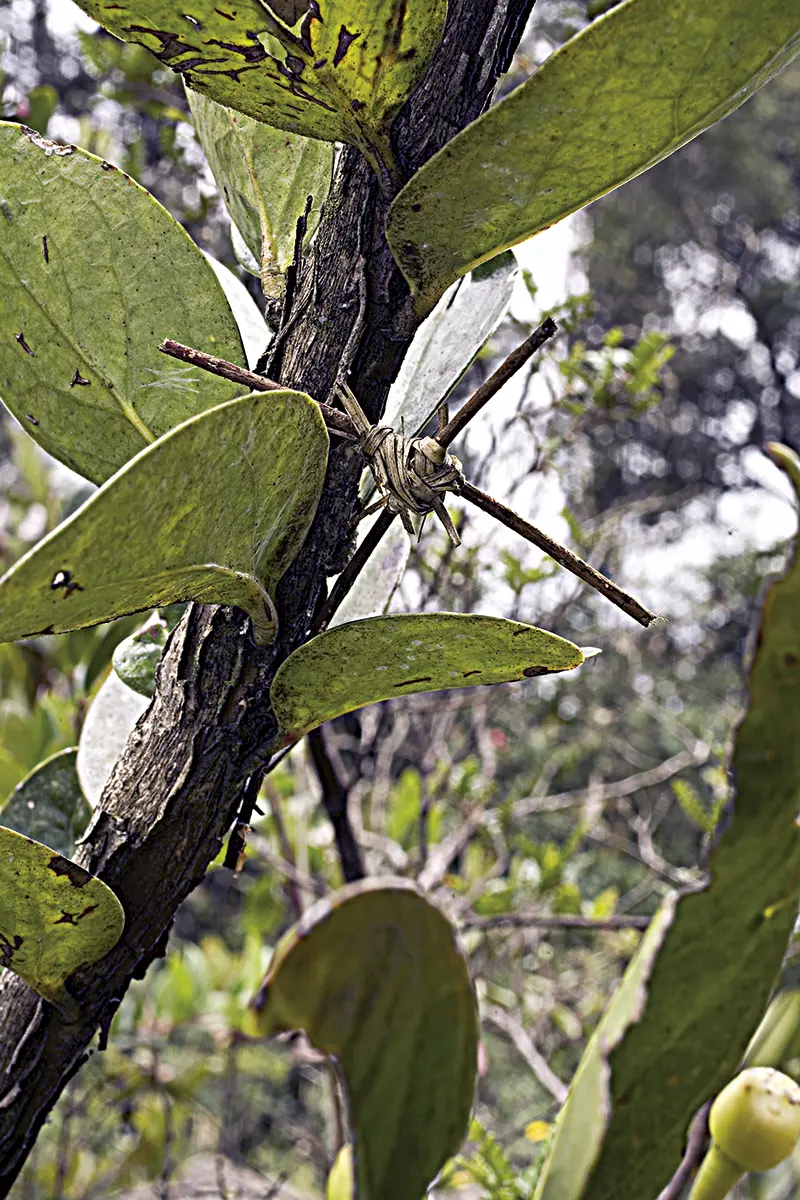
The proliferation of the shape and the primitive character of its manufacture makes Herrán’s images drive us to question the way in which the encounter of the horizontal line and the vertical line works in our imaginaries. As if it were an innate knowledge, it is understood that what is being symbolized there is the encounter of the earthly plane and the spiritual plane, life, and death, and in this case, it is even possible to think about it in terms of the confrontation between nature and rational order. In this place, the cross appears as a gesture that is primitive and sculptoric at the same time.
In a context such as ours, where the public character of actions acquires ever greater importance, these photographs formulate questions about survival, self-withdrawal, and the private celebration of rites. It is impossible, in approaching these images, not to wonder about the nature of this place that despite its evident religious charge is not a temple nor an altar. In his preparatory notes for the Ulysses, James Joyce wrote: “Places remember events.” Perhaps this place is in essence the event it remembers, the heights of the crosses being in that sense one of the territories of memory.
There is in Colombia a very strong contextual charge for these kinds of images. This is obviously always present in Herrán’s mind. Yet thanks to his education as an sculptor the shape and manufacture of these crosses acquire a protagonic role. They are mostly made using natural materials found in the area: flowers, branches, and even rocks are part of this Campo Santo. The resulting shapes, despite their precariousness, have the capacity of being moving, even more so because, being made of high-plains vegetation, these shapes are familiar to us and we feel them painfully close.
Despite the magnitude of the spectacle, it is possible to intuit, given how the photographs were taken, that this place has been formed on the basis of intimate gestures. It is not a monument like a cemetery could be, but it is a site marking, a private gesture on which a space loaded with collective feelings are built.
In that sense the site chosen for the show acquires special importance. It represents inescapable resonances with the photographs themselves, being the house-monument of one of the icons of violence in Colombia. The Centro Jorge Eliécer Gaitán, despite being unfinished and forgotten, is the depository of shared memory.
The challenge for Herrán after the encounter with the crosses is how to give it the dimensions this space possesses, how not to betray it in its exhibition, how not to fall into the traditional disposition of the intimate as spectacle. Communicating the vital experience of the encounter becomes a requirement, it is necessary to somehow replicate the sensation of being in a place that is sacred not by decree, but by consensus.
It is impossible to be confronted with these images and not to wonder what moves the artist to bring light to this space hidden between the mountains. Why defy the private character of the place? We understand, however, that only thus is it possible to attempt the preservation of something that disappears with every day that passes, not only in the sense that the crosses return to the nature from which they come, but also for the imminent forgetting of the event they commemorate. In this way, it seems that by bringing these images to us, Herrán is staking another cross, repeating the act of not abandoning the event to oblivion.
MARÍA CLARA BERNAL