
The works of the Argentinean artist Leandro Erlich occupy space in the gallery and at the same time function as objects of expression and documentation. They are living characters, reflected characters, individuals who shuttle from one place to another, from one wall to another. Erlich captured international attention during the 2001 Venice Biennale, where he presented Swimming Pool, which he later followed by a growing number of emblematic works. His work explores the loss of the real image and the rescue of lost images: scenes with no beginning or end, emotive faces, and interacting shadows.
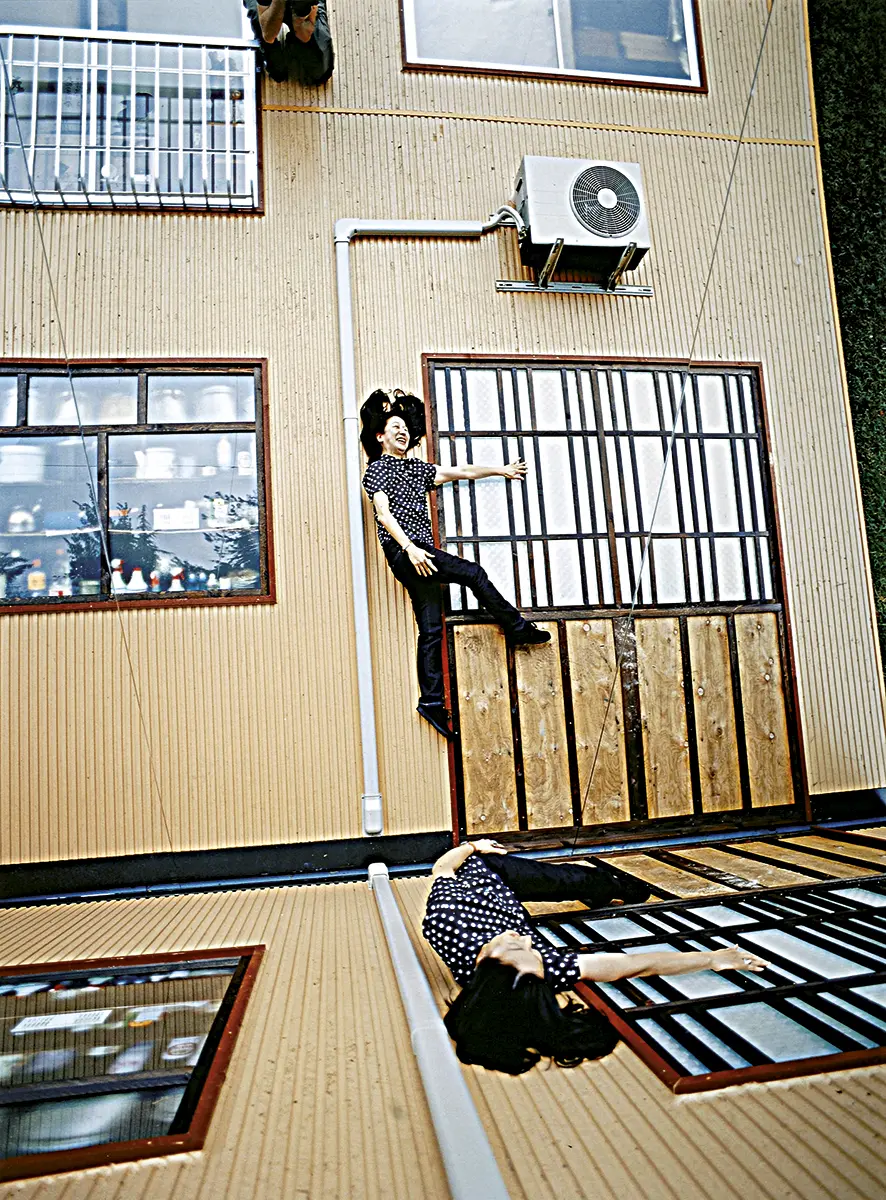
In his essay The Precession of Simulacra, the French philosopher Jean Baudrillard asserts, “In the trick of the visual, the issue is never to confuse the real but to produce a simulacrum, in full awareness of the game and the artifice.”1 Leandro Erlich’s work operates on the enigma of unreality as it proposes a hypothetical concept associated with human existence that can take shape underwater or on the flat surface of a building. In front of the mirror, stories unfold that are immersed in a particular poetics of suggested movement—contraction, reaction, the immediate response of the falling body. A girl on the balcony slips inexorably, a woman appears adhered to the wall like a fly, and a man slips through the window, trying to recover his glasses in an attempt to defeat gravity, a gravity that persists in holding him aloft.
The visual representation strategies multiply, involving video, performance, and installation. For almost ten minutes, the artist places the viewer in the midst of a Chinese ballet rehearsal—a staging with actors who repeat chains of actions with great precision, dancers who replicate themselves without the viewer perceiving it, the object and its double greeting one from the haphazard intimacy of the room. Perhaps because of its cadence, El Ballet Studio brings Japanese kabuki to mind. The dancers play and maneuver their bodies and their hands appear and disappear in tiny fractions of time. Energy is contained, held back: there is no hurry, no need to charge against the mirror because the content escapes, disaggregates, and becomes ungraspable matter, a conjecture, a conception of a tomorrow which does not exist, a reflection that cannot be captured. The music that accompanies these physical exercises inundate the imaginary space of the video and the public space of the gallery.
The body is completed in its own illusory echo, its own image, a phantasm that leans against a reflective surface. The installation The Ring becomes a perpetual observation of the object, of duplicated dimensions, a perfect square, and its bi-polarity. The structure located on one side of the small gallery attracts the public’s eye not only for the intensity of its colors, of contrasting red and blue but also for the formal and conceptual beauty that distinguishes it. The figure emerging from the mirror constructs, simulates, and perfects the proportions of the real entity through mimesis and the process of contemplation. The viewer is disarmed, watches attentively, and waits for the moment when nobody is near. Then, he or she touches and can barely intuit the fragile line, the subtle trace separating the corporeal from the unreal.
“The impossibility of staging the scene of illusion is of the same kind as the impossibility of salvaging an absolute level of reality,” Baudrillard writes in reference to the controversial origin of illusion.2 Leandro Erlich explores that tenuous space that separates the tangible world from the immaterial. This space marks his area of study; Erlich mixes combine and discovers new, scabrous, and cruel possibilities of a real unreality—or an invented reality. His works contain the waning coloration of the simulacrum, the ethereal fiber, the trompe l’oeil, and the metaphor of the prohibited, along with the solid, touchable mass and ecstasy of the bodies placed on the building. Who hangs from the window? Who slithers and slides? Perhaps the viewer has become a necessary element for the artist’s work, while the documentation of the original piece mutates gradually into a work of art.
The Corridor seems to be a protuberance on the wall, a closed, narrow passageway that penetrates the wall. The tunnel presents two rows of closed doors that shrink until they reach eye level, which arouses the unwholesome machinery of the imagination. “We react emotionally to what occurs,” says the anthropologist Eugenio Barba.3
The viewer stops in front of the suspended shadow and allows himself to be seduced by the proposal without questioning or interpreting it, in a guilty gesture. The shadow of the vacuum remains and invades the viewer’s psyche, which is that of the accomplice. When all the questions are exhausted, the public still imagines where the passageway ends or where it begins.
Exploring the cult of the object and its adjunct reflection, Leandro Erlich’s works recover the pleasure of play and illusion. His figures appear superimposed and intercalated, mesmerizing the viewer, complementing existence, and altering the senses. The immense power of the image is once again revealed, a perfect weapon to recreate or subvert the subject’s essential qualities.
NOTES
1. Jean Baudrillard, “The Precession of Simulacra,” in La precessions des simulacres l’effet beaubourg a l’ombre des majorites silencieuses (Editorial Kairós, S.A., 1978) 34.
2. Ibíd., 47.
3. Eugenio Barba, Más allá de las islas flotantes (Colección Escenología, Universidad Autónoma Metropolitana, 1986) 268.
DINORAH PÉREZ